




Why was the govt super-generous?
Why was the gov't extra-generous?
That is the question hanging on everyone's lips regarding the RM32.5 million reimbursement given to ex-corporate poster boy Halim Saad and his business partner for the share premium that they paid in Metro Juara's takeover of Metramac in 1991.
Why was the gov't extra-generous?
That is the question hanging on everyone's lips regarding the RM32.5 million reimbursement given to ex-corporate poster boy Halim Saad and his business partner for the share premium that they paid in Metro Juara's takeover of Metramac in 1991.
Halim's admission that the government agreed to make the multi-million ringgit reimbursement calls for a full investigation into the business dealings between his business conglomerate, Renong-UEM Group, and the government since 1985, said an opposition leader.
 "My question is, 'where on earth do you get a reimbursement for premium that you pay on shares that you buy?' asked a fuming Abdul Rahman Othman, who heads PKR's economy and finance bureau.
"Share premiums are amounts that you pay over and above the par value, net book value or market value of the shares because of certain business goodwill, price for control or positive market expectations that the target company, such as Metramac has. These premiums are agreed on a willing buyer and willing seller basis.
"Halim cannot now say that he was a reluctant purchaser and the government coaxed him to swallow the purchase price. The question is, why should the government reimburse him when he gets 100 percent control of Metramac? Why was the government extra-generous?"
Halim, Daim implicated
The Metramac scandal was sparked by a recent Court of Appeal judgment linking the termination of the contract of toll concessionaire STKG to business tycoon Halim and his ex-partner Anuar Othman, alleging that they had siphoned off RM32.5 million from Metramac.
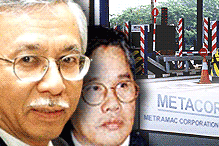 Also implicated in the judgment was former finance minister Daim Zainuddin, who had told STKG the government did not have RM764 million to compensate the company for the termination of the contract.
Soon after Metramac's RM97.5 million purchase of the financially-ruined STKG, the new owners - Halim and Anuar - were paid RM756 million in compensation, money which Daim had earlier said the government did not have.
Both Halim and Daim have since denied the allegations.
Halim had also issued a nine-page press statement arguing that the RM32.5 million was a 'reimbursement' by the government after he was 'urged' to take over the troubled STKG. He also attached a 1992 letter from the secretary general of the Works Ministry to back his case.
'Ever ready' gov't
Abdul Rahman said that section 60 of the Companies Act 1965 is "very strict and specific" about the usage of share premium.
"A refund of share premium to shareholders is unheard of and prohibited as it prejudices the other stakeholders in the company," he added.
"The company law certainly does not allow share premium to be reimbursed in cash to the shareholders, thereby resulting in a reduction of capital.
Abdul Rahman demanded to know what had happened to the share premium account in Metramac's books.
"It looks like the payment circumvented the share premium account in the books of Metramac unless later 'corrected'."
He accused the government of being "ever ready" to accede to Halim's request for a reimbursement using taxpayers' money.
"There must be some orchestration involving the Finance Ministry, the Economic Planning Unit of the Prime Minister's Department and Works Ministry to manoeuver the chief secretary of the Works Ministry to issue the letter dated Feb 13, 1992, detailing specifically how the sum of RM32.5 million should reach Halim's and his partner's pocket.
"The public ought to know who had instructed the chief secretary to reimburse the share premium."
Now I understand
He said the reimbursement to the individuals was "unprecedented" as the government usually deals with the contracted party, which in this case was Metramac.
"I have found that the creation of share premium was popular during the heyday of Renong-UEM Group. They will structure layers of business deals to create share premiums.
"These share premiums are later used to create bonus issues, rights issues and payments of dividends. With Halim's revelation, I now understand who gets the bonus shares, the rights shares and dividends."


