




Water bills, another name for privatisation
Over 250 people today unanimously rejected the Water Services Industry (WSIA) and the National Water Services Commission (SPAN) bills at a public consultation in Kuala Lumpur.
Over 250 people today unanimously rejected the Water Services Industry (WSIA) and the National Water Services Commission (SPAN) bills at a public consultation in Kuala Lumpur.
The representatives of resident associations, religious and consumer groups, political parties, academicians and trade unions from all over the country said they will not support legislation that promoted privatisation.
The water bills are scheduled to be tabled at the March-April Parliament sitting.
 Coalition Against Water Privatisation (CAWP) co-ordinator Charles Santiago (left) said the day-long session proved that people did not favour privatisation in any form.
"The public has clearly rejected the bills in terms of attempts to privatise water management and related services," he said, reiterating the CAWP's consistent stand .
"After today's feedback, we will develop alternative principles in organising water management before submitting our feedback and proposal to the government."
The CAWP plans to do this once Energy, Water and Communications Minister Dr Lim Keng Yaik returns from abroad.
Water as a commodity
The objection from the floor to 'commodifying water' was overwhelming as almost everyone present considered it morally and socially unacceptable.
The United Nations General Comment No 15 is clear where "governments have a responsibility to respect, fulfill and protect" the right to water.
"The government must realise its responsibility to provide the public access to water," added Santiago.
The UN Committee on Economic, Social and Cultural Rights reaffirmed the comment in November 2002.
Water Supply director-general Ir Low Chee Par, who gave a briefing on the two bills, was swamped by questions in no time.
Qualifying his replies as not in defence of any party, he said the bills were designed for consumer protection "which is sorely lacking now".
"If you have any specific comments or suggestions, please submit them to the ministry," he said, adding that two committees chaired by the secretary-general and the minister respectively are tasked to consider the public input.
 He observed that this was the first time a draft bill was open to so many public discussions.
The bills will be presented to the cabinet on March 1 followed by a final scrutiny by the Attorney-General's Chambers on March 8 before being tabled in Parliament.
"There will be a briefing for all members of Parliament on Feb 23 followed by a second briefing for the Malacca state government the following day."
He also said that of the 300-odd public feedback received from over 80 parties so far, only one could be considered, namely the 30-day period for disconnection of supply for non-payment of charges as opposed to the initial 14-day period.
"The rest were mostly public complaints about quality and services, not specifically on the two bills."
Topping the list of concerns was whether the performance of the parties mentioned in the bills will be made public.
Other concerns were over the use of taxpayers' ringgit and government agencies to help a few individuals and private companies roll in millions in profits.
"Why should this be so? Why not channel the funds to the public utility and enhance the efficiency of public services?" asked a participant.
Water sources ignored
Representatives of environmental groups also repeatedly highlighted the absence of any mention of water sources in the bills.
"We cannot talk about legislation on water without touching on water sources. It imperative that water sources are made a part of water laws," said Environmental Protection Society Malaysia president Susheila McCoy.
There were also four feedback presentations by the Penang Consumer Protection Association, Fomca, Greenfields Consultants and Jerit, the marginalised people's network.
One of them highlighted a number of amended clauses in the draft bills which were meant to be a counter-proposal.
During the question-and-answer session, many expressed anger over deteriorating water quality especially in the Klang Valley, a point that was illustrated by two mineral bottles of water from Section 5 in Petaling Jaya which was the colour of kopi-O (black coffee).
Research for Social Advancement executive director Richard Yeoh who chaired the consultation said there was no justification in putting water management in the "hands of a few profit-oriented businessmen".
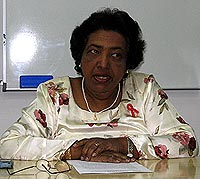 Tenaganita executive director Irene Fernandez left) said the adverse implication of the bills would translate into further hardship for migrant workers and women working as pesticide sprayers.
"Given that there are 3.1 million migrant workers in our country, what will happen to those who reside temporarily at construction sites?
"What about the 30,000 women pesticide sprayers who rely on huge amounts of water as part of the cleaning up process? What is their fate when less water is supplied given the privatised rates?"
Beware the trap
On the water bills, Fernandez said there is no way they can be accepted in their present form.
"It cannot be a fait accompli position that we take simply because it's very dangerous."
Echoing her concerns, a participant cautioned against re-drafting the bills as feedback.
"We shouldn't even consider them because the drafting itself was already in the wrong spirit and on the wrong premise.
"It is unwise to make amendments to the draft bills as it could turn into a dangerous trap."
 Malaysian Trades Union Congress secretary-general G Rajasekaran (right) asked if the bills gave an assurance against privatisation and exorbitant director's fees, and whether the tariff mechanism would include automatic hikes as found in present concession agreements.
"How do the bills regulate such matters? It is still very vague and lacking details. The tabling should be deferred pending a proper consultation nationwide. We don't want any eyewash consultation."
On the licencing requirement to operate water services as provided in the bills, Santiago asked if these were really licences or concession agreements hidden as licences.
"We want institutional reform in the form of a parliamentary oversight. There is also a need to create a regulatory or benchmarked competition.
"This is a clamouring for water not to be privatised and whatever has been privatised must be reverted to the public sector."
At the heart of the bills, he said, was the clear attempt to privatise water when it should strictly remain within the public sector.
A few participants noted that the wide powers proposed for the minister were arbitrary because there was no provision for judicial review.
Earlier, human rights advocate Malik Imtiaz presented views on the right to life and the right to water as a basic right.
The consultation on the future of water management in Malaysia was organised by CAWP, comprising about 25 civil society, non-governmental, trade union and consumer groups.


Are you sure you want to delete this comment?
This action cannot be undone.