




PM launches offensive to counter fuel hike dismay
Prime Minister Abdullah Ahmad Badawi has launched an information offensive to counter public dismay after the government imposed the country's biggest ever fuel price hikes.
Prime Minister Abdullah Ahmad Badawi has launched an information offensive to counter public dismay after the government imposed the country's biggest ever fuel price hikes.
 Abdullah yesterday tasked thousands of politicians from the ruling Barisan Nasional coalition with explaining the rationale for Monday's steep hikes during a lengthy session over the issue held in the nation's capital.
"Lack of information on the government's move to raise the petrol price caused some people not to understand the rationale ... and the opposition has taken advantage of the situation to criticise the government," he told delegates.
In the rises, the size of which took Malaysians by surprise, the government upped the price of petrol and diesel by 30 sen per litre to about RM1.90 ringgit and RM1.58 ringgit respectively.
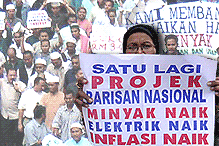
Opposition parties, a rights group and ordinary Malaysians held a rare protest Friday over the rises and the negative impact on low income groups
Still solid
But Abdullah took pains to spell out that fuel was still sold at subsidised prices, although the government has said subsidies will eventually be phased out.
"For instance, for a 10 kg cooking gas cylinder, the actual price is RM32.10 but the government subsidises the price by giving RM14.60 in subsidies," he said.
Abdullah said the increases were made to conserve the country's oil resources and curb smuggling into neighbouring countries.
He also answered a barrage of questions and listened to comments from leaders, who criticised the lack of information over the rises and expressed concern over inflation.
 But an executive councillor from Negri Sembilan, Rais Zainuddin, told
AFP
he was satisfied with the prime minister's explanation.
But an executive councillor from Negri Sembilan, Rais Zainuddin, told
AFP
he was satisfied with the prime minister's explanation.
"He asked us to understand the reason why," said Rais.
"It's not easy, it's not popular, but the price increase is not because of (domestic) problems ... it's because of the international increase of petrol, we have to adjust to the price."
Only the oil-rich kingdom of Brunei retains its fuel at prices lower than Malaysia, which is also an energy exporter.
Penang Chief Minister Koh Tsu Koon, said his party Gerakan would take to the grassroots immediately to explain the rises.
"I'm sure most of the Malaysian public will be able to be very rational about it and look at the long-term approach, rather than the short-term burden," he told reporters.


