




Mahathir vents frustration on DVD, Pt 2
exclusive The following is the final part of Dr Mahathir Mohamad's Q&A session with a group of Malay professionals in a close-door talk organised by think-tank Institute of Economic and Political Studies.
Given the circumstances surrounding Proton now, what are your feelings?
 MAS CEO (chief executive officer) has gone, he has retired. But Proton's case is unique. They sack people who are successful. Now I'm beginning to question whether what (former Proton CEO) Tengku Mahaleel (Tengku Ariff) has been telling me is the truth or not. He told me that it (Proton) makes so much money that it has billions of dollars and that when he built a plant in Tanjung Malim, he didn't have to borrow money either from the government or from the bank. He used internal resources. But now I'm beginning to ask myself whether he has been telling me the truth or not, because now it has been losing money.
Now, how do you lose money? It must be because you're selling the car at below cost or something like that, or because of one reason or another your operation cost has gone up, or something like that. I'm not able to say, but certainly a little bit surprised that a company which had so much cash, which apparently had been doing well, suddenly reports that it has not been doing well and one of the reasons is that it has bought Augusta, an Italian motorcycle-maker and it seems that by buying Augusta it lost money.
exclusive The following is the final part of Dr Mahathir Mohamad's Q&A session with a group of Malay professionals in a close-door talk organised by think-tank Institute of Economic and Political Studies.
Given the circumstances surrounding Proton now, what are your feelings?
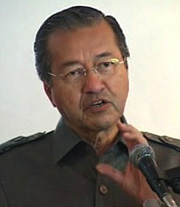 MAS CEO (chief executive officer) has gone, he has retired. But Proton's case is unique. They sack people who are successful. Now I'm beginning to question whether what (former Proton CEO) Tengku Mahaleel (Tengku Ariff) has been telling me is the truth or not. He told me that it (Proton) makes so much money that it has billions of dollars and that when he built a plant in Tanjung Malim, he didn't have to borrow money either from the government or from the bank. He used internal resources. But now I'm beginning to ask myself whether he has been telling me the truth or not, because now it has been losing money.
Now, how do you lose money? It must be because you're selling the car at below cost or something like that, or because of one reason or another your operation cost has gone up, or something like that. I'm not able to say, but certainly a little bit surprised that a company which had so much cash, which apparently had been doing well, suddenly reports that it has not been doing well and one of the reasons is that it has bought Augusta, an Italian motorcycle-maker and it seems that by buying Augusta it lost money.
Now I tried to figure out how you lose money when you buy something. You lose money if you buy it at a very high price and it doesn't deliver. But when you are buying a company which has debts, you have to shoulder the debts and that, of course, goes into your account. But because you have to shoulder the debts, the price of the company becomes very low. Who wants to buy a failed company if the price is high? A successful company can ask for premium, but a failed company cannot ask for premium.
So I'm still trying to figure out how is it that after the new management takes over, not the new CEO, but after the new management takes over suddenly Proton loses money. Is it because the new management is not capable that it loses money? I cannot think that they are incapable because they are highly qualified, so there is some mystery. We have to get to the bottom of this mystery to find out why a company that was successful until the removal of the CEO, it has now become a failure. And as a failure, of course, it can be sold to other people at a cheaper price. The cash notwithstanding.
I feel that, yes, I am the advisor, but I am the advisor post the decision, not pre-decision. So I'm told what has been decided, and that is about all. I'm not like the British advisor, as I said, I'm the Malay advisor, whose advice is asked for after decisions have been made. It is a pity, because Proton is not just about making money, it is about acquiring engineering knowledge, and believe me, the amount of engineering knowledge we acquire through Proton is tremendous.
In 15 years, from a country that has no engineering capability, no understanding of the automotive industry beyond screwing up parts that are provided by others, we are now able to design and test and produce cars, which this not very reliable British magazine called Car , says is very good. So, we have been able to do something.
Now (with) the new management, there will be more bad news, as I said the other day, when the first bad news came, there will be more bad news because there is a need to prove that the previous people were wrong so that you will appear right. If the previous people you say were right, then you will be wrong. So this is a necessary process that you are seeing.
How do we measure our progress towards Vision 2020?
I've always believed in two things. Number one, you must know from where you come. In order to go forward, you must know where you are coming from, otherwise, you may going backwards thinking that you are going forward because you don't know where you came from. You have to learn the lessons of history. That means, the young people must know the history of this country. Must know where we came from.
Four hundred and fifty years, practically, under colonial rule. Not independent. We became independent only in 1957, now 48, 49 years. So, we have seen the progress of the country since independence and before independence and if you decide that you do not want to be dependent, you do not want to be colonised, you have to strengthen yourself. Keep on strengthening yourself from the time we became independent, we have reached this level of development, but we must develop further.
For the young people, I notice, many of them are better educated. They are engineers, lawyers, doctors, professionals, and we have great hopes for them. However, knowledge alone is not sufficient for you to succeed or contribute towards your country's progress. What is equally important, or more important, is the value system that you believe in. If you don't have a good value system, then your knowledge is not going to help you. You may even abuse your knowledge, abuse it for the wrong things. For the Malays in particular, this is worrisome.
I admitted, when I stepped down, that I had failed to change the mindset of the Malays. I think that is still important, changing the mindset of the Malays. I feel Pahang is a state with a Malay majority, but there are a lot of Chinese and Indians there. Today's paper, if you read the New Straits Times , among the HIV/Aids sufferers in Pahang, 86% were Malays, 5% were Chinese, 7% Indians, or the other way around.
You have to ask yourself these questions. Why Malays? Why are they involved, suffering from HIV/Aids? Somebody tells me, well, they take drugs. That begs the question: Why do they take drugs? Why don't the Chinese take drugs? Why don't the Indians take drugs? And the answer came back that, well, they have a lot of time on their hands, nothing to do. Is that a good enough excuse? To me, it is not good.
You have to build not only a knowledgeable person, but a person who is resistant to the bad influence around him and that requires a great deal of discipline. The education system in Malaysia today does not emphasise character building. Yes, we have religious teachers who teach us what is good and what is bad, but you know what they teach you: the colour green is better than the colour blue. I wonder why. For the arts class, they draw a circle around the plate, colour the outside green and the centre part white.
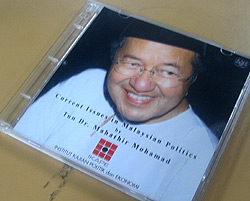 Here, we are in a place where people use other colours, but these people are not teaching the right values in order to build the right character, the right character for struggling, for fighting, for winning in whatever you do. So if you don't have the right character, even if you are an electrical engineer or whatever, you are not going to succeed. To succeed, you have to have that drive, that passion for your work.
You know, if you go to Japan, it is 8 o'clock, 9 o'clock at night, you see the light still burning because they are working. Here, of course, at 4 o'clock, we've got to go home, play golf, things like that, very important things.
One of the reasons why I introduced clocking when going out, was because when I was minister for trade and industry, I looked out of the window, at 3 o'clock, I saw people streaming out of the office. I asked where are they going? Where are they going? They are going to avoid the traffic. So you pay them also to avoid the traffic. So my answer to that was to make them clock. So after that there was some reduction.
But character building, I want to emphasise this to young people, especially. Character building is very, very important. Apart from your education, you must have good character. The kind of character that is able to stand up and face challenges and overcome them. If you have that, insha Allah (God willing), Malaysia will succeed and you will achieve Vision 2020.
How do you see the direction this country is going in?
You're asking me to say I was right and other people were wrong. Very difficult for me.
But I think there is direction. I mean, we have Islam Hadhari, we want to become an agricultural country, we want to emphasise agriculture now. That is direction, also, but I thought we are not so good at agriculture apart from planting palm oil. The rest, we don't go for agriculture. I think Thailand is much better, further ahead of us in terms of better fruits, better durian and all that. But we have D24 (durian) and that's it. No more.
So I feel we should do something that is based on high technological knowledge and skill, but the present government says we should focus on agriculture, so I understand Tan Sri Muhyiddin Yassin (agriculture and agro-based industries minister) is going around and trying to find sites to grow things and maybe now we can export to Japan after we sign this agreement in exchange for motor cars.
I think we will have to export several tonnes of vegetables to compensate the free entry of one Japanese car. Maybe that is the direction we want to go. I can't say I disagree because I have made a decision not to comment or say anything about the present government. However, I am still trying to find out the direction we are going, and when I do, I will tell you.
What do you think of Puteri Umno now? Where do you see Malaysia 50 years from now?
You know I got a lot of objections to setting up Puteri Umno. I expected Puteri Umno to do a lot of good. By and large, they have done so. They have been active, they have done good, not too focused on getting a job or becoming candidates.
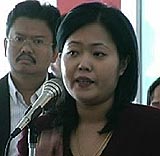 Puteri Umno has, of course, frightened the opposition because the opposition realised that these young women can have a lot of influence. I don't know if I should say this or not, but I noticed that Wanita Umno was ageing and it has become what the doctors call 'ossified'. You can't shape it in any way. As a result, the young people were not going to join these ossified people, so you had to have another door for them, which is why we decided to have Puteri. As you know, there were a lot of objections from the ossified leadership, but I think our decision was correct. Puteri Umno has brought in new life into the party.
But I think it can do more. Puteri Umno should never allow itself to become ossified. You must always be renewed from the bottom and the older people should retire, even if they are good. No permanent leaders. Quite a number of leaders promised me that when I step down they will step down. Only Khalil Yaakob (former information minister) did that, the rest did not do that. But he (Khalil) became the governor of Malacca, maybe that's why he stepped down.
I think one has to remember, the time comes when you should fade away and let other people take over. I want to fade away but people come and bother me and ask me too many questions. I think Puteri should remember that. Never allow yourself to become ossified, become so hardened that you cannot reshape into anything.
With regards to (Malaysia) 50 years from now, well, we have to be ambivalent about it. If you have good leaders, I think this country can maintain its premier position among other developing nations in the world. Today, Malaysia is regarded as the model of a developing country, an agricultural country which successfully transformed itself into an industrial country.
I get asked this question every time I go abroad. In fact, the reason why people invite me is to ask me, 'How did Malaysia convert itself, an agricultural country into an industrial country?' How did Malaysia, a multiracial country? All these things have been pioneered by Malaysia. Of course, they always ask how we managed the financial crisis of 1997. Malaysia has shown the way for the rest of the world. If it is going to continue in that way, we must find leaders who are willing to be not so popular with certain people.
If you want to be popular with some people, then you do the wrong things. I don't believe in being popular, including with the Malays. You don't know how many times I criticised the Malays. Melayu mudah lupah (Malays forget easily). I do it because I think it is necessary. We mustn't do it to be popular. If you do things to be popular, you are going to do the wrong things. So, in 50 years, given good leadership, and we have a good leadership now, I'm quite sure we will still be among the most successful among the developing countries in the world.
What is your view on the suggestion that we assimilate opposition members into the government to provide for check and balance and additional insight?
Already we have so little opposition. If we absorb them, we will not have any opposition at all. I'm against one-party government, although I never saw the opposition very useful during my time, of course, but I think they should be there. There should be an opposition because they are there to remind us that we are making mistakes or that we need to study things much more deeply. But if there is no opposition, you'll think that whatever you do is right and it may be very, very wrong.
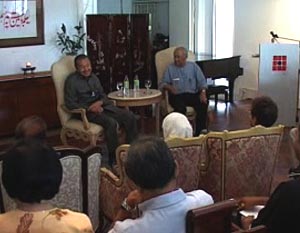 That is why, after 1969, Tun (Abdul) Razak was bringing in all the political parties into Barisan Nasional, I was quite happy that DAP didn't join.
I believed that we need to have an opposition. That is the essence of democracy. Not too powerful, because if they are too powerful, they become a nuisance, but sufficient to give the other viewpoint. Then you have to discuss, you have to even modify your own thinking. I wouldn't like to see the opposition join the government, whether in politics or whatever. They should stay where they are.
I congratulate them. But this I say after I've stepped down from being prime minister. Of course, as prime minister, I would not say anything nice about them, but I think they serve a useful purpose, so let's put up with the opposition.
The opposition parties see Anwar Ibrahim as their de facto leader. In one article I read, Anwar said he would never join Umno. But being a political animal that he is, I'm sure he's keeping his options open. I've heard of moves, maybe from certain books that I've read, that even Umno might even open its doors. So where does that leave parties like PAS and Keadilan (PKR)? Where will they find themselves if, one day, Anwar joins the party (Umno)? Your son (Mukhriz) in an article by The Edge , reported that he will be the leader of a group that will deny Anwar ever joining (Umno).
Finally, Anwar has cropped up.
You know Anwar is quite capable of doing things which you don't expect of him. For example when he joined Umno during my time, actually, I and everybody else expected him to join PAS, but he joined Umno. Surprise.
He managed to convince Abim (The Muslim Youth Movement of Malaysia) that it was a good thing to join Umno. So it won't be surprising that he wants to join Umno again. He may work his way in through people who are still sympathetic and believe the case against him was a conspiracy by the then-prime minister. But, we are not very good to attending to details. We don't go into the depth of things.
I think Anwar, like myself, must accept that our days are over. I think Umno would reject him if he tries to make a comeback, up to this point in time. Later on, I wouldn't be able to say, a new generation might think differently, because as you know, the most liberal societies as the most advanced societies, accept homosexuality as a right. So, we may even follow them and say, what is there? Everybody does it anyway. You see, even if you don't do it, they can still say that.
So, there may be an opportunity for him to come back in the future, but by that time, he would be quite old, so the younger generation may not want him. So his chances are, really, very slim. So PAS is welcome to (have) him, I think it would be good for PAS.


Report this comment
Are you sure you want to delete this comment?
This action cannot be undone.