




Constitution meant to be secular, court hears
Lina Joy's apostasy case The commission behind the Federal Constitution intended to place secularism before Islamic law, the country's highest court heard today.
Lina Joy's apostasy case The commission behind the Federal Constitution intended to place secularism before Islamic law, the country's highest court heard today.
Dr Cyrus V Das, Lina Joy's counsel, said this in his submission against the argument made by Sulaiman Abdullah, who is representing the Federal Territory Religious Council (MAIWP).
He told Federal Court's justices Ahmad Fairuz Sheikh Abdul Halim, Alauddin Sheriff and Richard Malanjum that the Reid Commission assigned to draft the Constitution of Malaysia consists of constitutional law experts from United Kingdom, Australia, India and West Pakistan.
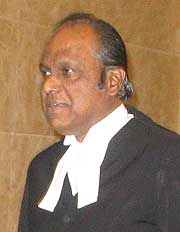 "Notwithstanding the history of Islam in Malaya, the framers of the constitution had intended that Malayan law be secular law. Article 3 does not make Islam the governing law (but was intended to be) for ceremonial purposes," Das said.
Article 3 states that "Islam is the religion of the Federation; but other religions may be practised in peace and harmony in any part of the Federation".
Das went on to elaborate that ceremonial purposes include the recital of the Quran during functions and on National Day celebrations and the King being the religious head of state.
"The Alliance party (as it then was) stated the religion of Malaysia shall be Islam. The observance of this principle shall not impose any disability on non-Muslim nationals," he stressed.
Sulaiman had argued yesterday that Islam superceded the Malaysian constitution as the religion was in Malaya before the constitution was written. He suggested that the courts look at constitutional provisions from a wider angle taking Malaysia's historical background into consideration.
Ought to be rejected
In response, Das said, "(Sulaiman's) submission also ignores and seeks to suggest that Islamic law pervades the constitution. The definition of 'law' in the constitution does not refer to Islamic law but to written law, common law and custom and usage.
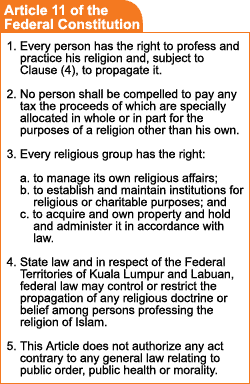 "I strongly disagree with the new thinking emerging from writers who propounds the theory that Article 3 overrides all other provisions including Article 11.
"It ought to be rejected as a kind of revisionism and re-writing of the Federal Constitution," he added.
.
At this juncture, Chief Justice Ahmad Fairuz quizzed Das as to how the court should interpret the constitution and the court's jurisdiction over this issue.
Daz replied, "We should take the express judicial approach."
"Islamics matters such as fikrah, zakat and baitumal are detailed in the Constitution. Such matters expressed in the constitution can be dealt by the Syariah Court. Otherwise, it should be dealt with by the civil courts."
Das asserted that "this is the uniqueness and richness of the Malaysian constitutional experiment that the multiracial and multi-religious people of Malaysia exist in harmony under the guarantees given by a single common document."
This was the last submission made to this case. The case now awaits for the decision to be made by the apex court.
Joy, an ethnic Malay, was originally known as Azlina Jailani but changed her name when she converted in 1998.
The National Registration Department granted a card with her new name a year later but refused to remove her religion, stated as Islam, saying it needed permission from a syariah court.
Rightly decided?
Her attempt to quash and overturn this administrative decision at the High Court failed when the court on April 18, 2001 ruled that she could not renounce Islam and the issue should be decided by the Syariah Court.
She then took the matter to the Court of Appeal which upheld the lower court's decision in a majority 2-1 decision.
The three main issues on which the Federal Court has to decide are:
- if the NRD is legally entitled to impose as a requirement a certificate or a declaration or an order from the Syariah Court before deleting the entry of 'Islam' from the applicants (Joy's) identity card;
The court will deliver its judgment at a date to be set later.


