




Calls get louder to suspend course on ethnic ties
There is a growing call from students and academicians alike to suspend the ethnic relations course, following Wednesday's order by the prime minister that the controversial ethnic relations guidebook be withdrawn.
There is a growing call from students and academicians alike to suspend the ethnic relations course, following Wednesday's order by the prime minister that the controversial ethnic relations guidebook be withdrawn.
Leading the way is a loose coalition of student groups, under the Malaysian University Students Solidarity (SMM), which has urged the Ministry of Higher Education to freeze the subject for one semester, for the first semester study session 2006/07, in all public higher learning institutions.
SMM, in a statement yesterday, said they are convinced that the problems related with the guidebook are likely to be found in other public institutions of higher learning. SMM, together with eight other student groups, were the first to publicly condemn the guidebook early this month.
The group pointed out that the Higher Education Ministry had never officially stated why an ethnic relations module was needed in the first place.
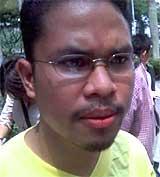 "The government has also not given its word that this would not be repeated," said SMM president Mohd Rifaudin Abdul Wahab (
left
).
"The government has also not given its word that this would not be repeated," said SMM president Mohd Rifaudin Abdul Wahab (
left
).
A special committee, consisting of nine academicians, was formed recently by the ministry to draft a new ethnic relations module.
The committee, called the Purification and Evaluation Committee, is chaired by Prof Dr Shamsul Amri Baharuddin of Universiti Kebangsaan Malaysia (UKM). Rukun negara co-author and Suhakam commissioner Prof Dr Khoo Kay Kim, is on the advisory panel.
Most of the advisors are retired or semi-retired academicians who have published papers on Malaysia's socio-economic history.
"We want discourses to be held before any special committee finalise their evaluating in a book form," said Rafaudin.
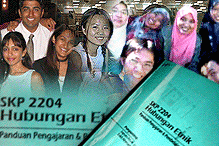
The original guidebook had been authored by Universiti Putra Malaysia (UPM) lecturers Jayum Anak Jawan and Zaid Ahmad. The guidebook had been used for a 2-credit hours prerequisite ethnic relations course for first year students since December last year.
Each class involves over 100 first-year students of different majors, students said. There are two objective tests, while assignments account for 60 percent of total marks. Classes are weekly two-hour lecture sessions. The course takes four months to complete.
Many complaints received
UPM student group, Student Progressive Front, said that students currently taking the course are confused.
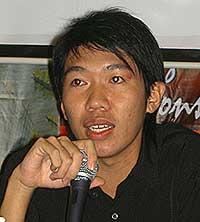 "The subject should be suspended for at least one semester. Students will not be able to cope with the new implementation after such a sudden withdrawal," said the group's co-ordinator, Simon Ooi (
right
).
"The subject should be suspended for at least one semester. Students will not be able to cope with the new implementation after such a sudden withdrawal," said the group's co-ordinator, Simon Ooi (
right
).
The small but active Malaysia Youth and Students Democratic Movement (Dema) voiced similar concerns.
Dema, which has 'external co-ordinators' in university student groups around the country, said they have received a steady influx of complaints since the module was added to the compulsory Islamic Civilisation and Malaysian Studies modules a year ago.
However, the movement is unable to say if the problem is prevalent in other universities.
"There seems to be a bigger story behind all this, but we don't have anything definitive yet," said its secretary, Lee Huat Seng.
While most students were apathetic to the ethnic relations course, several students felt that the course drafters had already won if their goal had been to get students to sway to a different version of history.
The first chapter of the guidebook stated that the objective of ethnic relations is "assimilation all races into one race"; a 'bangsa' Malaysia.
"It's a complete opposite of what we learn in secondary school, that Malaysia is a plural society, that it is multi-racial. It's like they want us to be like Indonesia," said second year accounting undergraduate, Ei Ki.
She said that while most students were not taken in by the content of the guidebook, many have begun to have different impressions on certain issues.
Ei Ki, who is among the first batch of students to take the ethnic relations course, said that any revision of the guidebook would need to undo any skewed perception of incidents such as May 13 and the 2001 Kampung Medan tragedy.
She felt that the guidebook hinted at a conspiracy to distort students' political views.
"It feels like a long term thing," she said.
Local universities, meanwhile, have become concerned of being dragged in after the issue heightened last Tuesday when Higher Education Minister Mustapa Mohamed told Parliament that he would not withdraw the guidebook from UPM's syllabus.
Public misconceptions
And in spite of statements by the minister and frequent references by the media, local universities stressed that there is no such thing as a universal textbook for any subject.
"Textbooks are for schoolchildren in primary and secondary schools. We don't have textbooks in universities," said senior lecturer, Dr K Anbalakan of Universiti Sains Malaysia (USM).
Anbalakan, who was one of five lecturers who drafted the university's syllabus for the ethnic relations course, expressed concern that the issue would have a spillover effect on USM.
 "The public misconception is that there are uniform programmes for academic subjects, even ones that are made compulsory by the ministry.
He said universities are entirely responsible for the its syllabuses. "The problem now is that we also want them to freeze the course for one semester, so that we have time to prepare a clear syllabus."
He said that the original guidebook should have been written by historians. "The book should be thrown out. Those people were not qualified to write anything," he said.
"When you make a point, you have to back it up with research and come up with a thesis. Even then, people can disagree with your points.
"To force such a book onto fresh students is not only irresponsible, it flies in the face of proper academic practice," he said.


