




EC to be allowed to update electors' addresses
Existing laws will be amended to allow the Election Commission (EC) to update the addresses of electors.
Existing laws will be amended to allow the Election Commission (EC) to update the addresses of electors.
According to a Bernama report today, the draft bill will be submitted to the Attorney-General's Chambers in October.
EC chairperson Abdul Rashid Abdul Rahman said the draft amendments to Section 25 of the Elections (Registration of Electors) Regulation, 2002, would ensure a "clean" electoral roll, expected to be ready in time for the next general election.
It would also help erase doubts among certain quarters, he told reporters after attending a function in Putrajaya.
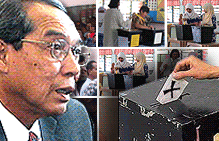 Abdul Rashid said prior to July 2002, there were about nine million voters, but of these, 3.5 million were not residing at their registered addresses, which meant they had moved.
"It (the electoral roll) must be properly compiled...before this we had no power, people don't understand. I didn't explain this before, but now is the time for us to explain," he said.
"If an elector does not reside at the registered address, the electoral register will continue to be doubted and all sorts of questions and allegations will be thrown at the EC," he added.
Moved to another state
Abdul Rashid said with the changes, the EC would cross-check the electors' addresses with the National Registration Department (NRD) and if they did not match, the EC would contact them and advised them to change their addresses.
He said if they refused to heed the advice, the EC had the power to change their addresses without their approval.
He said the requirement to change the address only applied to voters who moved to another state.
"Those who had moved, but to a similar voting area, do not have to change their address with the EC," he explained.
Abdul Rashid said the EC had also informed the Housing and Local Government Ministry, asking all local authorities to create a complete address system.
"At present, addresses are only available on taxable properties, and there are no addresses for non-taxable properties. As a result, postmen would dump the letters in one area at one address.
"That is why we found in the electors register, many house addresses with many occupants or many electors staying there. Even that, we have been accused of so many things and we cannot take them out of the list. If we do this, we have removed the legal voters," he said.
Cleaning-up exercise
At the same time, he said the EC had directed all state directors to undertake a "cleaning-up" exercise of their respective electors register by verifying the information if it was found that the voters had died.
"In the villages, we use the village head to confirm deceased voters, and if the electors had already died, then we would take them out of the list. Previously, we depended on the NRD and I don't blame the department, if people do not provide the latest report," he said.
Abdul Rashid said recently, the EC found nearly 13,000 electors of Sarawak longhouses, who had died, but were still listed in the electors register.
Meanwhile, he said there were about four million people who were eligible but did not register as voters.
"Based on the NRD's records, there were about 15 million people who had reached 21 years old and above, but in the electors register, there were only 10.3 million people, and of the total, 3.5 million voters do not reside at the given address," he said.


