




Former AG says 'No' to review of judicial crisis
More questions were raised than answered when Human Rights Commission (Suhakam) chairperson Abu Talib Othman shrugged off the possibility of reopening of the 1988 judicial crisis which saw the sacking of then Lord President Salleh Abas.
More questions were raised than answered when Human Rights Commission (Suhakam) chairperson Abu Talib Othman shrugged off the possibility of reopening of the 1988 judicial crisis which saw the sacking of then Lord President Salleh Abas.
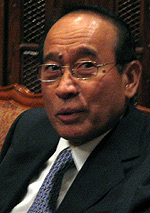 Abu Talib, who was attorney-general (AG) from 1980 to 1993, played a key role in the sacking of Salleh and two Supreme Court judges, Wan Suleiman Pawanteh and George Seah under directives from former premier Dr Mahathir Mohamad.
They were tried and found guilty of misconduct for questioning constitutional amendments by a tribunal of six judges, including one each from Singapore and Sri Lanka.
He was answering questions at a press conference at the Malaysian Human Rights Day 2006 conference organised by Suhakam in Kuala Lumpur this morning.
Abu Talib did not deny his involvement in the matter, conceding that he "was very much involved" before switching to a defensive tone.
"What do you want to ask? It has all been settled. It has never been discussed in Suhakam and it has never an issue till now," he said.
'What aspect to be reviewed?'
He then proceeded to lay out questions contending that the case was handled in accordance to the constitution and it should not be reopened.
"Let's put it this way. What aspect of it should be reviewed? Was it not done in accordance to the constitution? (Were) the judges not given the full opportunity to defend themselves? (Were) the charges not clear?
"Was there insufficient evidence to support those charges? And even though there's suspicion (of foul play), the panel consisted of other foreign judges as well. So it was done in accordance with the constitutional requirement," he said.
"There was a finality. And what is there to be reviewed?" he added.
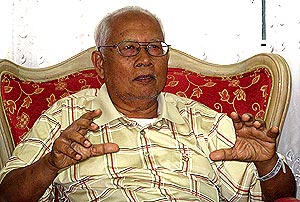 He then asserted that this is merely his view and not Suhakam's before proceeding to answer other questions.
The reopening of the 1988 judicial crisis came into light when Bar Council president Yeo Yang Poh called for it last month.
Numerous quarters, including Salleh, who broke his protracted silence over the incident, supported the call.
However, the government dismissed it, saying there were no solid reasons for it to re-examine the crisis and that it cannot indulge to the 'whims and fancies' of certain individuals.
Earlier in his speech in opening the Suhakam conference, Abu Talib has nevertheless called on the government to review 'ouster clauses' in existing laws, where ministerial decisions are prevented from being challenged in court.
In the wake of the 1988 judicial crisis, the government had included such ouster clauses - many of which were drafted by Abu Talib when he was AG - to shackle the judiciary through provisions such as "any decision of the minister shall be final and not be questioned in court".
"Every legal power much have legal limits, otherwise there is dictatorship. And we do not want a dictatorship," said Abu Talib.
"The court is the last bastion of liberty. If we are prevented from going to court to seek justice, where do we go?
"When the judiciary is deprived of reviewing ministerial powers, you disarm an essential branch of a democracy, creating injustice for the ordinary man."
Credibility at stake
Abu Talib's tenure as AG had been marked by several controversies which raised disturbing questions about his credibility, independence and integrity. Among them were:
-
 The RM2.5 billion Bumiputra Malaysia Finance scandal, in failing to initiate any prosecutions to allow it to become, according to an oppostion leader, "a heinous crime without criminals".
He was appointed the second chairperson of Suhakam since its establishment, succeeding Musa Hitam in 2002.


Report this comment
Are you sure you want to delete this comment?
This action cannot be undone.