




Nazri defends sacking of ex-top judge Salleh
De facto law minister Mohd Nazri Abdul Aziz has made it clear that he is unconvinced of the need to review the 1988 judicial crisis, which has been dubbed as the judiciary's 'darkest hour'.
De facto law minister Mohd Nazri Abdul Aziz has made it clear that he is unconvinced of the need to review the 1988 judicial crisis, which has been dubbed as the judiciary's 'darkest hour'.
Nazri, who is minister in the Prime Minister's Department, said that the decision not to reopen the case that had led to the sacking of former Lord President Salleh Abas and two other senior judges was final.
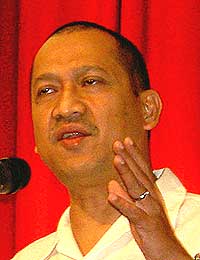 The minister also described the arguments for the reopening of the case as 'mere speculation'.
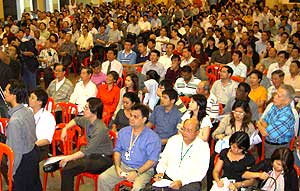
He told the ' 1988 Judicial Crisis - To review or not? ' forum last night that the judges who sat in a special tribunal convened 18 years ago to try Salleh for misconduct had indeed discharged their duties without fear or favour.
"I came here to listen and you're right, you have to convince me," he told the crowd of 1,000 people who packed the Selangor Chinese Assembly Hall.
"For example, all the objections raised by my colleagues here was raised 18 years ago. It was discussed and deliberated at that time," said Nazri, who rebutted Bar Council president Yeo Yang Poh's argument that the tribunal was unconstitutionally convened.
In 1988, Salleh was tried at a special tribunal on charges of misconduct when the former chief judge questioned the government's constitutional amendments which seriously eroded the powers of the judiciary.
Two of five Supreme Court judges - George Seah and the late Wan Sulaiman Pawanteh - who had earlier ruled that the tribunal was convened unconstitutionally, were also sacked along with Salleh.
Nazri was invited to speak at the DAP-organised forum together with two opposition parliamentarians and three prominent lawyers.
The minister said there had been no discussion at the cabinet level to reopen the case on the sacking of the three eminent judges.
"The decision is final. Unless there is material change, like a former tribunal judge saying he was forced to make a judgment to remove Salleh Abas, we won't reopen the case," said Nazri.
"I need this kind of evidence for me to recommend that the case be reopened. Try harder to convince me," he challenged his fellow panelists and the crowd.
Salleh's alleged misconduct
Earlier, Bar Council chief Yeo had questioned the participation of junior High Court judges in the Salleh's tribunal.
 The special tribunal was made up of seven judges, including one from Singapore and Sri Lanka. One of the judges was a retired High Court judge.
"How can Hamid Omar be included in the trial of his immediate boss (Salleh Abas)?"
Hamid Omar was Salleh's junior in the then Supreme Court (the country's highest court, now called Federal Court). He later succeeded Abas as Lord President.
On the charges of Salleh's alleged misconduct, Yeo argued that the definition of judges misconduct was too broadly interpreted and that the charges were baseless. He also said the proceedings were also brought into question as it was held behind closed doors.
 "The tribunal's findings were not supported by facts. No judicial misconduct were ever disclosed," he said, quoting Queen's Counsel Geoffrey Robertson, who has written on Salleh's trial.
In view of that, Yeo said a review of the crisis was required if the government was to restore faith in judicial independence.
Senior lawyer Tommy Thomas, who was Abbas' former counsel during the tribunal, said his participation in the forum was to convince Nazri and the government to restore the judiciary as an equal branch of the government.
"The judiciary is the third branch of government. In the separation of power, it determines the conflict arising between state and citizen, and between citizens," he said.
Thomas called for the formation of a royal commission to look into the circumstances that led to Salleh's trial and the trial itself.
Legal experts have generally agreed that the judiciary had become weaker and more susceptible to government interference after the controversial sackings.
"Politics is the art of the impossible and Pak Lah (Prime Minister Abdullah Ahmad Badawi) should do the right thing," he said, urging Nazri to convince his boss to set up an independent inquiry.
'Life never the same again'
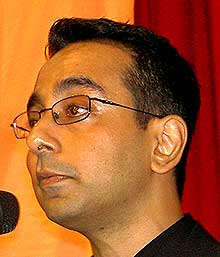 Human rights lawyer Malik Imtiaz Sarwar said the manner in which the Supreme Court judges were removed had damaged the judiciary's ability to administer justice and to stand up to executive interference.
"Our way of life never became the same after the judicial crisis," lamented Malik, adding that the civil society is demanding an inquiry into the 1988 judicial crisis.
He said the call for a royal commission was not intended to be a "witch-hunt into the judiciary, find blame or to seek retribution".
Meanwhile, lawyer and DAP politician Karpal Singh lambasted former premier Dr Mahathir Mohamad as the 'man who had singlehandedly destroyed the judiciary'.
"Salleh Abas broke his silence 18 years later and now cries for justice," he said.
To loud applause, he said the public - and not Nazri or the government - was the judge and jury of whether a royal commission should be formed to probe the crisis.
Karpal then told the crowd that the prime minister should move an act of Parliament to reverse the tribunal's decision.
"(The ruling coalition has) 91 percent majority in Parliament, it's easy to nullify the decision. Every effort should be made to clear Salleh Abas' name," he said.
Opposition Leader Lim Kit Siang said the country had suffered terribly from the crisis.
"Salleh Abbas, Wan Sulaiman and George Seah were not the only victims of the 1988 judicial crisis - Malaysians and the country were also the casualties," he said.
The DAP veteran, who is a trained lawyer, said the judiciary which had taken decades to develop what had been destroyed in a week during the crisis.
He stressed that the country could not afford to wait another generation to seek the truth.
Lim quoted former Lord President Suffian Hashim, who while launching his book ' May Day for Justice ' in 1989, said the judiciary took generations to build up but could be destroyed in a day.


Are you sure you want to delete this comment?
This action cannot be undone.