




Oil subsidies miss target group, says analyst
"Our budget is financed by oil. Oil is like lottery. You win a lottery, what do you do? You have a big feast, you finish your money. No more. There is no multiplier effect from your sweepstakes winnings.
"The statistics show we have 20 more years to go, with our oil reserves (which) finance about 30-40 percent of our budget. It is a huge percentage.
"So shouldn't we be a bit more ambitious and spend even more on education? What's another three, four billion ringgit on education? The impact on the economy and other sectors will be minimal. But the long-term (benefits) of education are a lot."
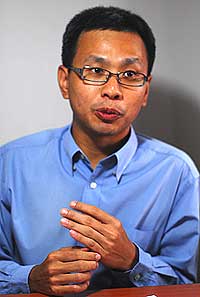
So said economic analyst Tony Pua, who studied politics, philosophy and economics at Oxford University, in the first of a three-part interview on the country's future economic woes.
"Our budget is financed by oil. Oil is like lottery. You win a lottery, what do you do? You have a big feast, you finish your money. No more. There is no multiplier effect from your sweepstakes winnings.
"The statistics show we have 20 more years to go, with our oil reserves (which) finance about 30-40 percent of our budget. It is a huge percentage.
"So shouldn't we be a bit more ambitious and spend even more on education? What's another three, four billion ringgit on education? The impact on the economy and other sectors will be minimal. But the long-term (benefits) of education are a lot."
So said economic analyst Tony Pua, who studied politics, philosophy and economics at Oxford University, in the first of a three-part interview on the country's future economic woes.
Pua, who runs an IT company in Cyberjaya, referred to the following Budget 2007 proposals, which as announced two weeks ago, in the interview with malaysiakini :
- a 30 percent increase in development spending (or RM46.5 billion) in 2007
Malaysiakini: What do you think of the budget proposals?
Pua : Overall, I actually thought it was a decent budget. It had a bit more character, it had a bit more ambition compared to the last three years when he (Abdullah) was just going through the motions, it was colourless, it worked, but there was nothing exciting about it.
 In this budget there was a little more excitement, there was a little more ambition in terms of infrastructure, spending and stuff like that. But there are of course areas where we can improve further. Given that they came out with a slightly better budget, we had to raise the bar and come up with slightly better stuff.
I had a problem with a lot of things said on the web (which advocated that oil) subsidies should not be removed. The way it is being given out now, the oil subsidy isn't going to the poor. This is simply because the poor do not have cars. They have motorbikes. The people who benefit the most are the people with the biggest cars, and people with the most number of cars.
So from that perspective, it is a very inefficient way of reaching out to the poor. The only people we are subsidising are people with two, three cars. And the question is how we (resolve) this problem.
Subsidies change the pattern of demand. When oil is cheap, people buy more cars. When they buy more cars, we get more traffic jams. People who buy more cars avoid public transport because it's not so convenient. I'd pay for the convenience (of having a car).
If it (oil) is expensive, then possibly people would spend more on public transport and hence the sector would get more revenue to sustain itself. (But if subsidies are) allocated, it would add up to an inefficient public transportation system.
The next one is major in terms of principle, but it is minor in terms of impact - tax relief on purchase of personal computers every three years and books (annually).
It is odd for the government that is seeking equity, in that the more money you make, the (greater the tax relief). Anyone who earns RM8,000-9,000 would get 20 percent of RM3,000. If I'm in the 28 percent bracket, I would get RM840 in tax relief on computer purchase.
So why are the rich subsidised more? There's also the principle that the rich would almost definitely buy a computer irrespective of tax relief. I would buy, I would say I am the top tax bracket, this relief is irrelevant to me. So from the perspective of trying to promote computer usage, this is defective.
Why do you think that they would come up with such a policy?
I think it is just an oversight. There's absolutely no reason to be sinister here. The issue is this. They granted RM500 per person before. I think it became a bit costly, because people may have been abusing it. It is easy to abuse. They tried to remedy it into a relief structure that is proportionate, without fully realising the impact of what they are trying to do, which is a regressive type of tax relief.
What recommendations would you make to address this?
The recommendation is a grant-based system, direct to the person, whether in voucher or cash form.
But it would be going back to the rebate system...
No, the rebate system only works for people who submit an income tax form.
 If I'm poor, if I only earn RM800 per month, I don't pay tax. I need the help. The graduates, yes, in the city, you still make RM2,000 per month and you still pay tax (of) 10 percent, 12 percent, or thereabouts. They need a bit of help. But not as much as those people who make RM800.
If I don't submit my tax form, then how do I get my rebate? It has to be a grant-based system, (but) whether in voucher form or in actual cash or savings, that needs to be worked out. But it has to go down to the grassroots.
Isn't it a politically-wise decision to build universities in Terengganu and Kelantan?
It is probably a politically-wise decision, but it is not a wise decision in maintaining standards of quality. You can still increase the number of students in universities and maintain the same quantity of graduates without building new universities.
It is a lot of money to spend purely on construction purposes, instead of expanding libraries and carrying out renovations.
The problem with politics is that it is always a bit short term. So it looks good to have a university in Terengganu ... we have done something for Terengganu, we have done something for Kelantan.
 But in the longer term, because of the lower quality, you eventually get unemployed graduates. The number of unemployed, depending on who you listen to, now varies from 20,000 to 80,000. This number will increase. For now they can absorb into the civil service, but the civil service will not be able to absorb them in the future.
With the two new universities, we will have a 12-13 public universities, six public university colleges, 22 private universities, plus private university colleges - a total of 40 institutions...
Singapore sets a good benchmark because it has very high education standards. They have three universities serving a population of 4.4 million. We have 40 (institutions) serving half the proportionate number of the population. Do we have too many universities?
We obviously don't have as much money as Singapore, which allocated about RM$14.2 billion for education, almost 20 percent of which goes to the three universities. In our case, we don't even have 20 percent going to the three universities and we have to split this among (all) the universities.
How do you see economic growth in 2007?
To be fair, I thought that the expectation of growth is quite interesting. I mean, they could have said 5 percent, instead of 6, and no one would have batted an eyelid. I'm not saying they are wrong, I'm just saying that they could have been a bit more conservative, and no one would have said anything.
Why would they want to say 6 percent if they can't achieve that target?
As much as I'm using their data to produce this assessment, I obviously would have some skepticism as to how they arrived at this figure. A lot of things can be done to adjust a few percentage points here and there.
Of course, with an economic crisis, or a world crisis, that they can't avoid, then they have a reason not to be at 6 percent. But given normal circumstances to match 6 percent if they really have to, isn't too much of an issue. If it's not making 6 percent next year, by March have a mini-budget. Spend more money. They have the money. One thing I was pleasantly surprised about this budget is that they have the money.
Do you think the fact that they are spending quite a bit in terms of construction and all that will help spur the economy?
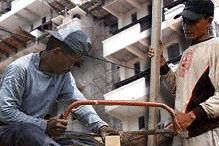 Construction is one of the key drivers in maintaining things like GDP numbers, percentage growth and stuff like that. So from that perspective, yes. Construction is infrastructure. There will always be limits on infrastructure. Worldwide, world standards, we have decent infrastructure. Not the best, but decent infrastructure.
But, the soft side is missing, education and stuff. With education, the problem is that you don't see the results immediately. With construction you see the results quite quickly. From the spending they are putting in, RM27 billion into construction, from that perspective alone, it is likely that the GDP can meet the 5 or 6 percent target. Not a problem.
With this kind of spending, would they still have money in reserve?
I think they have reserves. I suspect they have reserves, given that oil obviously plays a huge role in our revenue. The prices have gone up from US$40-80 a barrel. It was a jump. That was why (former premier Dr) Mahathir (Mohamad) was jumping up and down, saying that Petronas has money.
I think in the last few years Abdullah did right to try and stave off expenditure until the excesses had been sort of normalised. Whether he started spending again because of that, or because Mahathir is making noise, that is a separate issue.
But it is the right thing to do to try to even out all the expenditure. I mean, as much as Mahathir said, that he didn't spend more than what we had, I'm sure he did. The question is whether this oil money will be used wisely or burnt for short-term interests.
Our budget is financed by oil. Oil is like lottery. You win a lottery, what do you do? You have a big feast, you finish your money. No more. There is no multiplier effect from your sweepstakes winnings.
The statistics show we have 20 more years to go, with our oil reserves (which) finance about 30-40 percent of our budget. It is a huge percentage. So shouldn't we be a bit more ambitious and spend even more on education? What's another three, four billion ringgit on education? The impact on the economy and other sectors will be minimal. But the long-term (benefits) of education are a lot.
You mentioned inflation of prices in terms of transportation. So transportation is going to be a problem...
It is the biggest headache for the government ... it's easy for me to argue that they should just remove the oil subsidy. Economically, it is the right thing to do, but the political impact would be fairly heavy.
So the question is, how do they do it without (suffering) from the political impact? It is okay to have a one-off inflation. I mean the inflation numbers can jump once - if you do raise the oil price by 50 percent, you get inflation of 15-20 percent for the first one or two months, after which it will go down again.
 But opposition politicians or economists would scream at the fact that we have 15 percent inflation, and say the government is doing badly and stuff like that. So it is managing that balance from the government's perspective.
I do think they should remove the subsidies. If Indonesia can do it, why can't we? They are in a (worse) state than us and they can remove 100 percent of the oil subsidy and, of course, end up with a grant-based type of system. Why can't we do it if not for political (reasons)?.
Singapore's inflation has been kept at 1.3 percent despite all the oil price rises and stuff like that for a simple reason - they don't have subsidies.
So looking ahead, if Abdullah decides to spend, it should look pretty good...
General economic numbers should look pretty decent. Whether the rich are getting richer or the poor are getting poorer, those are issues we are looking at in the next two years.
If the rich get richer, the poor don't get richer, the economy will still grow. It's whether this will be the right type of economic growth.
Tomorrow: China's economic dominance


Are you sure you want to delete this comment?
This action cannot be undone.