




Judicial crisis: Bar Council mulls several options
Although the cabinet has decided against reviewing the 1988 judicial crisis, the Bar Council said it is looking at other possibilities to keep the issue alive.
Although the cabinet has decided against reviewing the 1988 judicial crisis, the Bar Council said it is looking at other possibilities to keep the issue alive.
This could include calling for an extraordinary general meeting (EGM) for the Malaysian Bar, to hold its own inquiry into the matter or initiate a petition to the King.
 Contacted today, Bar Council chairperson Yeo Yang Poh said discussions were underway but declined to elaborate on the council's next move.
"We are considering future action, but at the moment it is too premature to be disclosed," he said, adding that the media will be informed when discussions are finalised.
Since the Bar Council made the call on Aug 15 to review the judicial crisis - which saw the removal of Lord President Salleh Abas - various groups have expressed their support.
"I hope the government will change its mind," Yeo said.
Under the Legal Profession Act, at least 150 members of the 12,000-strong Malaysian Bar must requisition for the EGM to be held. It must also meet the quorum of 500.
If an inquiry is initiated, it might not be done in accordance with the Commission of Inquiry Act 1950 and therefore would not be legally binding.
In 1988, the Bar Council had taken the lead in defending the judiciary and expressed its lack of confidence in Hamid Omar, who replaced Salleh. As a result the relationship between the Bar and the judiciary was severely damaged and took many years to mend.
Hamid had chaired a tribunal which removed Salleh as lord president after the latter was found guilty of judicial misconduct.
'Finality' argument
Meanwhile, Yeo also disagreed with the government's argument that there should be 'finality' to the matter and thus rejecting the need for a review.
"The 'finality' argument applies to a person seeking remedy. It does not, and cannot, apply to a society in pursuit of the truth," he said in a statement.
"One cannot argue that, because we need finality in our legal or administrative processes, we should let the truth be buried, or history be packed with errors," he added.
He also pointed out that what happened in 1988 had been consistently described as a 'judicial crisis' both domestically and internationally.
"This in itself is telling, this by itself cries out for a truthful re-examination. This is a cry for justice, it is a cry to confront the truth," he said.
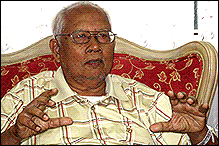 Yeo also said former premier Dr Mahathir Mohamad's admission in asking Salleh to
step down or face a special tribunal
amounted to executive interference in the judiciary.
Yeo also said former premier Dr Mahathir Mohamad's admission in asking Salleh to
step down or face a special tribunal
amounted to executive interference in the judiciary.
"For the head of one branch of government (the executive) to require or demand the resignation of the head of another branch of government (the judiciary), is an obvious violation of the principle of separation of powers," he added.
The Bar Council chairperson said it is Prime Minister Abdullah Ahmad Badawi's turn to answer the people's wish to hear the truth.
Earlier, Minister in the Prime Minister's Department Mohd Nazri Abdul Aziz said the cabinet had agreed with him that there is no merit to reopen the case.
He said the matter was discussed at the cabinet's weekly meeting yesterday following Salleh's appeal on the government to review his sacking and that of his fellow judges.
According to the minister, the government will consider a review only if any member of the tribunal that tried the top judges come forward to admit being pressured into making a decision.
Two of five supreme court judges - George Seah and Wan Suleiman Pawanteh - who ruled that the tribunal which found Salleh guilty was convened unconstitutionally were also sacked.


