




Q&A: Sukma's discharge vindicates all of us
The following is the first of a three-part interview with Dr Munawar A Anees where he tells malaysiakini , among others, about the days leading up to his arrest.
Malaysiakini: What is the latest status with your legal cases in Malaysia?
Munawar A Anees: What the Malaysian judiciary has up its sleeves is anybody's guess. More than eight years have elapsed since the beginning of this catastrophic cycle of events and there seems to be no end to it. After a long and agonising wait, when I traveled to Malaysia in April this year, several appeals came up for a short hearing but nothing has been heard since then.
The following is the first of a three-part interview with Dr Munawar A Anees where he tells malaysiakini , among others, about the days leading up to his arrest.
Malaysiakini: What is the latest status with your legal cases in Malaysia?
Munawar A Anees: What the Malaysian judiciary has up its sleeves is anybody's guess. More than eight years have elapsed since the beginning of this catastrophic cycle of events and there seems to be no end to it. After a long and agonising wait, when I traveled to Malaysia in April this year, several appeals came up for a short hearing but nothing has been heard since then.
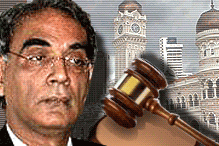 It is heartening that under Prime Minister Abdullah Badawi there appears to be a move for greater independence of the judiciary. This bodes well for restoring the reputation of Malaysia as a country governed by the rule of law. Anwar Ibrahim's release was the first successful litmus test. The recently concluded case of Sukma, for instance, offers further evidence to that effect though the celebration of justice was spoiled by comments from the prosecution quarters.
More salt was rubbed into the wounds by Mohd Nazri Abdul Aziz, the de facto law minister, who adamantly stated that: "We cannot be apologising every time we drop a charge against someone. This is not the system here, (and) not even a communist country like China (would do that)." He further expressed "the view (that there was nothing in the legislation which) requires the government or its agency to tender an apology when a charge is dropped."
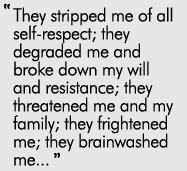 If legislation has been the sole arbitrator, as so piously implied by minister Nazri, then he needs to help me find one piece of Malaysian legislation under which, in September 1998, I was searched and seized, disallowed to make phone calls, handcuffed, blindfolded, stripped naked, driven in an animal cage, shaven bald, endlessly interrogated, humiliated, drugged, deprived of sleep, physically abused, threatened, blackmailed, tormented by police tout acting as lawyers, brutalised to make a totally false confession, hospitalised for a consequent heart ailment, and treated as a psychiatric patient with symptoms of Stockholm syndrome.
Unless minister Nazri wants to turn the clock back on Prime Minister Abdullah's initiatives and take pride in emulating the example of communist China.
How do you feel about Sukma's discharge?
 Sukma's discharge vindicates Anwar Ibrahim and all others falsely implicated in a plethora of concocted cases that failed the test of evidence as much as that of common sense. But this case carries more meanings for me since both Sukma (
left
) and I, being foreigners in Malaysia, were the chosen targets. We were brought in front of those kangaroo courts on the same day and at the same time with the same trumped-up charges.
Sukma's discharge vindicates Anwar Ibrahim and all others falsely implicated in a plethora of concocted cases that failed the test of evidence as much as that of common sense. But this case carries more meanings for me since both Sukma (
left
) and I, being foreigners in Malaysia, were the chosen targets. We were brought in front of those kangaroo courts on the same day and at the same time with the same trumped-up charges.
The captain of the sycophantic media, the New Straits Times , took the lead by putting the blaring headline: "We were sodomised" - attributing it to our (horribly forced and utterly false) confessions. Has not the time of reckoning come for the Malaysian media too as it is for (then NST editor-in-chief) Kadir Jasin to explain to the world how Anwar Ibrahim, sitting heavily bruised in a jail cell, could snatch a comet to come up with the "self-inflicted" injuries?
I recall people were pouring out on the streets in support of Anwar's call for reformation and an increasing number of them were being arrested. Perhaps that caused a severe shortage of handcuffs with the police. That is why they made Sukma and I share a handcuff. We were then bundled off, just like dragged animals, to Kajang (prison) in an overcrowded lorry barely fit for animal transportation.
In this ordeal (lawyer) Manjeet Singh Dhillon has marvelously acted as a saviour to us. He stepped in within the first week. It was when Yacob Karim, a callous and culpable police-appointed lawyer, was trying to exploit my condition to convince me not to lodge any appeal against the court rulings. From that time on, Manjeet has never looked back. He not only has offered me consistent legal defence for the last eight years but displayed an unparalleled commitment to the ethical dictates of his profession.
I certainly hope that Prime Minister Ahmad would continue to implement programmes at all levels of governance in order to build a culture and tradition of law and justice in Malaysia. My counsels, Manjeet Singh Dhillon and Balwant Singh Sidhu, will pursue my long-pending appeals in the hope that justice be served sooner than later. As the old adage goes: justice delayed is justice denied.
What brought you to Malaysia? How did you meet Anwar Ibrahim?
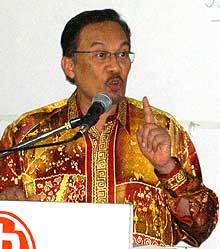 My first encounter with Anwar Ibrahim dates back to mid-70s. While pursuing my studies at Indiana University, Bloomington, there were just a few Malaysian students at the campus. One called Hussein, whose full name evades my memory, approached me with the request that the Malaysian student group had invited Anwar for a lecture and if I could accommodate him for a couple of nights at my apartment. I readily agreed.
I had some idea of his role as a student leader and his initiative in establishing Abim (Islamic Youth Movement of Malaysia). I certainly felt privileged at an opportunity to host him. He impressed me with his oratory and his vision for the Muslim world.
Contrary to today's demonisation of things Islamic (which is partly our own doing with the rampant intra-Muslim killings and inexcusable targeting of innocents by suicide bombers) that was a time when Islamic resurgence was in vogue. Like many others, as a young student, I was going through a flux of certitude and doubt. Anwar and I struck a chord but then lost active contact for over a decade.
 In the meantime, God had blessed us with (daughter) Aisha (
left
). As she grew so did the concern for her education. (Wife) Nadia was not in favour of raising her either in France or in America. While we were weighing the pros and cons of Pakistan or Algeria (birthplace of Anees and Nadia respectively) as our destination, I was invited to a conference in Kuala Lumpur.
In the meantime, God had blessed us with (daughter) Aisha (
left
). As she grew so did the concern for her education. (Wife) Nadia was not in favour of raising her either in France or in America. While we were weighing the pros and cons of Pakistan or Algeria (birthplace of Anees and Nadia respectively) as our destination, I was invited to a conference in Kuala Lumpur.
My first visit to Malaysia left me deeply impressed. In my earlier travels, I had chosen Turkey to be the only favourite. But Malaysia convinced me to enlarge my solo collection of favourites.
When did you meet Anwar again?
Anwar and I met after a very long time. He had become minister of education and engrossed in educational reforms. Beside his promotion of Bahasa Baku, reading habits, and other curricular innovations he wanted to raise the level of intellectual engagement in Malaysia.
At several universities he had incepted a series of talks known by its weighty title: Intellectual Discourse. Anwar asked me if I would be interested in joining him in the realisation of our common vision that shunned extremism and promoted Islamic ideals of justice, liberty, and knowledge .
I returned to France convinced of having found a niche where Aisha could prosper while retaining an organic link with her broader cultural heritage. In spite of the tragic sequence of events in September 1998 that resulted in incalculable physical, psychological, financial, and social losses to our entire family, we do not regret our decision to have brought Aisha and (son) Omran to Malaysia.
Nostalgic it may appear but Malaysia transformed itself so dramatically that we continue to miss what we saw there upon our first arrival. A mellowed living, caring people, and a clean and safe environment seem to have been replaced by a hasty lifestyle, traffic jams, perpetual haze, and all the woes of rapid urbanisation.
Prior to your ISA detention on Sept 14, 1998, did you expect to be arrested?
It was around the last week of August 1998 that our dear friend Alvin Toffler came to town. At Mahathir's invitation he had joined the Advisory Panel of the Multimedia Super Corridor. During that visit Toffler met Mahathir and discussed several issues, including the banning of the movie Schindler's List.
In fact, I drove Toffler to Prime Minister Mahathir's office. Nadia was just returning from Paris with the children after their summer break. Neither I nor Toffler had any inkling of the impending doom. A few days prior to when Anwar was sacked, I attended the birthday party of one of his daughters in a restaurant in Petaling Jaya. We had sensed that something was brewing at the top.
Before Nadia returned to Kuala Lumpur on Aug 31, she called me from Islamabad and we briefly discussed the matter. She expressed some caution but I reassured her. I had neither a reason nor a fear of being falsely implicated in the acrimonious exchange between Anwar and Mahathir.
Anwar's unceremonious dismissal by Mahathir on Sept 2 shocked us but we had never thought that this matter would lead to a catastrophe forcing us to live with it for the rest of our lives.
Are you still being troubled by your appalling experience in Malaysia?
Yes, there is always a fleeting nightmare. A sudden knock at the door frightens me. There is a lingering loss of memory, though for brief moments. Often a feeling of utter helplessness overwhelms me. Excluding any possible age-related factor, I am still not at my optimal level of performance in speech or in writing.
 Like the rest of the world, Nadia (
left
) and I know that this tragedy has nothing to do with the people of Malaysia. It was nothing but a wicked plot hatched by those who had little or no respect for human dignity. As a result, we continue to suffer from enormous losses to our physical and emotional health and financial condition. With each passing day, the accumulated financial losses are becoming more and more pronounced, which in turn are taking a very heavy toll on all of us.
Like the rest of the world, Nadia (
left
) and I know that this tragedy has nothing to do with the people of Malaysia. It was nothing but a wicked plot hatched by those who had little or no respect for human dignity. As a result, we continue to suffer from enormous losses to our physical and emotional health and financial condition. With each passing day, the accumulated financial losses are becoming more and more pronounced, which in turn are taking a very heavy toll on all of us.
In spite of the adversities we endured in Malaysia, we have come to admire the people of that country. During our stay for over a decade in the beautiful land - that we took pride in calling our second home - we developed lasting friendships and look forward to an occasion to renew our links. We are eager to meet those who, in the face of imminent danger, resolutely stood by us. We extend our deepest respects to them.
Our heart goes out to those who risked their personal safety and defied intimidation. One such Malaysian hero was our driver, Ali. It is through ordinary people like Ali that Malaysia lives in our hearts.
Tomorrow: My reunion with Anwar


Report this comment
Are you sure you want to delete this comment?
This action cannot be undone.