




RM30 mil yacht: It's a lie, says Pak Lah
Prime Minister Abdullah Ahmad Badawi today denied he had purchased a RM30 million boat as reported by the Turkish newspaper Hurriyet .
Prime Minister Abdullah Ahmad Badawi today denied he had purchased a RM30 million boat as reported by the Turkish newspaper Hurriyet .
 "The report is inaccurate. It is a lie. I don't know where it (the newspaper) got such facts," he told reporters in Caracas, Venezuela, where he is on a working visit.
The newspaper had claimed that the premier went to Bodrum in Turkey recently to check on the progress of his super-luxury yacht, which he ordered four months ago.
According to Bernama , Abdullah said he would ask the newspaper to make a correction.
The Hurriyet report said the boat is made of Akuju, Maun, Sipo and Brimanya's tree which is imported from South Africa and expected to be completed in 16 months.
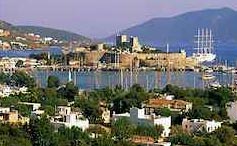 According to the report, Abdullah was in Bodrum (
right
) - one of Turkey's prettiest holiday resorts - to go fishing with Malaysian tycoon Ananda Krishnan.
According to the report, Abdullah was in Bodrum (
right
) - one of Turkey's prettiest holiday resorts - to go fishing with Malaysian tycoon Ananda Krishnan.
"I was in Turkey but did not see the boat," he said in reference to his transit in Turkey from Kuala Lumpur before going to Venezuela.
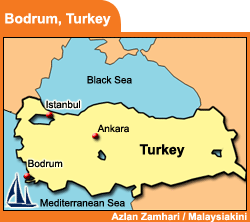 The issue was first highlighted in the Internet earlier this week by blogger and former
Malay Mail
editor Ahirudin Attan in his
Rocky Bru blog
.
The issue was first highlighted in the Internet earlier this week by blogger and former
Malay Mail
editor Ahirudin Attan in his
Rocky Bru blog
.
In another development, Abdullah said Malaysia does not plan to adopt a similar stance as Thailand by imposing capital controls.
He said this was because the nation was financially strong after it embarked on measures and a policy of liberalising the financial system to strengthen the ringgit.
Hence, the people should not be concerned over the latest development in Thailand, he added when asked on the Thai central bank's move to impose capital controls last Monday on capital inflows to curb the appreciating Thai baht.
"The people should not be unduly worried by the Thai government's decision as our financial position is strong," said the premier.
He said there would not be a follow-up action as a result of this latest development, but the government would continue with its present stance and hoped the people remain confident of the present currency and market position in Malaysia which pointed to strong fundamentals.
No impact
Abdullah said the development in Thailand would not have an impact on the Malaysian economy.
Asked on the effects of cheaper Thai exports due to the depreciation of its currency, he said: "Normally, when the value of a currency drops, exports will be cheaper but what is important is that people import products based on quality and reasonable prices, hence our trade position is good."
To another question, he said Malaysia always hoped that investors would come to Malaysia to invest including buying shares in the local bourse.
On Bursa Malaysia, the Composite Index dropped 21.24 points or by two per cent to close at 1,060.36 points yesterday, the biggest intra-day drop since May 22.
Thai stocks spiralled to their worst position since the Asian financial crisis, wiping some US$28 billion (RM99.4 billion) from the market, as foreign investors withdrew following the drastic measures by the Bank of Thailand to rein in the baht.
Bank Negara Malaysia issued a statement yesterday saying capital controls were out of the question.
Malaysia imposed a series of capital controls in September 1998 to ward off currency speculators after the ringgit fell against the US dollar in reaction to the regional financial and currency crisis of 1997/98 when the Thai baht was attacked by speculators.
The capital controls eventually brought about stability to the currency market and enabled the economy to recover.
Malaysia has since then dismantled almost all of the capital controls, including removing the ringgit's RM3.80 peg against the US dollar in July last year.


Are you sure you want to delete this comment?
This action cannot be undone.