




Article torn out of Economist
The Internal Security Ministry's censorship of two articles on the belief in the existence of jinn (genie) and on practices in certain countries in a recent issue of The Economist has been condemned by a media watchdog.
The Internal Security Ministry's censorship of two articles on the belief in the existence of jinn (genie) and on practices in certain countries in a recent issue of The Economist has been condemned by a media watchdog.
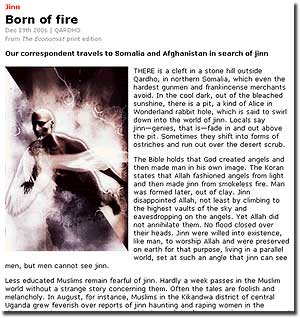 English-language daily
The Sun
reported today that a two-page special report entitled
'Jinn - Born of fire'
in the Dec 23 issue of The Economist was torn out of the magazine distributed in Malaysia.
English-language daily
The Sun
reported today that a two-page special report entitled
'Jinn - Born of fire'
in the Dec 23 issue of The Economist was torn out of the magazine distributed in Malaysia.
The article was on Muslims in Somalia and Afghanistan who believe in the existence of jinn (genie). Some women there have allegedly turned 'possession' of jinn to their advantage to 'ask' questions such as whether their husband will take a second wife.
(While Islam acknowledge the existence of jinn, Muslims are prohibited from seeking their 'services'.)
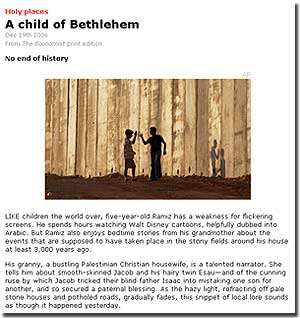
In another article entitled 'A child of Bethlehem - No end of history' , a two-sentence excerpt about Muslim and Christian women visiting a shrine related to the Virgin Mary was blanked out with black ink.
 Deputy Internal Security Minister Fu Ah Kiow has reportedly said he is unaware of the matter but that the government is responsible for censoring all imported publications to ensure these are suitable for local consumption.
The Centre for Independent Journalism (CIJ) criticised the ministry in a statement signed by executive director Sonia Randhawa.
She said CIJ had contacted a ministry official, who said action was taken because the contents contravene Islamic teachings.
In the statement, the official was quoted as saying: "Muslims cannot believe in jinn as this goes against Islam."
Randhawa said censorship deprives the public of information about practices and cultures of people in other parts of the world.
"Rather than discouraging people from discovering about the traditions of others, Muslim or Christian, the government should encourage the quest for knowledge, in a spirit of encouraging tolerance and understanding," she said.
She also pointed out censorship of publications that are available online - such as The Economist - only lead the widening of the digital divide.
 "Urban-based individuals with Internet access will be able to acquire information denied to (those) who do not have Internet access or the skills to navigate the Internet," she said.
Randhawa urged the government to stop banning and censoring publications; repeal the restrictive Printing Presses and Publications Act 1984; and set up a parliamentary select committee on communication rights to examine legislative change for greater transparency.


