




Shahrir defends NEP
Malaysia's inability to compete globally is because of its lack of competitiveness, and not due to the uneven playing field created by the New Economic Policy, said veteran parliamentarian Shahrir Abdul Samad.
Malaysia's inability to compete globally is because of its lack of competitiveness, and not due to the uneven playing field created by the New Economic Policy, said veteran parliamentarian Shahrir Abdul Samad.
 Speaking at a NEP forum at the Bar Council auditorium in Kuala Lumpur last night, Shahrir said the actual problems that should be addressed are one of corruption, privatisation, and cronysm.
The Johor Baru member of parliament said the NEP, in its original format with the intention to eradicate poverty, was "excellent".
"However things changed when the government replaced the NEP with the National Development Policy (NDP) and National Vision Policy (NVP)," he told a crowd of 100.
The forum, entitled 'Do NEP had the ability to face the challenges of the globalization era' was organised by Youth For Change (Y4C) and National Young Lawyers Committee (NYLC).
The NEP, a socio-economic restructuring affirmative action programme, was introduced in 1971 to ensure a 30 percent share of the economy for the bumiputera.
The NEP ended in 1990, and was succeeded by the National Development Policy in 1991, which was then replaced by NVP.
The government had extended the policy through NDP and NVP on the grounds that it has yet to achieve the main aim of NEP - to uplift the economic status of the bumiputera.
Recently the continuation of the NEP caused major controversies when studies indicated that bumiputera participation in the economy sector has breached the 30 percent target. The government however disputes this.
Good ranking
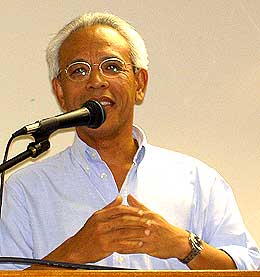 Shahrir also said the leadership tussle within the ruling party Umno in 1987 was a reason for changes in the implementation of the NEP policy.
"After 1987, there was no NEP or it was used for certain other things," he said, adding that it was a period he was not in the government. He did not elaborate further.
However, Shahrir said that people should not look into the negative aspects of the NEP, but should talk about the achievements of the policy.
He added that in order for Malaysia to be globally competitive, it was important for Malaysians to think out of the box and develop critical thinking.
"Successful people can always find himself or herself a place overseas because they think out of the box and be able to step out from it," he added.
He also said that not everything was bad for Malaysia as the country was still highly regarded by the international business community.
"In the Kearney Foreign Policy Globalization Index, out of 62 countries, Malaysia was ranked 19, while developed countries such as Germany (21), Spain (26), Japan (28) and Greece (29) were all behind Malaysia," he stated.
He also cited the Swiss-based KOF Index of Globalisation which placed Malaysia at a respectable 23rd position out of 122 countries.
Uneven playing field
The other panelists in the forum were DAP leader and Ipoh Barat MP M Kulasegaran, PAS's MP for Tumpat Kamaruddin Jaafar and Parti Keadilan Rakyat Information chief Tian Chua.
 Kulasegaran said many individuals had become super rich as a result of the NEP.
"No doubt the NEP has served its purpose. But the NEP's noble intentions have been defeated as the economic disparity of the various races is widening," he said.
Chua agreed with Kulasegaran, adding that NEP had become synonymous with enriching Umno and Barisan Nasional members.
Kamaruddin said the NEP has caused racial tensions in the country with the non-bumiputera citizens feeling they are being marginalised.
"And some Malays too fell marginalised as not everyone benefits from the NEP," he added.


Report this comment
Are you sure you want to delete this comment?
This action cannot be undone.