




Of ghosts, thieves and beasts
The Ijok by-election results have been marred by allegations of irregularities and abuse of government machinery resulting in some poll watchers calling it one of the dirtiest by-elections in the country's history.
The Ijok by-election results have been marred by allegations of irregularities and abuse of government machinery resulting in some poll watchers calling it one of the dirtiest by-elections in the country's history.
On Saturday, Barisan Nasional's K Parthiban defeated Parti Keadilan Rakyat's Khalid Ibrahim with an increase majority of 1,850 votes in the hotly contested by-election. Parthiban bagged 5,884 votes against Khalid's 4,034.
The following are some responses from key poll watchers:
Wong Chin Huat, elections expert
The Malaysian election process is threatened by three things - ghosts, thieves and beasts.
 The ghosts are the phantom voters. Thieves are those who buy votes using state money which does not belong to the party. They are stealing public money to woo voters.There are also those who buy votes with their own money so they would have a chances to steal from the public later.
Beasts are those in the electoral process who use actual physical violence on voters to intimidate them.
There are two ways to fight this. Law enforcement and government agencies should be given the authority to act and the voters should punish them (those who threaten the democratic process). If not, the democratic process will continue to deteriorate.
This concerns all of us and if we don't solve this issue, the entire election process will not get the respect and confidence of the public. People will then use other means to attain power if the ballot box is useless in bringing change.
Dr Mavis Puthucheary, Universiti Kebangsaan Malaysia's Institute of Malaysian and International Studies (Ikmas)
I have only been to Ijok once to see the campaigning. Just by looking at the political situation alone, the BN candidate had a clear advantage. The deputy prime minister (Najib Abdul Razak) was allowed to visit polling stations and the PM had arrived in Ijok in a helicopter. The voters were given the impression that the government and the party are the same.
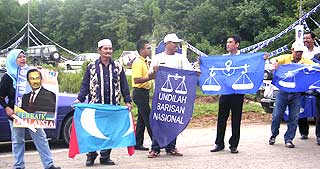 In 2004, the EC said no more 'pondok panas', which I thought was a good idea. Campaigning stops at midnight before polling day but you see there are all these vehicles carrying party flags and banners and shuttling voters to the polling station and indirectly campaigning (for the party).
Clearly this work to the disadvantage of the opposition as this process is clearly biased in favour of BN.
It is dangerous for the people to think that BN and the government are not separate. Even at the nomination centre, those who are allowed to enter are all government officers.
I have seen on nomination day where the candidate was a former minister was given special privileges and given tea and a special seat.
I did think the opposition has quite a bit of support and it's a reflection of the voters. The votes for them were respectable given the fact that large amounts of money was used by BN in their campaign.
PKR did not have the same resources and they relied a lot more on their public rallies to get votes.
The 200-odd vote increase in the majority for the BN out of an increase of more than 1,000 voters showed that the intensity of BN's campaigning has gotten people who had never voted before to vote.
PKR would have done slightly better if the percentage of voters were less and if the BN did not carry out such intense campaigning.
Abdul Malek Hussin, Malaysians for Free and Fair Elections (Mafrel) chairperson
We will come out with a report from our monitoring team in Ijok so I will not say anything now.
The first parties to receive it will be the Election Commission and other government agencies like the police. We will also include an analysis on the pattern of the next election based on the previous by-elections in Pengkalan Pasir, Batu Talam, Machap, Ijok and Sarawak state election.
And I can give you a clue, it does not look positive.
Liew Chin Tong, election strategy advisor to DAP secretary-general
I think there is no doubt that this was the dirtiest by-elections I have seen. With the massive police presence at all the roadblocks and the emergency-like atmosphere, this is very unacceptable and it is not good for democracy.
It reinforced the impression that the atmosphere was created with the purpose to scare voters. The government wanted the people there to feel that PKR could create trouble. They were portrayed as a party of street demonstrators and violence.
After throwing so much resources in Ijok, I think that this was not a total victory for BN.
 This by-election saw an increased voter turnout but both sides did not lose support. PKR failed to nail the Malay votes and there was a massive increase in Malay votes for BN. These semi-rural Malays are quite happy with (Prime Minister) Abdullah Ahmad Badawi's agricultural policies and the contracts dished out to them under the Ninth Malaysia Plan.
He is also seen as a nice and pious man.
There is a lot of soul searching to be done by PKR in facing the situation that the rural Malays are not voting for them. This is the reality that the opposition has to face and they need to think on how to address the issue - that despite the dissatisfaction in urban areas, the government is gaining ground in rural heartlands.
PKR also had higher expectation which left them disappointed when the results came out.


Report this comment
Are you sure you want to delete this comment?
This action cannot be undone.