




Confusion reigns over interfaith conference
First, they were told that the 'Building Bridges' conference in Kuala Lumpur had been banned - now, they hear that it had only been 'postponed'.
First, they were told that the 'Building Bridges' conference in Kuala Lumpur had been banned - now, they hear that it had only been 'postponed'.
No one could blame the conference organisers for feeling confused over the abrupt switch in status of the global event. It was to have been held from May 7-11 and Prime Minister Abdullah Ahmad Badawi was apparently to have attended it.
Local committee members only found out two weeks ago from their London counterparts that there was a problem - a news report claimed that the Malaysian government had banned the Muslim-Christian interfaith conference.
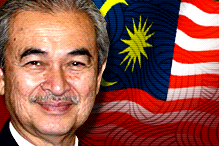 However, on Saturday, Abdullah said the conference was only postponed so he could attend it personally.
"I had to postpone it. We will find another suitable date," Bernama quoted him as saying after he had opened the 61st MIC annual general meeting in Kuala Lumpur.
Contacted today, Professor Emeritus Dr Osman Bakar, who is attached to the Institute of Islamic Thought and Civilisation, expressed surprise but said he welcomed the change in status.
"I was surprised when I heard (the prime minister's announcement) but I welcome his assurance that he wants to have the seminar here," he said.
The Archbishop of Canterbury Dr Rowan Williams was scheduled to chair the conference with confirmed participation by 30 religious scholars and theologians.
Osman, appointed by the office of the Archbishop of Canterbury as a prime mover of the seminar in Malaysia, pointed out that organisers are now thinking of holding it in the United Kingdom.
 "The annual seminar is sixth in the series and it must be held this year. The timing is fixed.
"I heard the organisers have made alternative plans to host it in UK after receiving the government's decision to cancel the seminar," he said.
The Building Bridges conference - set up in the wake of the Sept 11, 2001, terror attacks in the US - attempts to find theological understandings that might help prevent future terrorist attacks.
The get-together of Christian and Muslim academics first took place at Lambeth Palace in London six years ago and subsequently in New York, Qatar and Sarajevo.
Three points
Council of Churches of Malaysia general secretary Rev Dr Hermen Shastri also welcomed the government's change of mind.
 "The move... reveals the openness and commitment of the PM," he said.
However, he pointed out that such decision-making was strange because the late change has left the organisers confused.
Parliamentary Opposition Leader Lim Kit Siang lent his voice by highlighting three 'strange' points in a statement yesterday.
He said it was strange why the organisers had not been informed of the PM's unavailability much earlier than two weeks before the event.

 Lim (
left
) said it is "stranger" that Minister in the Prime Minister's Department Dr Maximus Ongkili had nothing to say "as if he knew nothing about it" despite being a member of the cabinet when probed about the issue in Parliament last Thursday.
Lim (
left
) said it is "stranger" that Minister in the Prime Minister's Department Dr Maximus Ongkili had nothing to say "as if he knew nothing about it" despite being a member of the cabinet when probed about the issue in Parliament last Thursday.
"What is strangest is that no date has yet been fixed for the 'postponed' international Muslim-Christian dialogue," he added.
"This is really unthinkable, raising questions about the prime minister's seriousness in 'walking the talk' to promote inter-religious dialogue in international forums."


