




M'sia, S'pore agree to closer ties
Malaysia and Singapore set aside lingering disputes today and agreed to closer cooperation in a bid to address competition from regional economic giants China and India.
Malaysia and Singapore set aside lingering disputes today and agreed to closer cooperation in a bid to address competition from regional economic giants China and India.
Both Malaysian Prime Minister Abdullah Ahmad Badawi, 67, and his counterpart Lee Hsien Loong, 55, used a rare, two-day meeting on the resort island of Langkawi to focus on strengthening bilateral ties.
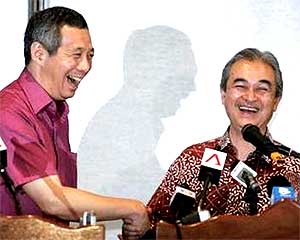 They identified investment, trade and tourism as potential areas of cooperation during a two-hour lunch cruise on the calm Malacca Strait, steering clear of disputes that have been sore points in their ties for decades.
"The purpose of my visit is a forward-looking one to see what areas we can cooperate on," Lee told reporters.
"How we can work on the relationship in an Asia that is dramatically changing, with China and India a big blot on the radar."
Relations have often been stormy since Singapore was ejected from the Malaysian Federation in 1965 over ethnic issues, but they have improved markedly in recent years, especially on economic cooperation.
Malaysia and Singapore are key members of the 10-member Association of Southeast Asian Nations (Asean), which aims to establish an economic community by 2015 to boost regional competitiveness.
Smart cards
Abdullah said he pitched for investment from the rich, tiny republic to develop a massive project in southern Johor state into a major regional hub.
Malaysia hopes to turn the Iskandar Development Region (IDR) into a regional centre to match Shenzhen, the mainland Chinese boomtown across the border from Hong Kong.
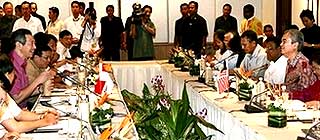 Both leaders agreed on Tuesday to the introduction of "smart cards" that will do away with traditional travel documents to speed up immigration into the IDR. They also said they would establish a joint top-level body to identify areas where they can cooperate on development.
"I welcome Singapore's role in the IDR in terms of investments. I did tell Lee that I see the position of Singapore vis-a-vis the IDR like that of Hong Kong to Shenzhen," he said.
To woo Singaporean investors and tourists to the IDR, Abdullah said travelling will be made faster with the implementation of the smart card programme, replacing passports.
Johor and Singapore share a sea border, which is crossed by a causeway.
"We want speedy access. I am happy the Singapore prime minister has accepted this," he said.
Deepening interdependence
Abdullah, also the finance minister, in February said Malaysia wanted to attract RM50 billion to the IDR in the next five years, and a total of US$105 billion in investment over 20 years.
Foreign direct investment into the country, Southeast Asia's third-largest economy, fell to US$15 billion in 2005 from US$17.6 billion in 2004.
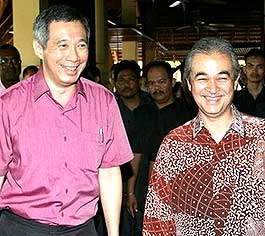 Lee, dressed casually in a pink, short-sleeve shirt, described relations with Malaysia as "very good."
"The interdependence is deepening. We ought to build on this progress," he said, responding positively to Malaysia's hunger for investments in the IDR.
"If this project takes off and succeeds, it can complement Singapore," he said.
Lee said outstanding sticking points should not be allowed to affect the rest of the bilateral relationship, and that they "ought to deal with them in a way which will be acceptable to both sides."
Among the lingering problems are the price of water supplied to Singapore, the future of Malaysian-owned railway land in the city-state and rival territorial claims to a rocky islet off Johor.
"And whichever way the judgement goes, Singapore will accept it and Malaysia will accept it," Lee said, referring to the island dispute, which is to be heard by the International Court of Justice in November.


