




A resounding NO to police state
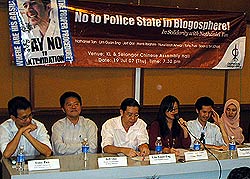
More than 150 people gathered last night in the Kuala Lumpur Selangor Chinese Assembly Hall (KLSCAH) to say a resounding "No!" to a police state in the Malaysian blogosphere.
More than 150 people gathered last night in the Kuala Lumpur Selangor Chinese Assembly Hall (KLSCAH) to say a resounding "No!" to a police state in the Malaysian blogosphere.
The forum, organized by DAP Selangor, was held in solidarity with Nathaniel Tan, the blogger who was remanded under the Official Secrets Act (OSA) last week.
 Tan, an aide to former deputy premier Anwar Ibrahim, was arrested on Friday in the basement of his office at Phileo Damansara I and
remanded
for four days.
Tan, an aide to former deputy premier Anwar Ibrahim, was arrested on Friday in the basement of his office at Phileo Damansara I and
remanded
for four days.
The forum last night discussed the implications of Tan's arrest for the cybercommunity in Malaysia, and for society at large.
There was an overwhelming response of anger and disquiet as Tan described briefly the four days of his detention, under a banner carrying his photograph and the slogan "Say no to police state in Malaysian blogosphere!".
Panelists included DAP Secretary-General Lim Guan Eng, his economic adviser Tony Pua, Protem Vice-President and renowned blogger Jeff Ooi, PKR representative Nurul Izzah Anwar and human rights lawyer Harris Ibrahim.
The panel expressed their concerns over the strengthening police state in Malaysia, and called for the implementation of the IPCMC to reduce the abuse of police power.
The Independent Police Complaints and Misconduct Commission, if implemented, will work to improve the police force, widely considered as riddled with corruption and abuses.
Freedom fighters
 Lim commented on rising crime rates in the country, giving the example that there were currently 8.2 rapes a day in Malaysia.
He added that the rate had risen drastically from 6.7 rapes a day in 2006.
"Is the police force doing anything about this?" he challenged. "Instead they remand Tan."
Lim also said that since independence, the nation has been replaced by one oppressive, colonial regime for another oppressive, local regime.
Likening Tan and other bloggers to "freedom fighters", he said that cyberwriters were breaking the government's monopoly on information.
"We want the truth," he said. "Why is that wrong?"
Harris agreed with Lim on the positive role played by bloggers. According to him, blogs are the biggest thorn in the government's side.
"The days of information monopoly are long gone," he said, adding that if Tan's arrest was a ploy to intimidate bloggers, it was not going to work.
"If you take one blog down," Harris warned, "Ten more will immediately spring up."
Tan said earlier that during his remand, 12 new blogs had been set up in protest of his arrest.
Operasi cyber-lalang
 Harris also said that he was shocked that the police had refused to divulge information about Tan's whereabouts for six hours after his arrest.
"The police had no business putting his parents through that trauma," he argued, saying that the police force was given power to protect, not to terrify, the public.
Harris said that Tan's arrest was a perfect example of power abuse in the Malaysian police force.
Prominent blogger Ooi told the attentive crowd that cyberspace can no longer be considered safe from the current police state.
Ooi, who mused on an upcoming 'Operasi cyber-lalang', urged all bloggers to protect themselves as now a single comment left on a blog or website could lead to arrest.
He was referring to Tan who was arrested in connection with an anonymous comment left on his blog which hinted at corruption allegations against Deputy Internal Security Minister Mohd Johari Baharom. Johari was recently cleared of all charges.
"Offline or online," Ooi said, "persecution has heightened. Is this the kind of country we envisioned 50 years ago?"
Changing mindset
Nurul Izzah said that the public must change its mindset about "irresponsible bloggers".
She urged bloggers to be responsible about spreading information, and to do it with the mindset of educating others who might not know much about crucial issues at hand.
"People do care about issues," she said. "We just need to explain why they should care, and make sure that they understand."
 Pua meanwhile urged the public to call for changes that would prevent police abuses from happening again.
"Whatever our political leanings or views are, we need to know that we will not be abused if we are arrested," he said.
The man of the moment Tan took large part of the forum to explain his experience from the moment he was arrested until he was freed on police bail on Tuesday.
He said that during detention, he was always in the company of four to five policemen in the police station.
Under siege mentality
He then spoke to the unknown plainclothes policemen in the audience, thanking them for their presence but urging them to take care of crime in the country instead of worrying about an " ikan bilis " (small fry) like him.
"I'd rather you stand outside the KLSCAH and make sure no one gets robbed." he said.
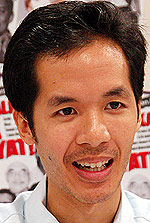 "I was under siege mentality," said Tan, of the four days he spent in prison. He told the audience of the numerous "unnecessary" conversations and interrogations in the cell, where various officers asked him the same questions again and again.
In the end, he, too, repeatedly stated his information.
"I gave them my name, age, occupation," he recalled. "Then I would repeat it when they asked me any other question."
"I retreated, they retreated." said Tan. "It was like an escalation of war. None of this was necessary." Tan, a Harvard University graduate, majored in Peace and Conflict Studies, a self-designed degree.
After more than three hours of speaking, the panel members urged the public not to allow Tan's arrest to be a passing memory, but to take positive action.
"Civil society is a lot more powerful than we think," said Tan in his closing comments.
"We have made huge changes over the past few years - reality is something we can shape."
"You ask me if I'm scared, and I am scared." he said, of the aftereffects of his arrest. "But the mark of our strength is not whether we are subject to fear, but it is measured by how we control those fears."


