




Gov't launches RM177 bil northern development plan
Prime Minister Abdullah Ahmad Badawi today launched a RM177 billion development masterplan to spur economic growth and reduce poverty in northern Peninsula Malaysia.
Prime Minister Abdullah Ahmad Badawi today launched a RM177 billion development masterplan to spur economic growth and reduce poverty in northern Peninsula Malaysia.
The Northern Corridor Economic Region (Northern Corridor) is a government initiative to boost the economy and raise income levels in the northern states of Perlis, Kedah, Penang and Perak over 18 years.
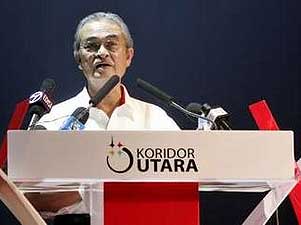 "Projects and programmes to enhance human capital, infrastructure, and competitiveness in the region will involve about 177 billion ringgit in public and private sector investments from 2007 to 2025," Abdullah told several thousand people, mainly farmers, local traders and political leaders under a huge white tent in the Kedah state capital.
If these four states are given the opportunity to flourish, "the country's overall competitiveness will be strengthened and prosperity will be better distributed," he said.
"The focus will be to turn the Northern Corridor into a modern food zone of Malaysia, increase the value-add in the manufacturing sector and strengthen tourism," a government statement said earlier.
Of the RM177 billion, one-third will be spent by the government, with the balance to be undertaken through private finance initiatives and private sector investments, Abdullah said.
"It will be led and driven by the private sector and market imperatives," he said, adding that the masterplan aims to create half a million jobs by 2012 and one million by 2018.
Happy locals
Abdullah, who is also the finance minister, warned that Malaysia must position itself to counter competition from China and Vietnam.
"To this end, we will provide special incentives to lure multinational companies that manufacture high-tech electronic products," he said.
The government also said financial incentives will be given to promote agricultural transformation through economies of scale.
Local residents hailed the long-awaited initiative.
"I feel proud and happy Abdullah launched the plan. It will help us increase our income levels," said Maimunah Osman, 48, a mother of three who runs a sundries shop.
S Saravanan, 31, a contract worker, said jobs were scarce in Kedah state, except in the low-paid agricultural sector.
Looking at his two young children, he said: "I hope this mega plan will one day ensure well-paid jobs for my kids."
The government added that financial incentives will be given to promote agricultural transformation through economies of scale.
Abdullah launched the project in the Kedah state capital, Alor Star.
Breaking poverty cycle
The masterplan includes key benchmarks, with the agriculture sector expected to increase its exports to RM48 billion by 2012 from RM32 billion in 2005.
For manufacturing, investments are projected to jump to RM24.3 billion by 2012 from RM16.5 billion in 2006, while the tourism sector aims to raise average spending per visitor to RM3,034 by 2012 from RM1,890 currently.
Government-linked conglomerate Sime Darby, which drew up the masterplan for the Northern Corridor, will act as a project manager and investor.
The launch of the Northern Corridor comes months after the prime minister kicked off the Iskandar Development Region in southern Johor state.
Abdullah, also finance minister, has said Malaysia aims to attract RM50 billion to the IDR in the next five years as part of an initiative to turn the area, 2.5 times the size of neighbouring Singapore, into a new Asian metropolis.
The Northern Corridor aims to improve the livelihood of farmers by breaking the poverty cycle and raising income levels, the government said.
"The theme of the initiative is growth with social equality," it said.
Umno support base
The Northern region, which borders violence-plagued southern Thailand, is home to a large ethnic Malay population who are mainly involved in agriculture and fishing.
They are traditional and important supporters of the ruling party Umno, which Abdullah leads.
The launch of the project comes amid speculation that Abdullah will call snap polls later this year. Malaysia must hold elections by early 2009.
Malaysia, Southeast Asia's third largest economy, has seen foreign direct investment steadily declining. In 2006 it amounted to an estimated 3.9 billion dollars compared to 5.5 billion dollars in 2001.


