




Insider view of crisis in MCA
MCA’s top leadership is again under the national spotlight, with the recent exposure of a sex scandal involving a senior vice-presidents. The scandal comes amidst signs of factionalism and party polls later this year.
MCA’s top leadership is again under the national spotlight, with the recent exposure of a sex scandal involving a senior vice-presidents. The scandal comes amidst signs of factionalism and party polls later this year.
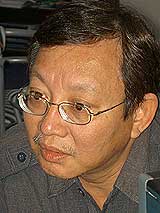
Former MCA Research and Planning Department head Stanley Koh shares his views and perceptions with Malaysiakini on some of the latest leadership issues and developments in the party.
Koh, who retired last December, has served the party for 22 years (1986-2007) under former presidents Tan Koon Swan and Dr Ling Liong Sik, as well as current president Ong Ka Ting.
Malaysiakini: What, in your view, are the major underlying leadership issues that will shape the political scenario in MCA in the coming year?
 Koh:
For a start I think it’s important for those outside the MCA circle who are seeking to understand the internal politicking, to firstly recall past developments on leadership successions, individual power struggles and related internal crises particularly during Ling’s leadership.
Koh:
For a start I think it’s important for those outside the MCA circle who are seeking to understand the internal politicking, to firstly recall past developments on leadership successions, individual power struggles and related internal crises particularly during Ling’s leadership.
Whatever underlying leadership issues are fermenting under Ong’s leadership are in fact a continuity of past causes or events. If we care to recall it, Ong was Ling’s anointed successor as part of his infamous retirement plan.
During the process of implementation, Ling was faced with a complex scenario and a series of contentious issues which effectively split the party into two factions, commonly known as Team A and B. I will not go into details of past history but I feel the Malaysian public must be told the truth of the ‘inside story’ one day.
Are you saying there are many ‘inside stories’ that the Malaysian public, in particular the Chinese community outside the MCA circle, are not aware of?
Generations come and go but the unwritten legacy of ‘inside stories’ which are directly played out by political actors are often ignored and left out of written records. It is a norm that political masters dictate to party propagandists and publicity machinery, especially under a strict policy of party confidentiality.
Politicians may trumpet that they are all for accountability and transparency but when they are involved in controversial politicking and decision-making, manipulating political supporters, or other unethical practices, they act hypocritically.
Hence, more and more civic-minded public members are beginning to feel that leadership issues involving politicians holding government offices should be exposed to public scrutiny if we seriously intend to pursue a healthy political culture.
To illustrate, records of minutes of political meetings by the top leadership often do not reflect the true state of discussions, even though these documents are accorded confidentiality within the relevant committees. In extreme cases, records can be deliberately distorted or manipulated. This will definitely mislead historians and researchers in future even if these party documents are declassified.
Do you see a healthy political culture emerging under the current MCA leadership?
 I would like to think that the average politically conscious Malaysian believes in the bottom-line principle of democracy in that a political party should not - in the selection process or election of leaders - (practice) nepotism or favouritism or habitually ‘anoint’ successors. Neither should incumbent leaders be given a free hand in promoting cronyism or create a family-based dynasty in political parties.
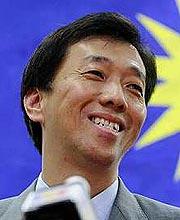
In MCA’s case, emerging criticism is that the party belongs to the 'Ong brothers' (Ka Ting, photo , and Ka Chuan). Loyalists to the president argue that there is nothing unethical for close family members to serve in the same party. It is happening in both Barisan Nasional and opposition parties.
Critics counter-argue that in MCA’s case, it is rather irregular that the posts of presidency and secretary-general are being held by two brothers. Interpreted politically, both are commanding and powerful posts, giving rise to the ironical question whether it is compatible with a healthy political culture.
Of course, we should not forget that MCA’s propaganda during Ling’s tenure was to attack DAP as a “father and son” opposition party.
Do you foresee this as a contentious issue in the party polls? What about practice of a healthy political culture?
I can only reflect some of the feedback from insiders. They say it should start with delegates using their wisdom. Critics argue that such negative developments reflect a dominant population of party representatives easily cowed into passive submission, dictated to by political masters despite the so-called democratic election process. The cry for a healthy and clean election process in selecting dynamic leaders, critics maintain, has been merely lip service.
There are also claims that the party has become a private company. There are ‘ears and eyes’ planted everywhere. There will always be an ‘election menu’ just as there will be public utterances disclaiming responsibility for such practices. Promises of party and government posts are unlikely to die a natural death. This is but a litany of criticism directed at the incumbent leadership despite formal proclamations of a healthy political culture.
In view of the disquiet within the party, leadership issues will gather momentum after the general election this year. Notwithstanding the fact that Ong’s term ends in 2012, this year’s MCA polls will be a testing ground for his loyalists to hold on to power.
What significance do you expect the Chua sex scandal to have on the party polls?
There is a saying that memories are short but in this case, I don’t think the episode will be forgotten. We hear various theories, allegations and unfounded accusations linked to the exposé, which incidentally is under police investigation.
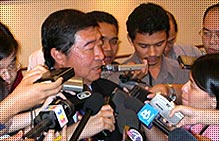 There are many who doubt that the police investigation will lead to the truth in view of the high political profile. We recall the MCA Youth chair-throwing fracas during the leadership crisis involving Ling (
photo
) and Lim Ah Lek.
There are many who doubt that the police investigation will lead to the truth in view of the high political profile. We recall the MCA Youth chair-throwing fracas during the leadership crisis involving Ling (
photo
) and Lim Ah Lek.
The controversy ended in dead silence from the police with no culprits charged in court despite formal complaints being lodged. It was alleged that those involved even got political promotions.
I think there are larger issues that will contribute to a collective platform engaged by rival factions challenging the president and his loyalists in the polls.
The sex scandal has unfortunately raised more questions than answers amidst emerging factionalism. Ironically, it is common knowledge that the old Team A has split, according to sarcastic observation, into Team A1 and A2. It is speculated that A1 comprises party loyalists to the president, while A2 belongs to Ling’s old guard.
Will the negative developments affect MCA in the general election?
I will not prematurely jump to a conclusion by saying that MCA is facing a leadership crisis. For a start, there is no open confrontation from any collective faction showing open defiance or making public statements against the president, unlike in previous crises. There are undercurrents and many simmering complaints involving the president which I will not dwell on for the moment.
MCA is a resilient party having survived more than a dozen leadership crises. Notable ones include the involvement of Tan Koon Swan against Neo Yee Pan in the mid-1980s, Ling faced two separate leadership challenges from Lee Kim Sai and Lim Ah Lek in the 1990s and later. Party crises erupting before a general election are nothing new.
I think the party will pull itself together despite pockets of dissent and the president’s ebbing popularity. It is a formidable challenge for the president to face the general election in view of serious negative feedback from the urban Chinese electorate and general disquiet in party ranks.
Lastly, Johor is the MCA president’s political homestead. Do you think Chua’s sex episode will affect the president’s political strength in the state?
This is a fascinating question. To answer this indirectly, it is interesting to note that following Chua’s resignation, the acting state chairmanship was given to Tan Kok Hong. I think I will answer your question with a question: Why didn’t he take it upon himself to take up the post?
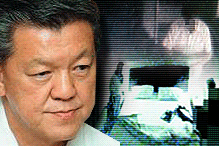 In the past, a decision was made under Chua’s leadership to discourage ‘outsiders’ from standing as general election candidates with an exception - provided the ‘outsider’ is the president or a candidate for the presidency.
I think, without question, that the sex scandal has undermined support for the president. In comparison, Ling’s tenure was characterised by a gentlemanly. friendly, easy-going and approachable style of leadership that earned him enormous respect and popularity in Johor.
A Johorean MCA veteran once described Ling’s greatest leadership attribute: “I have the most respect for the former president because he takes the spirit of brotherhood into his heart. He never fails to establish in us a close personal relationship with him and at the same time, he never distinguished himself as different from us, like he is the leader and we the followers.”


