




Umno's move to scupper Malaysian spring
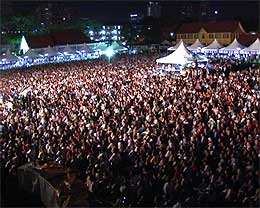
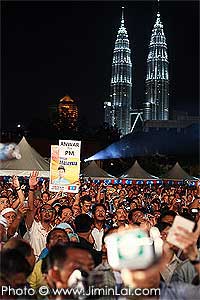
comment Drawing in the atmosphere at Sultan Sulaiman Club (SSC) in Kampong Baru last Monday to mark Anwar Ibrahim’s release from electoral shackles, middle-aged observers of political happenings like us could not resist going back 40 years, to that momentous year: 1968. It was a Dickensian year of the best of times and the worst of times. It was a time of turbulence and a spring time of hope.
The bloody Tet offensive of the Vietcong had breached the gates of the United States embassy in Saigon, dealing a mortal rent on Lyndon Johnson’s prospects of re-election to the US presidency; a bullet laid waste civil rights leader Martin Luther King, triggering race riots in several cities including Washington DC; Yakubu Gowon ratcheted up the ante in Nigeria’s fratricidal battle over secessionist Biafra; and in Czechoslovakia, Alexander Dubcek accelerated his country’s progress towards reform of a sclerotic communist system, causing deep concern in the bowels of the Kremlin.
To come, were the student-led disturbances in Paris that brought an end to Charles de Gaulle’s Fifth Republic; the stilling of Senator Robert Kennedy’s drive for the US presidency by the assassin, Sirhan Sirhan; and Israel’s attack on Beirut International Airport, resulting in an escalation of Middle East hostilities, a cauldron already on the way to becoming one of the most intractable in human history.
comment Drawing in the atmosphere at Sultan Sulaiman Club (SSC) in Kampong Baru last Monday to mark Anwar Ibrahim’s release from electoral shackles, middle-aged observers of political happenings like us could not resist going back 40 years, to that momentous year: 1968. It was a Dickensian year of the best of times and the worst of times. It was a time of turbulence and a spring time of hope.
 The bloody Tet offensive of the Vietcong had breached the gates of the United States embassy in Saigon, dealing a mortal rent on Lyndon Johnson’s prospects of re-election to the US presidency; a bullet laid waste civil rights leader Martin Luther King, triggering race riots in several cities including Washington DC; Yakubu Gowon ratcheted up the ante in Nigeria’s fratricidal battle over secessionist Biafra; and in Czechoslovakia, Alexander Dubcek accelerated his country’s progress towards reform of a sclerotic communist system, causing deep concern in the bowels of the Kremlin.
To come, were the student-led disturbances in Paris that brought an end to Charles de Gaulle’s Fifth Republic; the stilling of Senator Robert Kennedy’s drive for the US presidency by the assassin, Sirhan Sirhan; and Israel’s attack on Beirut International Airport, resulting in an escalation of Middle East hostilities, a cauldron already on the way to becoming one of the most intractable in human history.
 In a world wracked by conflict – “everywhere the blood-dimmed tide is loosed”, to quote Yeats - the springtime of freedom in Prague was a ravishing pause in an otherwise Hobbesian panorama of life as nasty, brutish and short. The Prague spring was an inspirational flowering of the best instincts of man, embodied by the Jeffersonian ideals of life, liberty and the pursuit of happiness. The fate of the Prague spring was watched, with great expectation mingled with mounting trepidation, all over the world where freedom is cherished.
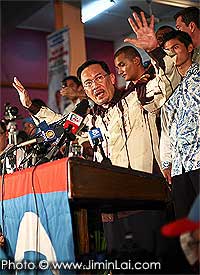
The evening of April 14, 2008 at the SSC, flowing naturally from the astonishing results of the 12th General Election, had all the expectations of the 1968 Prague spring. Anwar Ibrahim was on the cusp of release from arbitrary electoral encumbrances. Backed by 82 parliamentarians and five state legislatures, he was poised to lead the Malaysian polity to the fulfillment of the 1957 Merdeka Proclamation’s promise of freedom, justice and democracy to the new nations’ citizens.
But as a famous 19th century thinker warned about historical events - that in enactment, they were tragic, and in repetition, farcical - could the Malaysian spring of nascent political reform, the pursuit of economic equity, and of good governance, end the way Dubcek’s reformist drive ended, under the jackboot of the Warsaw Pact invasion of Czechoslovakia?
Sudden intrusion of men in blue
Why did these anxieties, like scudding clouds, darken our spirit of celebration at the SSC? Was it the sudden intrusion of the men in blue at the end of 90 minutes of the gathering when things were reaching a crescendo of sorts?
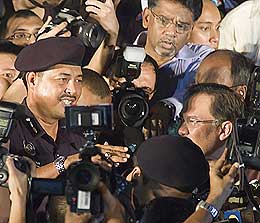 As if that blue-uniformed apparition was not bad enough, it reappeared at first light on April 15 to harass four of Pakatan Rakyat’s leaders in their homes as they slept off the effects of a heady night of celebration. Were the men in blue, draped in the mantle of repressive laws, a portent of things to come?
The results of the 12th GE have threatened the entire structure of power relations in our society. As things stand, the principal wielder of power for 50 years, Umno, is a hotbed of internecine conflict for reason of its loss of parliamentary supremacy. Hitherto, its political primacy was based on its espousal of Malay suzerainty (Ketuanan Melayu).
In the last two decades, Umno exploited this concept to exact economic rents to serve elitist interests that have in recent decades become plutocratic. The current intramural feuding pits one family and its cronies against another nepotistic combine.
The antagonists, however, are careful to camouflage their class interest under the rubric of Malay interests. This is a tired, old, discredited hobby horse which no longer attracts the support of the Malay street, awakened to the reality that they are mere pawns in this political game.
 Inured to a decades-old worldview, Umno’s powerbrokers disdain to accept the reality that their game is up, that Ketuanan Melayu has been manipulated to serve class interest, and that it no longer washes with Malay hoi polloi. Still, the beneficiaries of this warped system can hardly be expected to meekly give up their privileges and perquisites.
There is fear that as their political legitimacy crumbles, Umno vested interests will move to scupper the Malaysian spring. After all, the accoutrements - a muzzled mainstream media; a supine police force; a compliant, if mildly reforming, judiciary; and an obedient bureaucracy, backed a raft of draconian laws - are in place to buttress their will to power. Given this array of props, even if the ballot box yields a verdict that gainsays their worldview, their will to power can annul its promptings.
With the tumult in Umno as backdrop, its oligarchs, of reflexively authoritarian bent, backed by their business cronies, might decide to wrest power. This need not take the form of an open coup d’tat. Instead they could propel a candidate for prime minister wholly subservient to their needs, for reasons of his fatally compromised character and integrity. Then they would have found the ideal instrument for their tawdry masquerade.
Malaysia’s nascent liberation from the shibboleths of the past may yet end like the Prague spring. The parallels are there. All it needs for the sinister to triumph is for simple citizens to be blase.


