




PM takes major political risk in slashing subsidies
Prime Minister Abdullah Ahmad Badawi is taking a major political risk in removing subsidies even as he attempts to recover from disastrous March elections that dealt his ruling coalition its worst results in half a century.
Rising prices of food and fuel were a major factor in the ballot, which has triggered repeated calls for the premier to stand down.
Prime Minister Abdullah Ahmad Badawi is taking a major political risk in removing subsidies even as he attempts to recover from disastrous March elections that dealt his ruling coalition its worst results in half a century.
Rising prices of food and fuel were a major factor in the ballot, which has triggered repeated calls for the premier to stand down.
"It is not an attempt to be popular, we have to think in the best interests of the people," Abdullah said.
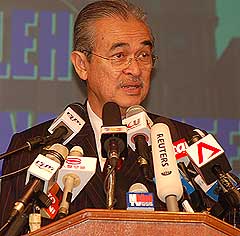 The government today announced that petrol prices will jump 40 percent from midnight, as it moves to cut the spiralling cost of subsidies despite the prospect of public outrage.
"The cost of petrol and commodities has risen drastically and so subsidies have to be restructured," he told a press conference.
"God willing I hope Malaysians will not demonstrate over this," he said, referring to fury over earlier hikes in a country where public transport is poor and most people are reliant on their cars.
Fresh street protests likely
But his call may go unheeded as fresh protests over the price increases are likely, said PAS parliamentarian Mohd Hatta Ramli who led anti-inflation demonstrations earlier this year.
"This is a massive hike and will create big problems for all and sundry. It will have a knock-on effect of increasing prices of all kinds of goods," he said.
"We strongly feel that it is a severe misjudgement on the part of the government," he said. "In all probability, there will be a protest."
Abdullah indicated that further increases were in the pipeline as Malaysia moves to completely abandon fuel price controls that would have cost RM17.4 billion this year - about a third of the national budget.
"We are moving towards a market price regime but it has to be step by step, we cannot do it immediately," he said.
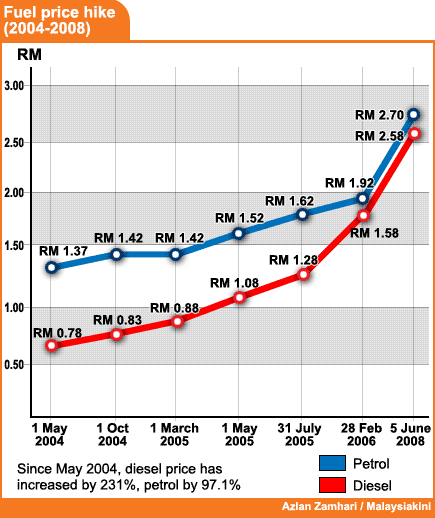
The new pump price for petrol will be RM2.70 and RM2.58 for diesel. Petrol currently costs RM1.92, among the cheapest in Asia.
Increase higher than expected
The subsidy cut was deeper than anticipated, said Yeah Kim Leng, chief economist with research firm Ratings Agency Malaysia.
"A price increase has been seen as inevitable and expected, but what happened is way beyond expectations," he told AFP .
"We were looking at 20 to 30 percent but 40 percent means the government must be trying to make up for not raising prices last year as well."
Under a revamped subsidy system, drivers of smaller vehicles will receive a cash payment of RM625 to offset the rising cost, equating to subsidising some 800 litres of fuel.
Yeah said the rebates were not large enough to compensate for average use.
"It is clearly only a partial subsidy so we need to see how the lower-income group will be able to now absorb all this," he said.
Domestic Trade Minister Shahrir Samad said the pump price could rise as high as RM3-4 when price controls are completely removed in August.
Inflation to go up
Abdullah indicated that economic growth, which the government had tipped at 5.0-6.0 percent this year, would be clipped.
"We will be able to manage at 5.0 percent this year," he said.
Inflation "might go up by 4-5 percent for the year", he added.
Some RM13.7 billion would be saved by the new measure, including RM1.7 billion in a windfall tax charged to independent power producers and palm oil growers who have benefited from rising oil prices.
As part of the subsidy reform, industry and power producers will be charged higher prices for gas from July.
Electricity tariffs will rise 18 percent for householders, and 26 percent for commercial and industrial users.
Malaysia has already moved to ban sales to Thais and Singaporeans who make trips across the border to fill up their tanks with fuel that is substantially cheaper here.
On Monday, it shut off petrol sales on its northern border with Thailand and from June 9 it will implement a ban in Johor which faces Singapore.


Report this comment
Are you sure you want to delete this comment?
This action cannot be undone.