




PM could do better in 9MP review
It was not a Ninth Malaysian Plan (9MP) mid-term review that was expected to please everyone but various parties still think Prime Minister Abdullah Badawi could have done better.
It was not a Ninth Malaysian Plan (9MP) mid-term review that was expected to please everyone but various parties still think Prime Minister Abdullah Badawi could have done better.
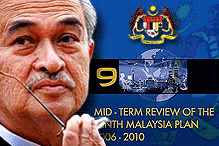 Yesterday, Abdullah
said
the main objectives for the second phase of implementation of the Ninth Malaysia Plan was to ensure that the quality of life of Malaysians is protected.
Yesterday, Abdullah
said
the main objectives for the second phase of implementation of the Ninth Malaysia Plan was to ensure that the quality of life of Malaysians is protected.
This includes deferring major projects like the RM2 billion Penang Monorail and RM1.5 billion Penang Outer Ring Road and prioritising people-centred projects instead.
Here are responses from several groups on the 9MP mid-term review:
Tricia Yeoh, Centre for Public Policy Studies director
With the exception of the two Penang projects scrapped, there were no major surprises in the mid-term review of the 9MP. The Gini coefficient fell from 0.462 to 0.441, which reflects a slight improvement on the equality of income distribution, but is still relatively high.
However, it seemed to project a stable inflation rate over the next two years, which is unrealistic. Although revising the estimate from 2.2 to 2.8 per cent, the document does not sufficiently address the impacts of inflation on the public, which ironically is the primary concern of Malaysians at present. It would have been better to face the issue of inflation squarely and elaborate on measures taken to address that.
 Also, the document follows the traditional breakdown of all Malaysia plans in classification, but it would be better for a disaggregated breakdown of those within the broad ‘bumiputera’ category. This is done for income breakdown in Sabah and Sarawak (i.e. Malay, Iban, etc) but not in Peninsular Malaysia.
The disaggregated figures should also be calculated for the Gini coefficient (breaking down ‘bumiputera’ into smaller groups - Malay, Iban, etc.). There is no data or statistic given on the status of Orang Asli, which needs serious attention. The concern is that there need to be specially tailored efforts for specific communities (even within the ‘bumiputera’ category), aside from a general objective of improving income inequality distribution. The focus is predominantly on hardcore poverty, with only a paragraph or two mentioned on urban poor, which also needs serious addressing.
Finally, the calculation of equity ownership in Malaysia still follows the same methodology as the 9MP, which is disappointing. A more detailed breakdown of the equity ownership used to be the practice in older Malaysia Plans, whereas the table shown today is a very general one.
Also, it still makes use of par value of shares - the reason given was that market value is available only for listed companies in Bursa Malaysia. If that is the case, then there should be two separate tables giving calculations of companies that are listed and those which are not listed, as this would give a clearer picture of actual equity ownership in the country.
As it stands, the methodologies used are still unclear and I would welcome a more detailed clarification of the calculations. This should be the standard practice for all developmental plans published officially by the government.
Lum Weng Keong, Gerakan deputy secretary-general
The federal government’s proposal to give emphasis to people-centered projects in the remaining period of the 9MP is most welcome in view of the hardship faced by the lower and middle income groups as a result of increases in prices of food and fuel oil prices.
Giving priority to projects like food security programme, construction of rural roads and schools; provision of low cost housing, technical education and vocational training is a step in the right direction. Emphasis must also be given to the implementation of the projects.
We must be mindful not to repeat mistakes of the past where millions are spent to build schools and computer labs that have leaking roofs, without electricity supply or access roads; or the case of the Matrade building and MRR2 (Middle Ring Road) elevated bridge fiasco.
We still remember the Auditor-General Report where tools and equipment are over priced. It will be a waste of public funds if the projects are not implemented properly. To ensure its proper execution, the government must ensure transparency and accountability be adhered at all times.
As expected, the government is relying on the private sector to spearhead economic growth. To achieve the targetted economic growth, the government must improve on the delivery system, reduce corruption and have clear and consistent policies. Only with such supportive environment will domestic and foreign investors have the confidence to invest in Malaysia.
Yong Poh Kong, Federation Of Malaysian Manufacturers (FMM) president
FMM is encouraged by the mid-term review of the 9MP, which has given a good bill of health on the performance of the Malaysian economy. Nevertheless, the performance of the manufacturing sector could be more subdued, especially if the industry is not able to recover strongly and adjust to the recent hikes in energy prices.
FMM is impressed with the list of policy commitments, outputs and targeted outcomes presented in the report. These policy commitments, outputs and targeted outcomes reflect the thrust of the government to be more outcome-based in planning, monitoring and reporting.
There are also some concerns that would need further review and/or clarification from the government, the key issues being the growth and export activities of manufacturing could be more subdued in light of the recent energy price increases, the urgent need to expedite programmes on the efficient use of energy resources including the review of pricing and subsidy schemes; new energy policies and strategies and fuel security. Also, entrepreneurship and innovation programmes should also be carried out earlier - not only at tertiary level.
FMM strongly believes that with the added assurance from the PM that the government would continue to maintain and improve the current level of openness and stakeholder engagement by the public sector, economic issues and challenges could be addressed to ensure greater efficiency in the use of resources leading to greater value for money in business investments and trade; and concurrently, a better standard of living for the people.


Report this comment
Are you sure you want to delete this comment?
This action cannot be undone.