




Save businesses, protect jobs
Signs abound that the June 5 fuel hike will put Malaysia into a major economic contraction. A month after the price hike, a random survey with businesses already showed drastic reduction in activities; signs abound that Malaysia could slide into a major economic contraction because of uncertainty and erosion of confidence.
The government of the day still does not seem to "get it", that it is important to direct and target policy measures to arrest the contraction before the system is beyond resuscitation.
In raising the price of fuel; so far the concern has been focused on the inflationary impact on the people. Given, this concern is legitimate, and the people's interest should come first. However, it is more important to focus on protecting the income of the people. The talk of inflation is meaningless if there isn't even any income to begin with!
To avert the crisis, the most important measure in front of us is to sustain the local business sector, protect their margins so they will not retrench their workforce, making hundreds of thousands or even millions of people unemployed. To keep them alive and robust, we need to keep up the economic activities in the country.
The development of the corridors is irrelevant and meaningless at this moment if we don't commit serious effort to protect existing businesses and jobs.
Don't kill the goose
The following table, extracted from the Human Resources Ministry illustrates the distribution of Malaysia's workforce.
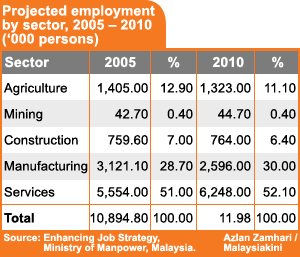 The large dominance of the service as an employer also includes the large civil service employed by the government (1.1 million people). The manufacturing sector has already made up of 32.1 percent of GDP in value terms; it has always been a high growth sector and a long time growth engine for the economy.
Development in agriculture and mining will hit growth limits as reserves (such as oil and gas) and land are finite. The big value churner has always been the industrial sector and governments would do well to help this sector protect its margin, enhance its competitiveness.
Hence, it is imperative that the government not only protects, but go further to help they cushion the international vagaries of a contracting global economy; saving these business, we save many jobs as well.
Major contraction feared
The June 5 fuel hike, plus and minus would probably help the government save a total of RM19.4 billion in expenditure; from the elimination of subsidy on oil (17.4b), windfall tax on palm oil (1.4b) and on the IPP (0.6b). The economic sectors have factored the impacts, and while prices must remain in turbulent times, margin erosion is inevitable. Across the board they see a 20-30 percent shake out.
When the effects work through a reverse multiplier in the economic system, the impact of this contraction could have the following eventual impact on the government's revenue:
a. Corporate tax: when margins are eroded, and businesses incur losses, they will not be able to pay any tax. Today, 80 percent of Malaysian direct taxes come from the corporate sector (RM30b in 2007).
b. Those who lose their jobs or have their salaries or overtime cut; would also not be able to pay taxes (RM12b in 2007 from individual income taxes), those who have been on a tight budget would also have difficulties paying their car, house and credit card loans.
c. Excise duty (RM8.5b in 2007) and sale taxes (RM7.1b in 2007) are collected on vehicles: Malaysia already has nine million vehicles. With reduced income, they cannot service their existing housing loans, the finance companies could not provide further financing; hence sales of car and other big ticket items will drop; hence cut in excise and sales taxes for the government.
d. Reduced economic activities will also affect income on licenses and permits. Transactions on houses are also expected to fall.
e. The government's investment income will also drop because the companies that the government invested in including the government-linked companies will also have their margins eroded. In a worse case scenario, the government could report a contraction of income of over RM30 billion once the economy goes into a serious downward spiral.
While the government cut the subsidies to try to reduce its expenditure, the net effect is an economic contraction which could see a drastic reduction of its revenue. The cut back in subsidy turns out to be counter productive; it also looks like we ‘throw the baby out with the bathwater' as we "erode business sector margins, and threaten millions of jobs".
Futher impacts
Two other additional points to note on the pressure on the government's cash flow:
- The government has to support 1.2 million civil servants, and only current pensions are funded; all past obligations need to come from current revenue. Pension payment for 2006 was RM8.3 billion.
- EPF withdrawals and dividends must be maintained. According to Bank Negara (2006) a total of 11.35 million contributors made a total contribution of RM29.7 billion, withdrawals of RM15.6 billion, with a net contribution of RM11.4 billion. It is important that EPF must bring in a cash contribution of above RM16 billion every year in order to meet withdrawals. When income is reduced, contributions to EPF will fall.
- The federal government has been running budget deficits since 1998, and it has been borrowing from the domestic economy (much of this from the Employee Provident Fund) to finance these deficits. According to the Economic Report of 2007/2008, Total government debt stood at RM247 billion, 39.5 percent of GDP.
The reduction of government revenue is the final outcome of the contraction triggered off by the erosion of business margins brought by rising cost from the fuel hike. When it works its way through the economy, it will bring a reverse multiplier effect that could suck the economy into a vicious cycle.
Consider the impact on the following:
Borrowings : Small Medium Enterprises (SMEs) will be hit first. According to Bank Negara, at March end 2008, SME financing outstanding provided by the financial institutions amount to RM132.4 billion. This accounts for 44.3 percent of total outstanding business financing with non performing loans standing at 9.1 percent from 11.1 percent of 2006. Given the pressure on margins and the threat of closure, the Non-Performing Loans (NPL) ratios will easily rise a few percentage points. We must note that there is total business loans outstanding in the Malaysian economic system standing at RM299 billion.
Many have warned that if we do not seriously address the imminent economic crisis, it will result in a financial crisis when government, businesses and individuals cannot service their loans.
The working population : Already faced with reduction of disposable income due to hyperinflation, some sections of the working class will further face the threat of unemployment:
a. Unemployment cut off the income of the people; the biggest employer of the Malaysian workforce are local businesses, which employs up to 90 percent of the workforce of 11 million people. It is hard to put an estimate to the severity of the problem but we choose to err on the conservative side, many industry leaders in the focus group we surveyed fear unemployment could climb to double digit. In the worse scenario we fear it is not hundreds or thousands but millions of people could suffer loss of jobs or reduction in income. The consequences are unthinkable.
b. When widespread inflation happens, there would be grave difficulty to service household loans; which amount to RM427 billion for the country, double-digit non-performing rate would send the banking system on a tailspin.
c. The nation's nine million car owners already have problems with the high petrol price, which again is expected not to stabilise at RM2.70 given the continuing escalation in the world market. Note current market rate of petrol in Singapore is already RM4.20 per liter. With reduced income or no income; they can't pay up their housing loan, credit loans and car loans. For the finance companies, it would be impractical to repossess the cars as demand in the secondary market is also drying up. Pushing this argument further, Proton would have problem selling more cars as financing would be withheld with increasing default rates.
d. People are at a loss on how to adjust to the difficulties. Already we see a substantial portion of the population, especially the rural Malay community finding it difficult to fill up their petrol tanks; cars parked at home or left abandoned due to lack of fuel, would be a common sight as the economy contracts. In many cities and towns with no efficient public transportation; people would not be able to get around; send their kids to school or do their daily chores. We fear this situation will send many frustrated people out on the street demanding government action.
e. We are further troubled by Minister in the Prime Minister's Department Amirsham A Aziz's revelation that as much as 24.3 percent (6.5 million) of our population, a quarter of all Malaysians would be below the poverty Income line (PIL) if we raised the PIL to RM1,500. The economic hardship impacts strongest on this group of Malaysians. No amount of government support or subsidy will be more effective than if we work to help them keep their jobs.
Hence it is paramount that measures are implemented to protect the margins of our local businesses, especially the manufacturing businesses and protect as many jobs as possible to avert this crisis.
Part 2: Forget mega-projects, SMEs are our 'golden' goose
FOONG WAI FONG is Director of Megatrends Asia and best selling authors of several books including The New Asian Way, We have to talk Mr Prime Minister and Culture Is Good Business .


