




Does a big majority matter?
That de facto PKR leader Anwar Ibrahim will win the upcoming Permatang Pauh by-election is not in question, even amongst Barisan Nasional leaders. The more interesting questions, politically speaking, are how large will Anwar's majority be and how significant is his eventual margin of victory.
There are reasons on both sides of the argument as to whether Anwar's margin of victory will be larger or smaller than the 13,400 majority obtained by his wife, Dr Wan Azizah Wan Ismail, in the general elections in March.
That de facto PKR leader Anwar Ibrahim will win the upcoming Permatang Pauh by-election is not in question, even amongst Barisan Nasional leaders. The more interesting questions, politically speaking, are how large will Anwar's majority be and how significant is his eventual margin of victory.
There are reasons on both sides of the argument as to whether Anwar's margin of victory will be larger or smaller than the 13,400 majority obtained by his wife, Dr Wan Azizah Wan Ismail, in the general elections in March.
On the one hand, several factors are at play that can reduce Anwar's majority. Polling day falls on a Tuesday and this might decrease the overall voter turnout and hence Anwar's absolute majority.
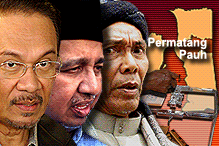 Since it is more or less a given that Anwar will win this seat, his supporters might not feel the urgency to come out and vote for him. Worse still, there may be some fence sitters who might want to cast sympathy votes for Arif Shah Omar Shah, the BN candidate. or even Hanafi Hamat, the Akim candidate.
The fact that Arif is a BN state assemblyman in the Permatang Pauh constituency might also help him garner votes, especially in his own state constituency of Seberang Jaya.
Some have even speculated that Saiful Bukhari Azlan's whole 'swearing on the Quran act' might cast some doubt on Anwar's innocence and cause him to lose some votes among the Malay community. Finally, Anwar's and Pakatan's apparent pro-non-Malay stance (at least compared to Umno), might have put off some Malay voters.
A vote for him, not his proxy
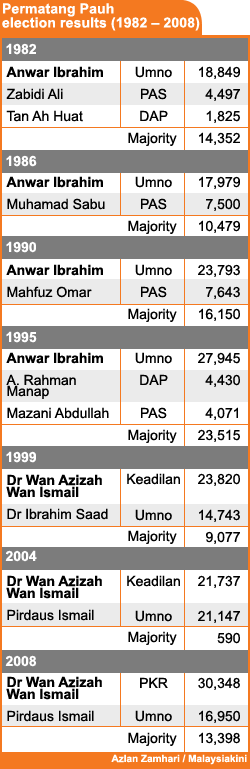 On the other hand, Anwar also has several favourable factors on his side. This will be the first opportunity that voters in Permatang Pauh, a seat held by Anwar from 1982 to 1999, to vote for him instead of his proxy, Wan Azizah.
Indeed, they have the opportunity to vote for a possible prime minister-in-waiting, if he indeed manages to convince enough BN MPs to switch over to his side. The fact that most of the public think that the sodomy charge brought up against Anwar is nothing but a BN-created conspiracy has definitely given Anwar a boost, especially amongst the Malay community.
Finally, Anwar is contesting in a Pakatan Rakyat-led state which would even out the battles of 'resources' on both sides.
It is probably not an overstatement to say that Anwar has sewn up the non-Malay vote. Given the opportunity to vote in a possible future prime minister who would, in all likelihood, implement more policies which are favourable to non-Malays (or at least not unfavourable to them), why wouldn't they?
Where there is greater uncertainty is amongst the Malay community. The question here is not if Anwar will win a majority of votes among the Malays in Permatang Pauh – he will – but by how much. It is the Malay votes that will ultimately affect the majority which Anwar will obtain.
Bellwether of voter sentiment
If Anwar's majority increases to, let's say 15,000 or more, as we think it will, he will re-enter Parliament with momentum on his side.
Since by-election results are always viewed as a bellwether of voter sentiment at the national level, Anwar can use the results to claim that he has the confidence of voters from all ethnic groups, especially of the Malays. It would certainly not do any harm to Anwar's cause of attracting BN MPs to cross over to his side.
In the unlikely event that Anwar's majority is actually decreased, perhaps even to below an unthinkable 5,000 votes or less, all is not lost for Anwar. While he might take a short-term hit to his reputation, he can always claim that the unexpected outcome was a result of massive fraud on the part of the BN.
And people will believe it, whether it's true or not. That is how lacking in credibility the government is. Even if these claims are without factual evidence, the reputation of the BN is such that this accusation would resonate amongst a majority of the public.
Once in Parliament, Anwar would quickly turn the spotlight away from the results of the by-election, whether or not they are favourable to him, and proceed to his ultimate goal – that of displacing the BN and forming the next government.
This is when the action really starts. The by-election is just an appetizer for what is to come.
ONG KIAN MING is a PhD candidate in political science at Duke University and OON YEOH is a writer and new media analyst. You can listen to both of them discuss this topic in their Realpolitik podcast .


Report this comment
Are you sure you want to delete this comment?
This action cannot be undone.