




Bid to amend RPK sedition charge rejected
The prosecution today failed in its bid to amend its sedition charge preferred against blogger Raja Petra Kamarudin to include the website address and title of the allegedly sedition article in the appendix of the charge.
The prosecution today failed in its bid to amend its sedition charge preferred against blogger Raja Petra Kamarudin to include the website address and title of the allegedly sedition article in the appendix of the charge.
The judge rejected the application after the defence team raised an objection.
This comes after Deputy Public Prosecutor Ishak Mohd Yusof told the Petaling Jaya Sessions Judge Rozina Ayob that the prosecution would like to apply for an amendment to include the web address for the said article as well as to add the title ‘Let's send the Altantuya murderers to hell' to the same article.
The article was allegedly posted by Raja Petra on Friday April 25, this year.
The original charge only stated the web address of the Malaysia Today website and not the web address of the article.
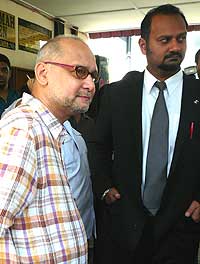 Raja Petra's counsel Gobind Singh Deo objected to the prosecution's application on two grounds, namely they could not alter or add anything to the charge and that it was prejudicial to his client.
"You cannot substitute, as the application if allowed would result in a different article altogether."
"Even words are changed and this is an attempt by the prosecution to substitute the annexe to the charge. The question still arose is this the original posting? Where is the original?" he asked.
Gobind also said the prosecution's application was also prejudicial to his client as there were a few of the prosecution's witnesses called based on the present charge and not the amended charge.
"Is the one provided by the prosecution the original or the document was typed out by them?"
He said the prosecution may have realised that they may have no case against the accused with respect to the original charge and decided to take this step.
"What they should do is to withdraw the charge altogether," he said.
Prosecution: It is not prejudicial
Ishak in his reply said the prosecution was not substituting the annexe but was only adding two ingredients to the charge - namely the address of the said seditious article and the title.
Rozina then asked the DPP if this was an editorial change or the subject of the charge and Ishak maintained they were changing the ingredient namely the address and the title of the article.
"We are not substituting the annexe but are adding these two ingredients so it would fulfil section 153(1) of the Criminal Procedure Code (CPC) to provide clarity."
Rozina then asked Ishak wouldn't it be prejudicial, and he replied it was not as the defence could have an opportunity to recall any of the witnesses who had testified.
Gobind in his reply said it would be prejudicial to his client as in the original charge it was not stated any title.
"This is prejudicial like bringing a new charge with a fresh title. Court has the discretion under section 158 of the CPC to allow the defence objection."
After a short break, Rozina said after scrutinising the arguments put forward, and the objection, the court would allow the objection and the charge would remain as it stands.
Forensic expert testifies
The trial then continued with police officer Wa'ie Iskal Kria Abdullah, 38, from the Computer Forensic division of the Commercial Crime Department telling the court that he was instructed by the investigating officer Mahfuz Abdul Majid to look into a Central Processing Unit (CPU) and notebook seized from Raja Petra's home.
The witness said Mahfuz came to his office at 1.30pm on May 2, 2008 to handover the two computers for him to analyse.
Ishak : What was Mahfuz's intention of wanting you to look at these two equipments?
Wa'ie: To provide a computer forensic analysis of the two seized items.
Ishak: What did Mahfuz want you to analyse?
Wa'ie: He wants me to look for the article titled "Let's send the Altantuya murderers to hell" and to look at files containing internet history."
Ishak: Did you find it
Wa'ie: Yes
Ishak: Did you prepare a report?
Wa'ie: Yes, I did prepare a computer forensic examination report. (The report which was earlier marked identification was then marked as an exhibit)
Ishak: In the course of your analysis did you find any other documents in both equipments?
Wa'ie: Yes, however, I did not open any of the documents. I only followed on what was instructed by Mahfuz and did not do any other things.
Ishak: If the court allows it or Mahfuz instructs it would you open the documents and read it?
Wa'ie: Yes, I would open and read it, if this was allowed.
Drawing a link
The witness told the court that after doing the necessary analysis, he called Mahfuz to pick up the two equipments. Mahfuz came two days later to pick the two equipments.
Another witness, S Sivanathan, 28, a senior digital forensic analyst from Cyber Security Malaysia told the court that from analysing Wa'ie's report, he can conclude that the seized CPU and notebook had administrator privileges to the Malaysia Today website.
"This means that the administrator could access and maintain the website."
Sivanathan also noted that two articles dated April 10 were uploaded using the computers.
The two articles in question were ‘Ceramah Perdana Black 40' and ‘Raja Nazrin for judicial reforms'.
Replying to questions from DPP Farhan Read, the witness also agreed that besides the user of the computer, there could be others given access to the Malaysia Today website to make amendments if the administrator used a different password or another person is allowed by the administrator to do this with lesser privileges by giving a user name and password.
Raja Petra claimed trial to publishing a seditious article on his website on April 25.
Hearing continues tomorrow.
Habeas corpus application withdrawn
And in Kuala Lumpur, earlier today, the High Court allowed an application by Raja Petra to withdraw his habeas corpus application of Sept 16 for release from ISA custody.
The application has become academic as he was freed by the Shah Alam High Court last Friday on another similar application.
 The Kuala Lumpur application was filed by Raja Petra against his arrest under Section 73(1) of the ISA which allowed the police to detain him for 60 days for questioning.
His application in Shah Alam was however on his detention under Section 8 of the same Act which allowed for him to be detained without trial for two years.
A writ of habeas corpus orders the authorities to produce detainees before a judge to determine whether the government has the right to continue holding them.
Last Friday, Shah Alam High Court judge Syed Ahmad Helmy Syed Ahmad freed Raja Petra after finding that his two-year detention order under the ISA was unlawful.
He had been in detention for more than a month over an article he had published on Malaysia Today that allegedly ridiculed Islam.
Justice Suraya Othman granted the application after Raja Petra's counsel Malek Imtiaz Sarwar made an oral application to the court.
"My client instructed me to withdraw it (the application) in view of the Shah Alam High Court decision to free him from the two-year ISA detention order," Malek Imtiaz told the court.
Suraya said that since the matter had become academic, the court was allowing the application and that it was up to Raja Petra, if he wished, to seek civil action over his detention.


Are you sure you want to delete this comment?
This action cannot be undone.