




March 8 emboldens monarchy
The outcome of the March 8 general elections, which witnessed the opposition making unprecedented gains, also appears to have given the rulers a new lease of life.
The outcome of the March 8 general elections, which witnessed the opposition making unprecedented gains, also appears to have given the rulers a new lease of life.
 At a luncheon address on 'The Role of the Constitutional Monarchy in 21st Century Malaysia' in Kuala Lumpur yesterday, Negeri Sembilan Regent Tunku Naquiyuddin Tuanku Jaffar outlined how the political twist has affected the rulers.
Among others, he said, the elections has given the Malaysian monarchy "an opportunity to come to the fore".
"The electorate expressed its displeasure with the ruling government resulting in the opposition taking control in five states and leaving the federal capital monopolised by opposition figures.
"Even in Negeri Sembilan, Barisan Nasional's majority in the state assembly was by a mere three representatives. A close shave by any standards," he added.
Calling it the "decimation of Barisan Nasional", the regent underscored the fact that the election results reflected the rakyat's deep dissatisfaction over many issues.
"I shall not endeavour to go through these issues to avoid misrepresentation. Even rulers have to be discretionary at times," he quipped.
'Courageous, bold and almost confrontational'
Nonetheless, Tunku Naquiyuddin said in Kedah, Perlis, Perak, Penang, Selangor and Terengganu, the rulers and the Penang governor had exerted their right under the constitution to appoint the menteris besar and chief minister.
In Perlis, he said, the ruler used the occasion to stand firm to express the rakyat's dissatisfaction.
"Despite the prime minister's public support for the incumbent (Shahidan Kassim), the ruler decided to appoint a new menteri besar (Mat Isa Sabu).
"Similarly in Terengganu, the new menteri besar-elect (Ahmad Said) was fully endorsed by the ruler against the recommendation of the prime minister who was again supporting the incumbent (Idris Jusoh).
"These two incidents which took place over a period of eight and 19 days respectively saw the whole country gasping at the political ramifications and the forthrightness of the ruler to put his foot down.
 "Never had a prime minister withdrawn his candidacy in the face of a vociferous ruler. In fact on March 23, Abdullah (Ahmad) Badawi actually called the appointment 'unconstitutional'.
"However, an audience with the (Yang di-Pertuan) Agong (who is also Sultan of Terengganu) on March 25 obviously paved the way for BN to fully endorse Ahmad Said as menteri besar."
In Selangor, Tunku Naquiyuddin said, there was a totally new experience to see an opposition member being appointed menteri besar by the sultan.
"Being so close to Kuala Lumpur, Malaysians were generally pleased that the changeover went so smoothly. This was a vivid example of a mature democracy in action."
All these instances, he said, witnessed the respective ruler exerting his power during times of change. By sensing the need for change, he added, the rulers exercised their role to appoint new faces.
"In the past when BN governments were in the clear majority, the rulers were often just endorsing and obliging the recommendations of the prime minister.
"In this instance, the ruler has actually taken stock of the situation. Some of the appointments were surely based on the feedback of the rakyat that change was necessary and a new face in politics was the order of the day.
"If you really analyse the situation that the ruler is supposed to act upon the advice of the prime minister, then one can sense that the action of the ruler (in those states) is really quite courageous, bold and almost confrontational."
'Perhaps select a PM one day'
Tunku Naquiyuddin also pointed out that the rulers share a close rapport with the rakyat and by being apolitical, this gives them an honest and accurate view of the situation.
"The ruler also thinks in the long term and what is good for the nation. Quite often, politicians look only to the next elections."
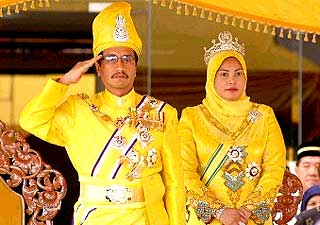 On the same note, the regent said, perhaps one day the king may have to select a prime minister if no one group has a majority in Parliament.
"Article 40 (2)(a) provides for the procedures and appointment of prime minister by the Agong using his own discretion. This means he is not bound by the wishes or advice of an outgoing prime minister."
However, he said there are certain constraints and conventions which guide the ruler in performing this role.
For example, he added if there is a party enjoying absolute majority in Parliament, the king has no choice but to appoint the party leader as prime minister.
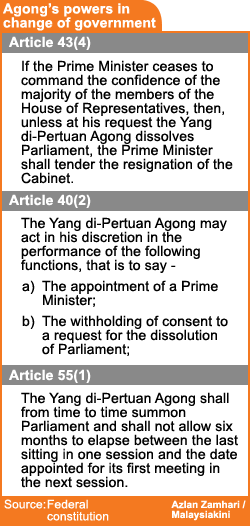 "But if a general election leads to a 'hung' Parliament, the king may exercise his discretion to choose a person likely to command the confidence of Parliament.
"As such, the king's ability to exercise discretion in his selection and the need to be politically impartial are very important attributes in his capacity to act as head of state."
Apart from this, the regent said, rulers have recently come out with timely reminders regarding peace and harmony as well as respect for the constitution.
He cited the Regent of Perak Dr Raja Nazrin Shah's call on rulers not to agree to the advice given by government leaders if it goes against the spirit of the constitution, rule of law and universal principles of justice.
"Several other rulers have also come out with various piece of advice. The Sultan of Selangor is well known for his drive for a clean and efficient administration."
"Corruption at all levels have been condemned and environmental degradation has been brought to the attention of the authorities. Racial unity is quite often a rallying cry. There are also many speeches which go unreported."
'Rulers need full immunity'
Inevitably, Tunku Naquiyuddin said, the ruler has to assert himself in the political process while trying his best to be apolitical.
"If Malaysia, in the future, is to see a much more vibrant scenario of opposition political forces then we can envisage the Malay ruler playing a more crucial and assertive role in order to ensure that peace and harmony prevails and that the laws are provided for under the constitution are adhered to by all parties.
"If political parties see themselves as the representatives of the people, then the rulers see themselves as the guardians of the constitution."
In order for the ruler to exercise his duties in a fair, just and impartial manner in protecting the constitution, the regent said, their sovereignty needs to be duly protected too.
"Thus full immunity from civil and criminal proceedings should be reconsidered so that he (the ruler is on par) with other constitutional monarchs around the world. It is ironic that judges are immune in the performance of their judicial functions but rulers are not.
"Royal immunity has been lost for 15 years. It needs to be reclaimed and reinstated so that the constitutional monarchy can be restored its full sovereignty so as to play a more fitting and effective role in the 21st century as guardian of the constitution so that the endeavour to safeguard the interests of all communities, to promote peace, prosperity, economic security and good governance can surely be fulfilled."
Tunku Naquiyuddin lamented that after the 1993 constitutional amendment which was made under then prime minister Dr Mahathir Mohamad, Malaysia is probably the only country in the world in which the monarchy has not been accorded with immunity.


Report this comment
Are you sure you want to delete this comment?
This action cannot be undone.