




Sulu sultan 'drops' Sabah suzerainty claim
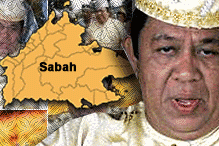
The Philippine government has recognised Sulu Sultan Esmail Dalus II's announcement over the weekend that he will 'drop' the suzerainty claim to Sabah since it is 'complicated'.
The Philippine government has recognised Sulu Sultan Esmail Dalus II's announcement over the weekend that he will “drop” the suzerainty claim to Sabah since it is “complicated”.
But instead he will press ahead for the restoration of his property rights to the oil and gas rich state in North Borneo, according to a report yesterday in the Philippine Daily Inquirer .
The report also quoted the sultan as saying that his claim for the restoration of his property rights will be pursued regardless of the territorial dispute between the Philippines and Malaysia over Sabah.
In effect, the sultan has effectively washed his hands off the Philippines claim to Sabah which is ostensibly based on the Sulu sultan transferring his suzerainty over Sabah, as with the Sulu sultanate, to the Republic of the Philippines.
 The sultan is basing his claim on the Sandakan High Court decision of 1939 by Chief Justice of Borneo, CFC Macaskie - in the matter of Dayang Hadji Piandao Kiram of Jolo, Philippines and Eight Others vs the Government of North Borneo which re-affirmed the sultanate’s right to the payment of yearly lease monies which now stands at RM5,300 “and which Malaysia has never failed to pay so far”.
“I am getting old and the wait is too long and so I have decided to sign development contracts with some legitimate foreign companies to develop our property (Sabah),” said Esmail in a speech at the Manila Pavilion Hotel in Manila on Saturday. “We will develop the oil and gas reserves of Sabah.”
The sultan has sent copies of the development contracts and agreements he has signed so far with the foreign companies, along with a copy of the 1939 Sandakan High Court ruling to Prime Minister Abdullah Ahmad Badawi.
“We mean to exercise our rights as stipulated by the British (Sandakan) High Court of Borneo in 1939,” said Esmail.
Maintaining law & order
The sultan’s son and royal commerce secretary, Abdula Kiram, reiterated: “We will exercise ownership (of Sabah) regardless of which government (Malaysia or the Philippines) owns (Sabah).”
Abdula added that the sultan of Sulu “will not question the suzerainty over Sabah because it is complicated” and lamented the fact that “Malaysia was only paying a measly sum every year for the lease of Sabah when the state is generating US$10 to US$12 billion a year for the Malaysian government.”
In the same forum, the sultan disclosed that he will tap private security agencies to maintain law and order in Sulu.
 “The sultan of Sulu and North Borneo (Sabah) has decided to tap quasi-government security and peacekeeping agencies to foil any attempt by terrorist and kidnap groups to use the sultanate’s regions for ransom activities,” said the sultan.
“Lawless groups using the regions of Sulu in sowing terror, send a negative signal to would-be investors in the region.”
In July last year, according to a report carried by The Star, nine heirs to the Sulu sultan announced that they were dropping their claim to Sabah. The nine heirs – not the original nine but their children - reportedly share the annual payment of RM5,300 being paid by the Malaysian government.
Datu Omar Aki Datu Backtiyal, a Malaysian, was reported in a local newspaper as saying that he had obtained the signatures of all the nine heirs of the late Sultan Mohamat Jamal Al Alam to relinquish their claim last year.
Annual lease monies
Apparently, he has written to the Malaysian government on the matter and is still waiting for a response. It is not known what they expect from the Malaysian government in return for dropping their claim.
The Philippine Daily Inquirer reported on Oct 8 last year that the heirs want the annual lease monies to be revised to US$500 million in return for dropping the Sabah claim.
In any case, the Sulu sultanate, which the British Colonial Office claimed died out without leaving a male heir, cannot pursue the Sabah claim since it had earlier claimed to have transferred suzerainty of Sulu and North Borneo to the Philippines.
It is also not known whether Sultan Esmail Dalus II is one of the nine heirs who were first mentioned in the 1939 Sandakan High Court ruling. But he has denied claims by Datu Omar as untrue.
 Senior lawyers in Kota Kinabalu, familiar with the 1939 Sandakan High Court ruling, warn that “the Sultan of Sulu establishing property rights over Sabah is fraught with even greater complications than the question of suzerainty”.
“Malay and Muslim sultanates in Southeast Asia have traditionally not been territorial in the western sense of the term,” pointed out one senior lawyer.
“These sultanates are kerajaan sungei (river governments); confined to collecting toll from any commercial and transportation activities that move along the rivers and confined to the riverine communities."
Just a matter of semantics
When the communities moved – if the sultan was too oppressive, for example – the sultanate moved as well to tend to the spiritual needs of the ummah (faithful).”
Justice Macaskie himself has been cited as saying: “Now as regards the cession – of course, the cession by the Sulu refers only to parts of the East Coast you know – the question whether the cession agreement was a lease or an outright grant is really just a matter of semantics. What must decide is the wishes of the people.”
Historical records show that in 1865, the United States Consul to Brunei, Claude Lee Moses, obtained a 10-year lease for the territory of North Borneo from Brunei. However, post-Civil War United States wanted nothing to do with Asian colonies, so Moses sold his rights to the Hong Kong-based American Trading Company.
 Besieged with financial difficulties, the company sold its rights to the North Borneo Consul of the Austro-Hungarian Empire in Hong Kong, Baron Von Overbeck. Von Overbeck managed to get a 10-year renewal of the lease from the Temenggong of Brunei, and a similar treaty from the Sultan of Sulu on January 22, 1878.
To finance his plans for North Borneo, Overbeck found financial backing from the Dent brothers - Alfred and Edward Dent. However, he was unable to maintain his government in the territory. Von Overbeck withdrew in 1880, leaving Alfred Dent in control. Dent was supported by Sir Rutherford Alcock, and Admiral Sir Harry Keppel.
In July 1881, Alfred Dent and his brother formed the British North Borneo Provisional Association Ltd and obtained an official Royal Charter on Nov 1 in the same year.
Sold to Colonial Office
In May 1882, the British North Borneo Chartered Company replaced the Provisional Association. Sir Rutherford Alcock became the first president, and Alfred Dent became managing director.
In spite of some diplomatic protests by the Dutch, Spanish and Sarawak governments, the British North Borneo Company proceeded to organise settlement and administration of the territory.
The company subsequently acquired further “sovereign and territorial rights” from the Sultan of Brunei, expanding the territory under control to the, Putatan river in May 1884, the Padas district in November 1884, the Kawang river in February 1885, the Mantanani islands in April 1885 and additional minor Padas territories in March 1898.
In 1888, North Borneo together with Sarawak and Brunei became a protectorate of Great Britain. Its administration however remained entirely in the hands of the British North Borneo Company, with the crown reserving only control of foreign relations.
Unable to repair the war damage after World War II, the company sold North Borneo to the Colonial Office in London for 1.2 million pounds.
There was a short period of British colonial rule for North Borneo, followed by independence on Aug 31, 1963 as Sabah and entry into the Federation of Malaysia two weeks later on Sept 16, 1963.


Are you sure you want to delete this comment?
This action cannot be undone.