




Give S'wak advance payment for 10th Plan: Taib
Sarawak strongman Abdul Taib Mahmud, already three decades in office, wants the 10th Malaysia Plan funding to be brought forward and injected into the current 9th Malaysia Plan.
Sarawak strongman Abdul Taib Mahmud, already three decades in office, wants the 10th Malaysia Plan funding to be brought forward and injected into the current 9th Malaysia Plan.
This, in the opinion of the chief minister, will help cushion Sarawak from the contagion effects of the financial tsunami and economic crisis currently sweeping the West and Japan.
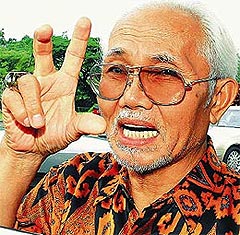 “Some of the programmes in the 10th Plan can be expedited. Already, Sarawak has a few billion ringgit waiting in the 9th Plan which should allow bringing forward some of the infrastructure works contained in the 10th Plan into the 9th Plan,” said Taib.
The veteran politician presides over one of the poorest states in Malaysia despite its timber, oil and gas wealth.
“I have a feeling that we can counter the effects of recession by having a good plan. That is my hope of how we can make the effects of the economic slowdown to be not as bad for Sarawak,” he said.
The chief minister was voicing out his thoughts when opening the briefing and panel discussion at a forum: “Towards sustained economic growth to counter global economic slowdown”. The event was jointly organised in Kuching yesterday by the Economic Planning Unit in the Prime Minister’s Department and the Sarawak state government.
Public sector investment
The thrust of Taib’s remarks was that the global economic recession may defy predictions to last for as long as three years and not the widely anticipated 18 months to two years. He admitted that he was painting a worst case scenario.
He pointed out that “there’s nothing much we can do (to counter economic recession) except through public sector investment”.
He conceded that it was inevitable that some sectors like the export sector would bear the brunt of the current economic slowdown “but even in this sector the pain would be temporary as the state government had laid down programmes offering investment opportunities capable of generating sound returns later”.
He held up the Sarawak economic corridor, SCORE (Sarawak Corridor of Renewable Energy), as the kind of approach that will ensure there is a foundation for sustainable development for the next few years.
Investments in SCORE were not only sound but of a long-term nature and not requiring the generation of any revenue until 2013, claimed Taib.
In the initial stage, the emphasis in SCORE is on construction and laying out the necessary infrastructure for the heavy industries that have been planned.
Decline in tourist arrivals
For SMIs (small and medium-scale industries), he suggested that “what was needed was to calculate what kind of investments they could make, alternative or new, that would not depend so much on the market at least for the next two years”.
“Malaysians banks are still supporting the SMIs and this brings hope to the people,” said Taib.
 Overall, Taib noted that Sarawak had suffered “a bit” mainly in the electronic industry, the retail trade, a decline in tourist arrivals and plunging commodity prices.
Still, he described the situation in the state as not so bad when compared with countries like the US, UK, Europe and Japan.
He said this is due to Malaysia’s high savings rate and the reserves built up over the years and “this should be taken into consideration to give more hope to the people rather than painting a picture of gloom and doom”.
“The private sector needs to be a bit more imaginative and adventurous, take a bit of calculated risk and try to see the economy within its proper perspective rather than be taken in by the news (pessimistic) on television,” urged the chief minister.
Ostensibly, the object of the half-day forum was “to create awareness among the target groups comprising the public and private sectors, industry players, academicians, NGOs, bankers and SMIs on the country’s current economic situation”.


Report this comment
Are you sure you want to delete this comment?
This action cannot be undone.