




Better for gov't to take over Plus
UEM Group Berhad, the toll concessionaire for Plus, is a wholly-owned subsidiary of Khazanah Nasional Berhad. Taking into account Employees Providence Fund (EPF) and Khazanah, the government has an effective interest of 74% in Plus.
UEM Group Berhad, the toll concessionaire for Plus, is a wholly-owned subsidiary of Khazanah Nasional Berhad. Taking into account Employees Providence Fund (EPF) and Khazanah, the government has an effective interest of 74% in Plus.
Assuming the shareholding structure of the government agencies remains and no additional Plus shares has been issued or converted from bonds, the number of shares in the open market or free float shares amounts to approximately 1,297,514,414 (round up 1.3 billion shares).
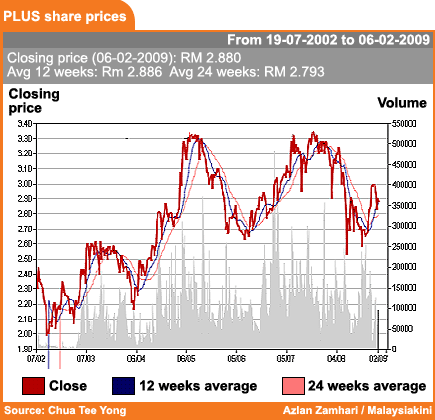
Based on the price chart, the highest closing price for Plus has been below RM3.40. Assuming a share price of RM3.50 to RM4.00 per share is offered for the acquisition of the remainder shares, the total acquisition price is between RM4.55 billion to RM5.2 billion.
The offer price is 21% to 38% higher than Feb 10 closing price of RM2.90 and 3% to 18% higher than the highest closing price for Plus.
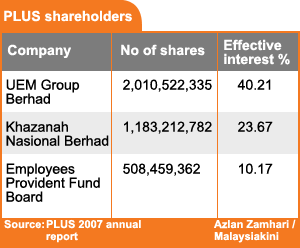 With the acquisition of the remaining shares from the open market, Plus would be delisted as it would not meet Bursa Malaysia’s listing requirements. The remaining shares could be acquired via Khazanah or UEM, and it should not be difficult to obtain a waiver from acquiring the 10% stake from EPF.
Upon completion, Plus is effectively ‘nationalised’ as the government would hold 90% stake, while the public through EPF would hold 10% stake.
Here are the advantages for such an acquisition:
Good returns and avoid ‘leakages’
Based on the recent review of the toll agreement, there have been numerous claims that the agreement are lopsided and only beneficial to the toll concessionaire.
Through the takeover of Plus, the government and EPF would be the ultimate beneficiary. Dividend income or revenue sharing to be received could then form part of the government’s operating budget, or a similar structure to Petronas could be established.
The accumulated profit before tax from financial year 2004 to 2007 is RM4.26 billion, and RM2.08 billion if toll compensations are excluded. Based on media reports, the total cost of construction for the Plus highway is RM5.94 billion.
In short, the return on the highway to Plus is 71% (profit before tax/total construction cost) when the toll compensation is included and 35% if the toll compensation is excluded translating into average return of 17.75% per annum, or 8.7% per annum for the latter, during the four-year period.
Analysing the return on equity (ROE) (profit before tax/shareholders equity) would indicate that the business is viable as the ROE is ranging from 22% to 24% inclusive of toll compensation and 10% to 13% if toll compensation is excluded. Profit before tax is used in the calculation for easier computation as income generated through the concession is tax exempt hence taxation has minimal impact.
As Plus is guaranteed to be profitable through the various terms and compensation, the acquisition of the remaining shares would not be detrimental to the government. Currently the benefits of Plus is also shared with 25% minority shareholders and any major decision taken would require the board to take into consideration the welfare of the minority shareholders.
No need for toll hike every 3 years
The concession agreement was signed in 1988 and it is for 50 years, ending in 2038 unless there are extensions.
The toll rate currently is set at 14.96 sen per km and by 2038 the toll rate is expected to double to 29.16 sen per km. As Plus is listed and have minority shareholders, waiver or reduction of contracted toll increase would pose some problems.
 Furthermore, Plus is expected to increase the toll rate in January 2009 and if the toll is not increased, the compensation expected to be paid by the government is approximately RM180 million.
However, with the acquisition of the remaining free float shares from the market, the shareholders of Plus would comprise of the government and EPF. With only two parties holding the stake in Plus, the impending decision of toll increase every three years can be waived or minimised.
From the financial aspect, if you analyse the profit-and-loss statement of Plus for the financial year 2004 to 2007, it indicates that Plus have generated a profit of RM400 million to RM600 million yearly even if the gross compensation from the government for not increasing the toll is excluded.
Meanwhile, the cash flow generated from operations excluding any receipt from government compensation for not increasing the toll is RM1.1 billion to RM1.4 billion yearly from 2004 to 2007.
This clearly shows that if Plus is taken over by the government and EPF, the possibility of waiving toll increase can be carried out both financially or legally. Even if there is a toll increase, it would not be based on contractual rates but more to sustain operations of the company and for loan repayment purposes.
How compensation owed to Plus could be used
The latest quarterly reporting figures show that the government owes Plus RM1.7 billion as at Sept 30, 2008. If the amount is being fully paid, the government has a few options:
- The amount can be used to pare down debt and hence reduce interest cost. Any savings in interest cost can be channelled back to reduce debt. Based on the financial results for Sept 30, 2008, the calculated interest rate per annum is approximately 6%. The expected interest savings is RM105 million yearly if the amount received is channelled towards repayment of debts.
- Distributing the repayment of RM1.7 billion to shareholders of Plus. The distribution through dividend or capital repayment based on the new shareholdings structure would be RM1.5 billion to the government and RM170 million to EPF.
The dividend received would reduce the acquisition price of the government to RM3.02 billion (RM4.55 billion - RM1.53 billion) assuming offer price RM3.50 per share and the bumper payment of RM170 million to EPF can be distributed to the contributors.
Lower toll rates possible in future
As at Sept 30, 2008, the long-term borrowings of Plus amounts to RM9.4 billion and the dividend announced for financial year 2007 is RM700 million. If yearly dividend announced and received is assumed to RM700 million and the entire amount is channelled for repayment of debts, Plus can settle the long-term borrowing in 14 years based on this financial results.
There should not be any problems on short-term borrowings as the cash and cash equivalent of the company as at Sept 30, 2008 is RM2 billion while the current liabilities is RM1.3 billion.
With the reduction in borrowings, the cash flow savings and expenses is estimated to RM454 million yearly based on 2007 financial figures. This would reduce the cost of operations of Plus and hence a reduction of toll fee is possible.
Easier implementation of ‘people friendly’ measures
As the shareholders are only the government and EPF, decision making would be faster and new measures can be implemented to assist the people:
- Providing a SmartTAG with Touch ’n Go card for every vehicle.
The cost of each SmartTAG with Touch ’n Go card is assumed to be at RM75 and the deposit for the tag is RM20. The initial capital cost for providing SmartTAG would be high but if the distribution is done in stages, this would alleviate the strain on the company.
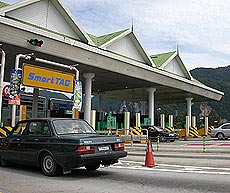 The implementation of all lanes using SmartTAG would also reduce the company’s staff cost and overhead (air conditioning at workplace, cashier machine) for ticket collection and receipt of money. The staff can be transferred to other departments like setting up top-up counters at rest stops for easy reload or for administrative work.
In the long run, it would beneficial for the company as providing the SmartTAG would be ‘one-off expense’.
Assuming there are 15 million registered vehicles on the road and if vehicles maintains an average balance of RM50 monthly, the total amount cash in advance received by Plus would be approximately RM750million!
Not only this improves the cashflow of Plus, on a daily basis the company would be able to earn interest income of approximately RM61,000, or RM1.8 million per month, assuming interest rate is 3% per annum.
- Providing discount during non-peak periods
Plus has announced some travel incentive package effective Jan 1, 2009, which includes a 10%+10% discount for off-peak travel during festive season and travelling done between midnight and 7am as well as a 5% rebate for heavy electronic toll-payment users.
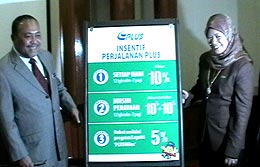 The expressways involved are NSE, NKVE, FHR2, SPDH and Elite. Calculations by Aseambankers indicate minimal impact from these incentives. As it is only for a two-year period, total earnings loss is about RM40 million. The 5% rebate would translate into a “revenue loss” of just RM2.6 million annually.
Hence, as a gesture of goodwill, with the takeover of Plus, the government could vary the discount provided or offer more incentive accordingly to control traffic during festive period instead of limiting only to midnight which has poses many health, security and safety issues.
- More efficient tag reader and tag lanes
With SmartTAG being the official tag reader for all highways, it is still a puzzle that a lot of road users find the tag still prone to error reading which cause long queues, especially during peak hours.
Some funds should be allocated to provide SmartTAG readers and SmartTAG lane that are both efficient and effective similar to Singapore and London, whereby cars do not need to slow down to enable the tag to respond.
We are always proud of Malaysia’s technological advancement hence problems like this should not exist and should have been resolved especially since SmartTAG is the designated tag used for all highways.
In summary, by acquiring the remaining shares of Plus, the government and EPF being the shareholder of Plus would be able to establish policies and measures to ensure that the rakyat are not burdened due to legal requirements and avoid the government from incurring additional toll compensation every three years.
Politically it would create transparency and at the same time mitigate some of lopsided terms in the concessionaire agreement.
 CHUA TEE YONG is the MCA member of parliament for Labis. A chartered accountant, he is former chief financial officer of a government-linked company.


Report this comment
Are you sure you want to delete this comment?
This action cannot be undone.