




Russia remains the hungry bear
Russian leaders have from time immemorial divided foreign and security policy into two areas: far off and uninteresting posts like the United Nations or Argentina - and the countries surrounding it, the interesting part - the ‘near abroad’. Of course a country with such a long frontier could be nervous, and the way Russia - and the penultimate Soviet Union - assuaged its fears was to expand.
 According to Harvard’s Richard Pipes, it expanded from mid-seventeenth to mid-twentieth century at a rate that equaled the annual acquisition of land equal roughly to that of today’s Netherlands.
In 1980 just after Ronald Reagan’s election, a think tank in Philadelphia held a semi-official meeting with Moscow’s foreign policy elite, starting with Yuri Arbatov, the head of the USA Institute.
Russian leaders have from time immemorial divided foreign and security policy into two areas: far off and uninteresting posts like the United Nations or Argentina - and the countries surrounding it, the interesting part - the ‘near abroad’. Of course a country with such a long frontier could be nervous, and the way Russia - and the penultimate Soviet Union - assuaged its fears was to expand.
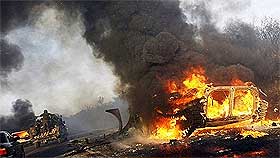 According to Harvard’s Richard Pipes, it expanded from mid-seventeenth to mid-twentieth century at a rate that equaled the annual acquisition of land equal roughly to that of today’s Netherlands.
In 1980 just after Ronald Reagan’s election, a think tank in Philadelphia held a semi-official meeting with Moscow’s foreign policy elite, starting with Yuri Arbatov, the head of the USA Institute.
Mr. Arbatov responded to our challenge - that Moscow was acquiring a vastly greater strategic military force than what America possessed - by saying that Moscow faced hostility along all its borders. China bristled with might along that border, all the European states disliked it, and on its southern border there were hostile regimes. He contrasted this with the unarmed and peaceful boundaries the USA had with Canada on its north and Mexico on its south. One of us responded, “If you treated your neighbours the way we do, you wouldn’t be facing enemies on your borders.”
Mr. Arbatov wasn’t amused.
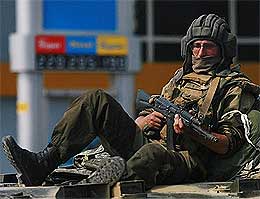 A great 19th century Russian foreign minister once said that his country expanded into neighboring territories to bring them the benefits of Russian civilisation and culture, but the problem was that there would soon be trouble on the new, expanded, boundaries, ‘forcing’ Russia to expand into a yet-deeper band of countries. The “problem,” Prince Gorchakov said, was “knowing where to stop.”
Now they are at it again, trying to regain some of the power that was stripped away in 1990-91 when the Soviet Union fell apart and those satrapies became ‘independent’ sovereign countries. But not quite; they’ve all been nervous that that old Russian habit of expanding into the ‘near abroad’ would spring back.
Rubbish excuse
Enter Vladimir Putin, the man of steel. He made his political fortune by pulling his boss’s Chechnyan chestnuts out of the fire with a ferocious and bloody suppression. So this past week he serenely enjoyed the Olympic opening while his minions justified their similar incursion into Georgia, an ancient culture and nation.
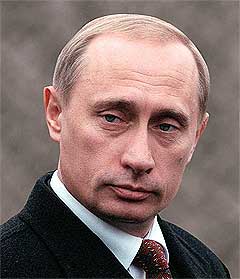 But Chechnya was within the new Russian borders; Georgia is not. The excuse of protecting Russian ‘peacekeepers’ in Ossetia is, as the young Georgian president Mikheil Saakashvili said, “rubbish.” You don’t need to bomb a major city deep within Georgia to protect ‘Russians’ (often Ossetians quickly provided Russian passports) who live near the Russian border with the unsettled province.
So all that lavish love offered to America in recent years, returned in rhetoric, goes wasted. It wasn’t just the Olympics that diverted world attention from the Georgian problem. A fatally weakened American administration has been so obsessed with Iran and Iraq that it had no extra will to explain to Mr. Putin that invading other people’s countries has consequences.
Where will Mr. Putin stop? My guess is that he will act like the ‘peacekeeper’ and stop at Ossetia - for now. He has gained his real goal, which was never protecting Russian ‘peacekeepers’ in North Ossetia. His obvious goal was to scare the wits out of all of Russia’s neighbours. Which one of them now will dare take a step closer to NATO? Doing so might well bring a new sprinkling of Russian passports to locals along all the other borders, in dissident provinces that characterise all the boundaries in that part of the world.
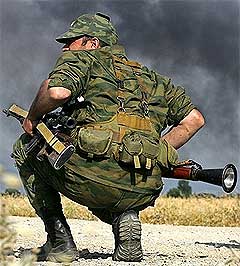 And along with the new passports would come yet another re-enactment of the old game of nations played so successfully by Russia in colonising that part of the world in the 19th century.
What can NATO or the US alone do? It’s too late. Russia isn’t going to back down and it has the massive military might to stay just where it is. The world will have to wait for the election in America of a strong new president who can match in will the new Russian Tsar.
W SCOTT THOMPSON is a national security expert who served four American Presidents and is a professor emeritus at the Fletcher School of Law and Diplomacy. He is the author or editor of 13 books on world political issues and resides in Washington, Bali and Manila.


