




Ustaad Zakir Hussain unplugged in Singapore

Ustaad Zakir Hussain is one of the most charismatic musicians of India. Once a musical prodigy, he started his musical journey at an early age with his father - the late Ustad Alla Rakha who, with Ravi Shankar, introduced Indian classical music to the West.
 I had seen Ustaad Zakir Hussian acting in movies, or playing the tabla on TV, or promoting Taj Mahal tea in commercials. But nothing beats the experience of meeting the man in person.
January 8. Sunday. Noon. I reach the New Age Indigo Bar in Boat Quay braving the incessant rain. Singapore's trademark view of the central business district, with fabulous skyscrappers by the side of the Singapore River, looks like a cut-out from Roberto Rodriguez's Sin City. The touristy bum-boats are licking the riverfront, the river's huge belly unusually shorn of anything afloat. It's lunch time on a Sunday but the often-busy promenade, chock-a-block with restaurants offering all kinds of international cuisine, is empty like the mood-evoking scene of the wilderness from a Western. On his way to the Princeton University, where he is going to teach a survey course on music in the fall semester to the students of fine arts, Ustaad Zakir Hussain has stopped by at Singapore to talk to the media about his forthcoming concert.

Ustaad Zakir Hussain is one of the most charismatic musicians of India. Once a musical prodigy, he started his musical journey at an early age with his father - the late Ustad Alla Rakha who, with Ravi Shankar, introduced Indian classical music to the West.
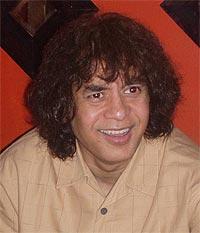 I had seen Ustaad Zakir Hussian acting in movies, or playing the tabla on TV, or promoting Taj Mahal tea in commercials. But nothing beats the experience of meeting the man in person.
January 8. Sunday. Noon. I reach the New Age Indigo Bar in Boat Quay braving the incessant rain. Singapore's trademark view of the central business district, with fabulous skyscrappers by the side of the Singapore River, looks like a cut-out from Roberto Rodriguez's Sin City. The touristy bum-boats are licking the riverfront, the river's huge belly unusually shorn of anything afloat. It's lunch time on a Sunday but the often-busy promenade, chock-a-block with restaurants offering all kinds of international cuisine, is empty like the mood-evoking scene of the wilderness from a Western. On his way to the Princeton University, where he is going to teach a survey course on music in the fall semester to the students of fine arts, Ustaad Zakir Hussain has stopped by at Singapore to talk to the media about his forthcoming concert.
Busy man
The setting for the meeting is quite Indian - a bar with low-lying drum-shaped seetees, stools and wooden benches, overlooking the Singapore River. Dressed in a safari suit, Zakir walks into the room and fills it with his charm. "Thank you for coming here on a rainy day," he says, thanking everyone personally and shaking their hands warmly. Soon we are all seated and the Ustaad starts talking - it all looks like a scene from a gurukul , the sagacious teacher sharing his wisdom with his disciples, who are huddled around him with keen eyes and ears. As he speaks, questions come up which he answers eagerly. With his teaching assignments, does he get time to do 180 concerts a year? "That used to be in my younger days, when I was carefree and rash," says the maestro with a smile. "Now I manage to do about 120 a year."
Still impressive. But apart from teaching and holding concerts, what does he do? He composes music for films and other international projects. Currently, he is composing music for a film, The Goddess , starring Tina Turner. He has also been commissioned to do the opening score for the National Symphony Orchestra. In the past, Zakir scored the soundtrack for Little Buddha (Bernardo Bertolucci) and The Fifth Element (Luc Besson) and co-created and produced his 1992 Grammy winning album Planet Drum with Mickey Hart from the veteran rock band, The Grateful Dead. He also co-composed the opening music for the 1996 Atlanta Olympic Games.
But what about Bollywood? Doesn't he compose music for Indian films too? He does but his involvement is limited. He takes small projects such as the one he did for the actor-director Rahul Bose for his film Everybody Says I'm Fine . In the recent years, he also composed music (and acted opposite the veteran actor Shabana Azmi) for the film, Saaz (Harmony) and Aparna Sen's acclaimed film, Mr. and Mrs. Iyer.
Someone asks him why a great musician like him should restrict himself to small productions at home? "Because they are planned," he says with a straightforward look. "When you have a small production, it is all planned from day one. So I am told six months ahead, then I can make the time." On the contrary, big banner films are too taxing for him. "When you have big productions such as a Yash Raj film or a (Karan) Johar film, you are at their beck and call all the time." Naturally, he doesn't have that kind of time on his hands.
Indian Music is at the limit of its popularity
From Hollywood and Bollywood, his talk moves on to the next theme: has the world been exposed to all the great music that India has?
"The whole world is interested in Indian music today," says Zakir. "It is a sound source for a lot of music."
"There is a lot going on in Hollywood; they are looking at other musical sounds to embellish whatever exists now, which I think has become very monotonous and dull," he opines. "There is this need for the Western world to tap into sounds which are mythical, mystical, magical and mysterious."
He thinks that all musical sources should co-exist. And his group, Table Beat Society brings people to the source.
So, what does he think about the popularity of Indian music today? Where do we go from here? Popularity and recognition, yes, they are there but, he says, Indian music has reached the limit of its popularity.
A few journalists, who are still not done with Bollywood, succumb to its charm again. Questions pop out.
"Bollywood music is a creative area with no boundaries," Zakir replies. He praises talented musicians such as AR Rahman and Salim Merchant (of the Salim-Sulaiman combo), who have successfully fused Indian classical music with Western styles.
"You can hear a classical Indian song with a rock beat to it. A classical Indian musician would never think - on pain of death - of doing that," he says, to the amusement of his admirers.
But knowing the basics was important, he emphasizes. "All musicians need to know the basics of music." Rahman and Salim are able to do it because they are aware of the fundamentals of Indian classical music, he says.
On the other hand, what are the classical musicians doing? "We are preserving the basics."
That is also important. While others experiment and play with the boundaries of the music, some need to preserve the basics.
So, what else is happening with the classical musicians? Is there a change in the classical musicians of the old and new generation?
Yes. There is. For example, he says, today's drummers are complete musicians. They know about other musical instruments too, and that's why, they are able to successfully collaborate with other musicians. Then, if the job of the Indian classical musicians is to preserve the basics, how does he see his contribution to Indian classical music, especially in the context of his fusion music?
"I have taken Indian music as far as possible," he says, with an incredible humility.
In fact, he has done more than that. He has been discovering new talent and showcasing them to the world. For example, he discovered a group of fabulous Manipuri drummers about two years ago. These drummers combine drumming and acrobatics in a unique fashion, hitherto unseen. He has presented this group of musicians to the world to great applause.
Another of his discoveries is the dholki-player Vijay Chauhan. He found him playing nautanki music in a village fair in Maharashtra. When he presented him to the musicians in Bombay, they were bowled over by his talent. Vijay, since then, has become a part and parcel of Bollywood music. One of his famous songs is the "choli ke peechhe kya hai" number in Subhash Ghai's film, Khalnayak.
Evolution of the Indian classical music
We come back to the topic of Indian music's worldwide popularity. And he patiently explains the nuances of Indian classical music as we know it and how it has evolved over the decades.
Indian classical music is not stadium musicit is chamber music. Yet today, it has become very popular. In fact, it is at the height of its popularity, he says. Earlier, music was only for connoisseurs. The rich patrons knew all the ragas and were musically educated, and they demanded the musicians to play a certain raga at certain times, depending on the vagaries of their mood. After the nawabs and rajas disappeared in India, musicians took the music to the masses who were not aware of the finer points of music. "That's why it took time for Indian musicians to develop the stagecraft to work with the audience," he says. "Indian classical music is very young as a stagecraft," Zakir expounds. The stagecraft developed in the 1940s and 1950s.
Today, there is greater awareness about music and musicians. And this true about all kinds of music, not just Indian classical music. "There is a sort of renaissance of arts," he says. "Indian music, along with other things Indian, is getting recognition. The same is true about the art and culture of other countries such as Japan, China, and Indonesia, among others."
"Media is also increasing the understanding of art and culture in society. Also, because of internet, the audience knows about our performance, our style, our achievements, and therefore, we don't have to bend too far (to communicate with them)."
He points out an interesting characteristic of Indian music. "Compared to Western music, where everything is written down, Indian music is fresh," he says. "It allows every generation to inject its own two bits."
Zakir's Inspiration
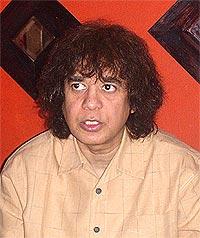 Starting out at the age of two or three, and touring by the time he was 12, Zakir has come a long way. Today he is regarded as an international icon of world music. He has wowed the audiences the world over with his mastery over both the traditional and innovative forms of music. His innovative offerings like Shakti, Diga Rhythm band, Tabla beat science have helped him carve a unique niche for himself in the world music scene.
So, what has been his source of inspiration for the kind of music he has developed?
"Every instrument has a spirit," he says. The genius of music comes from the ability to discover that spirit hidden inside the instrument and commune with it. "Though my father taught me how to play the tabla and I learnt all the ragas from him, one day, I asked the tablawhat do want to say? From there my tonal odyssey began."
Personally, he admits being inspired by other musicians. For fusion music, "inspiration came from Giovanni Hidalgo," one of the greatest Latin percussionists of our time. Today, Hidalgo is part of his ensemble.
One of us is curious to know about the term "fusion music." How did he coin that term, if he did it at all? After all, his album, Shakti, was the world's first fusion music album.
"World music or Fusion music or New Agethese labels are created by record companies so they can put a label on the shelves," he says with his characteristic ease. "We as musicians are not to be blamed for these terms." We all break into laughter.
"I think I have spoken enough," he says and gets up from his seat. Meanwhile, he has finished a cup of coffee and a plateful of his favorite gol-gappas are waiting for his attention. We let go of him for a quick TV interview. I wish him farewell and come out singing in the rain.
Endnote
Ustaad Zakir Hussain held a major show, "Kaleidoscope of Rhythms" (World Fusion Music), on Feb. 5, 2006 at the Espalanade Concert Hall, Singapore. The show also featured percussionists and musicians such as Terry Bozzio, Giovanni Hidalgo, U Shrinivas (Mandolin), Fazal Qureshi (Tabla), Salim Merchant (Keyboard), Vijay Chauhan (Dholki), and Kala Ramnath (Violin). Those who missed the Singapore show can still catch the ensemble at Bombay and Dubai around the same time.
ZAFAR ANJUM works in Singapore and writes fiction in his spare time. He has a blog, DreamInk .


Report this comment
Are you sure you want to delete this comment?
This action cannot be undone.