




'You'll be right, mate,' so says the Aussie to foreign students
Imagine a Malaysian-Chinese/Indian/Malay student being served at a counter by a white Anglo-Saxon Australian. Different accents. Odd inflections. Visual deflections. Innocuous mixed body language. You often see these mis-cultural transactions at immigration checkpoints, bank counters and supermarkets, second-hand car yards and real estate agencies in university towns.
Imagine a Malaysian-Chinese/Indian/Malay student being served at a counter by a white Anglo-Saxon Australian. Different accents. Odd inflections. Visual deflections. Innocuous mixed body language. You often see these mis-cultural transactions at immigration checkpoints, bank counters and supermarkets, second-hand car yards and real estate agencies in university towns.
The evasive eye contact by the ‘Asian' when asked a direct question often perplexes the Aussie when no direct answer is forthcoming when a polite nod may mean ‘no' or ‘yes' while a courteous ‘no' can mean ‘yes'. Ah, the inscrutable ‘Asian'.
To Mr Wong, Muthu or Ahmad the direct tone of voice and index finger calling by the Aussie often feels like racial intimidation and cultural disrespect. Racist! But, hang on, that was how Aussie Joe hollered his mate, John, a moment ago. No offence meant actually. Ah, the Aussie penchant for raw wit. You see it on Australian television all the time - those hilarious irreverent caricatures of puffed-up celebrities and populist politicians - even the Queen. Indeed, there are no sacred cows in the Australian public space.
 Because Aussies don't take themselves too seriously are generally not easily offended - they give as good as they get - they treat others no differently to how they treat their ‘mates', when perhaps more tact and sensitivity is needed. Which partly explains the mixed signals that foreign students get when they arrive in Sydney - many of them leaving their comfort zone for the first time.
Indeed, Malaysian students had to learn and acculturate to the Aussie social rules in a very short time - in fact, right after clearing immigration at Sydney airport - to reorientate to the dialectical learning environment and free-spirit social space in Australian universities.
Stereotyped perception of race
 Differences in languages and social cues can create uncertainties in interaction between the ‘staid yet loud Asian' and ‘laid-back yet boisterous Aussie'. Stereotyped perception of race inevitably comes into the equation - although local Aussie students are generally indifferent towards foreign students. Some would choose - if they have a choice - not to be assigned to do group assignments and class presentation with ‘Asian' students. I know because I teach them.
"It's not racial. It's just that I find it hard to communicate with them," says an Aussie student.
"It's hard to work with local students. They don't turn up for meetings, and they talk too fast," so says the Asian.
At this time of the semester where part of the final assessment is based on class presentations, I see this tension in lecture theatres and along the corridors. Many Aussie students have no personal experience with ‘Asian' students. Many Asian students likewise are close-knit groups - and have not visited an Australian home in their four years of studies.
What we see in Malaysian universities where foreign students ‘keep to themselves speaking their own language' we see on Australian campuses. Student associations fly their respective country flags. Thus, the Malaysian Student Association has its annual barbeque, ‘nasi lemak' and Aug 31 celebrations in Wollongong beach. Students from China, Hong Kong, Pakistan, India, and until recently from the Middle East have frequent weekend social meals - yes, it's all about food but little ‘grog' (‘Aussie' term for alcohol).
 No white-Aussie faces in the crowd though. Likewise in the mainly white student socials of grog and booze, the ‘Asian' face is rare except for a few Australian-born-Asians who find the ways of the overseas ‘Asian' student are as alien as the foreign student finds the ‘Aussie' way discomforting.
Universities see foreign students as revenue generators. For context, in 2007 out of a total of 22,237 students in University of Wollongong, where I teach journalism, about 40 percent were internationals. The main revenue comes from the course fees. International students pay more than double what domestic students pay for studying the same subjects and receiving the same study notes.
An undergraduate accounting degree for an international student costs about A$19,200 (RM55,093) per year. A domestic student pays A$8,677. An undergraduate engineering degree costs an international student about A$22,272 per year. An Aussie pays A$7,412.
The lower domestic fees come about because the Australian government contributes about three-quarters of the total tuition for Commonwealth-supported domestic students who pay a "student contribution" to cover the remaining costs for one year of full-time study. Foreign students are not subsidised nor do they get the benefits of bus and rail concession travel cards that domestic students do.
Foreign students bring in the dollar
Nearly half of the operating budget of universities is spent on marketing and foreign student recruitment. Universities have also introduced cross-cultural orientation programs to help foreign students settle in.
Professional development programmes help university staff understand the needs of international students. Indeed, foreign students bring in the dollar. Which explains the recent wake-up call to the state and federal governments and university administrators when Indian students, Indian cabbies and Indian permanent residents had a mass sit-in in Melbourne city on May 29 after a series of assaults and robberies on ‘their people', the most recent was a student party gate-crashed by a group of local teenage yobos.
 The Indian media gave the mass sit-in prime space. The Australian Prime Minister Kevin Rudd had even sent a message to the Indian Prime Minister Manmohan Singh, condemning the attacks and assuring the security of all Indian residents and students in Australia.
The Federation of Indian Students of Australia (FISA) said the attack was racially motivated and could have serious repercussions on the $3.5m Australian education industry. Police in Victoria, however, eschewed the race factor. They said the assaults and robberies were few among the many in Melbourne.
The Indian student community, understandably, believes the assaults on their people are racially motivated. However, the general public sentiment is that the student victims were unfortunately at the wrong place - mostly along deserted streets - at the wrong time, mostly in the evening walking home after classes. Many of the victims just happened to be foreign students who did not report these cases for various reasons - from unfamiliarity with local laws to fear of retribution and avoidance of further trouble with more yobbos.
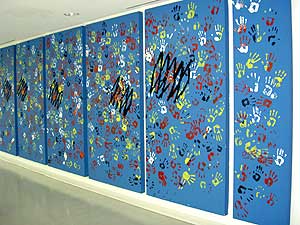 To address this cultural lag, universities have introduced "international weeks to celebrate cultural diversity" on campus. University of Wollongong has even come up with a
safety awareness guide for international students
in English and Mandarin.
To address this cultural lag, universities have introduced "international weeks to celebrate cultural diversity" on campus. University of Wollongong has even come up with a
safety awareness guide for international students
in English and Mandarin.
Just in case Malaysian families are worried for their sons and daughters, don't be. Media reports do not often tell the whole story. While foreign students in Australian universities are generally perceived to be isolated close-knit groups and ‘socially shy', Aussies are generally hospitable, samaritans, and happy to give anyone a ‘fair-go'. Racist remarks inevitably do crop up in some places in Australia - just as they do in unexpected places and situations in Malaysia and India. As Aussies say when they face a problem ‘We'll be right, mate!"
ERIC LOO, a former Malaysian journalist, teaches journalism at the University of Wollongong, Australia.


Are you sure you want to delete this comment?
This action cannot be undone.