




Nizar Jamaluddin: Our future PM?
If people are unconvinced by Mohammad Nizar Jamaluddin's passion for politics, then they would have been converted after his short talk. He was engaging, humorous and convincing.
If people are unconvinced by Mohammad Nizar Jamaluddin's passion for politics, then they would have been converted after his short talk. He was engaging, humorous and convincing.
The audience was captivated and although comparisons were made with the other prominent politician in town, Nizar was this audience's preferred candidate. He was full of sincerity and did not have accompanying baggage.
 The ex-MB of Perak gave a talk on ‘The Challenges of Islam and Democracy in Malaysia', at London's Imperial College. About 100 people, mostly Malaysians studying or working in England were packed into this small lecture theatre. Few were Perakians but many were curious to see, what they had heard from others or by what they'd seen on
YouTube
.
The ex-MB of Perak gave a talk on ‘The Challenges of Islam and Democracy in Malaysia', at London's Imperial College. About 100 people, mostly Malaysians studying or working in England were packed into this small lecture theatre. Few were Perakians but many were curious to see, what they had heard from others or by what they'd seen on
YouTube
.
Although Anwar Ibrahim, the other man in town, was the inveterate politician, this crowd's choice was without doubt, Nizar ( right ).
After three successive days of lectures in London by both men, Malaysians were mesmerised by Nizar's oratory skills. He was passionate and unyielding. Were we staring at a future prime minister of Malaysia?
Nizar's delegation included the Titi Serong assemblyperson Dr Khalil Idham Lim and Perak PAS assistant commissioner Dr Asmuni Awi.
Nizar fielded a wide variety of questions from the audience, with topics ranging from his entry into politics, apparently sparked by his desire to correct injustices, to his disbelief when he learnt that marginalised communities had been denied help and basic infrastructure simply because they are of a particular race.
The audience was shocked to learn of phantom voters, around 45,000 of them, or that the police have 2 MyKads. "Why?" asked the crowd. They were stunned to find that village headmen were not chosen by the villagers but were selected by BN. They agreed wholeheartedly with his promise to abolish the ISA and to not interfere with the workings of the highly bureaucratic and oppressed civil service.
Nizar told the audience to reject the idea of race-based politics. Citing verses from the Quran, he repeated the need for equality, establishing trust, earning respect and being just. He gave a different perspective on certain issues that were discussed and later encouraged members of the audience to raise awkward questions, if they wanted to.
Addressing the issues
He was asked about the position of women in society and his views on the Perak exco who said that a woman cannot be a menteri besar. He said Islam has always preached equality between the sexes and called it ‘ridiculous' that the same person who had made racist remarks about the Indians is the one who champions Prime Minister Najib Abdul Razak's ‘1Malaysia'.
With regard to non-Muslims being prevented from using the word 'Allah', he said that there was no provision in the Quran to prevent them from doing so. Nizar charged ahead with his explanation regardless of the watchful eyes and ears of a few individuals who were certain to relay what had been said there, to their masters.
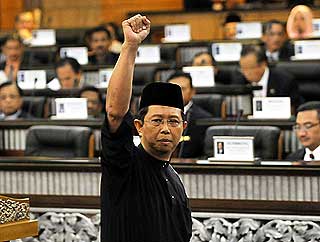 He covered Orang Asli issues; the land-grab and logging quota problems; land titles to Chinese and Malays; election of village heads; water supply to marginalised communities; sabotaging of Pakatan's efforts to lead by good governance; dealing with leap-frogging politicians; how to combat corruption; and much more.
Although he only talked for about 45 minutes, the other three hours were spent fielding questions from this eager crowd. They represented either the best minds of Malaysian students or experienced professionals living in London, some for over 30 years.
They had come from all walks of life and it was their diverse backgrounds that brought interest and insight into the topics of discussion. It was indeed stimulating to see Malaysians engaged in civil conversation with a maturity and sophistication that is sometimes not evident in our own parliamentarians.
When asked what he expected of the crowd, he said: "It would be the greatest tragedy if you were to return and support Umno. With your help, we will restore democracy to Malaysia, for a government that is elected by the people, rather than decided by the court."
It drew strong applause from the crowd.
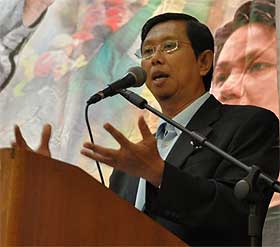 He expressed sadness that the Perak budget was treated with reduced importance, thus corroding investor confidence.
When a South American investor insisted that any disputes had to be heard in a Singapore court, it just showed how tarnished our reputation has become.
He lamented how Malaysians had lost freedom of expression. His said that the session that afternoon to meet, discuss and exchange ideas at a world renowned university was in stark contrast to students in Malaysia who were monitored closely. At a recent gathering of students in Petaling Jaya, they were threatened with disciplinary action for wanting to attend a national university students' congress.
It seemed that we have lived a lie these past 52 years.
And so, it was just like how one observer had noted: "We have got rid of one type of colonialism, only for it to be replaced by another form."


Report this comment
Are you sure you want to delete this comment?
This action cannot be undone.