




Dr M vs LKY Part I: How they're similar
QUESTION TIME These sometimes foes, sometimes mutual admirers who were the longest serving prime ministers for Malaysia and Singapore have much in common - but they are very disparate in some other areas - and therein lies the different contributions they made to their countries.
QUESTION TIME These sometimes foes, sometimes mutual admirers who were the longest serving prime ministers for Malaysia and Singapore have much in common - but they are very disparate in some other areas - and therein lies the different contributions they made to their countries.
The older Lee Kuan Yew, who will be 90 on Malaysia day, Sept 16, was the longest serving prime minister in Asia, ruling Singapore as chief minister from 1959 at the tender age of 36 and then as prime minister from the time it was expelled from Malaysia in 1965, right up to 1990, making in all over 30 years.
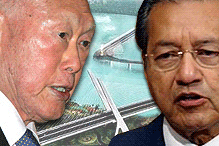 Dr Mahathir Mohamad, a hardline Umno member who played a key role in ousting Malaysia’s first prime minister Tunku Abdul Rahman in the wake of the 1969 riots, climbed rapidly to become Malaysia’s fourth prime minister in 1981, continuing until 2003, for a long reign of 22 years. That’s just three years short of Lee’s reign as prime minister of an independent country of 25 years.
Lee’s latest book, One Man’s View of the World , with pointed barbs at Malaysia, has predictably raised hackles here, especially for Lee’s criticism of Malaysia’s New Economic Policy which sought to favour Malays to improve their economic standing.
Still, Lee shares many similarities with Mahathir, which no doubt contributed to their long reigns as prime ministers of their respective countries, but it is in their differences that some of the things that mattered comes to the fore and show why Singapore has progressed economically far beyond Malaysia and even beyond Singapore’s own wildest dreams.
In this first part we list five similarities between Mahathir and Lee and follow up with five crucial differences next week which help to explain the different stages of economic development. This goes beyond meritocracy and affirmative action, the factors Lee seems to have latched on to.
The similarities
1. They both clung to power resolutely
They both used all means available to them to retain power. In Singapore this even included a system of four Parliamentary representatives for a single constituency to keep the budding opposition at bay. Early in his reign Lee used preventive and other laws to get rid of political opponents who he used to get into the seat of power in the first place.
Mahathir was ruthless against opponents in Umno. When he nearly lost the Umno elections for top post in 1987, he created a new Umno Baru, leaving out his opponents. In 1998, he used the weight of the law enforcement machinery against his former deputy Anwar Ibrahim on trumped up charges of sodomy after Anwar postured against him.
2. They both used the judiciary to stifle dissent
 Mahathir mounted a systematic attack against what was considered a largely independent judiciary in 1987/88, sacking the judicial head at that time, bringing the control of the judiciary under the executive and undermining the integrity of the institution. The judiciary is yet to recover from this assault.
Lee regularly took legal action against political opponents for defamation, silencing them and even bankrupting them with the help of a compliant judiciary. He also took legal action against foreign newspapers and periodicals which criticised him and his administration, forcing apologies from them. He brooked no dissent against his administration of the island state.
3. They both ruled with an iron fist
While they were democratically elected neither paid much attention to other democratic principles, with Lee being much worse than Mahathir. Singapore continues to be one of the most oppressed countries in South-East Asia with not even a semblance of a free press and with dissent being hardly tolerated even to this day.
4. They both can’t let go
Lee stepped down as prime minister in 1990 but remained in the cabinet until 2011, leaving only after the ruling People’s Action Party’s worst ever showing in the general elections. His presence in the Cabinet must have been intimidating and one can reasonably expect that no one would dare to oppose him, especially after his son, Lee Hsien Loong, became prime minister in 2004.
The younger Lee was carefully groomed, indicating elements of nepotism, and while very able, one wonders if he would have become prime minister so fast if he was not Lee’s son.
Mahathir stepped down in 2003 but has incessantly poked his nose into politics and anything else of interest unlike previous past prime ministers. He launched a fierce and bitter campaign to unseat Abdullah Ahmad Badawi who eventually made way for Najib Abdul Razak after a poor showing in the 2008 polls following upon the best ever performance for Barisan Nasional in 2004.
Now, Mahathir is cultivating his son Mukhriz, a not particularly bright politician, who has become chief minister of Kedah after the recent polls. Another son, Mokhzani, is now a billionaire not least because of contracts from Petronas, of which Mahathir is adviser. Mahathir is now a thorn in Najib’s side.
5. They both are racist
Lee, racist? Yes. He has gone on public record to say that the Chinese population in Singapore must be maintained at some 85 percent. Why would he do that if he was not? True to his word and intention, Singapore has imported many Chinese from overseas to keep to this, including those from the mainland, even at the expense of considerable social disruptions such as language and culture.
A group of mainland Chinese in a condominium were reported to have tried to stop other occupants from cooking curry, sparking a sympathetic outcry from other Singaporeans of all races and to even declare a curry day.
Mahathir rose to the political fore via racist politics, expounding some of his thoughts in the controversial but unscientific book The Malay Dilemma which was banned until he came to power in 1981.
As education minister he led the charge to teach all subjects in school in Malay but subsequently overturned it for science and maths subjects just before he stepped down as prime minister. Mahathir’s policy change itself was overturned and the teaching of science and maths went back to Malay and the vernacular languages.
Till this day, Mahathir tries to whip the Malay community into a frenzy by exaggerating fears that if they backed down in Malaysia’s race-based politics, they will become eventual losers in their own land. He has tried to use such methods to keep himself in power previously.
So much for the similarities.
Next week: Dr M vs LKY Part II: How they differ
P GUNASEGARAM is founding editor of KiniBiz .


Are you sure you want to delete this comment?
This action cannot be undone.