




US election shows there is a majority
For all that has been said about President Bush, and how he divides the US right through the middle, it must seem quaint that this time around his re-election was backed by almost the whole of the country except the Californian and New England coasts.
Writing in The American Spectator , George Neumayr, affirmed: "The Democrats at this point are a bi-coastal party, claiming elite, populous pockets on the two coasts, but the rest of the country isn't interested in their effete agenda."
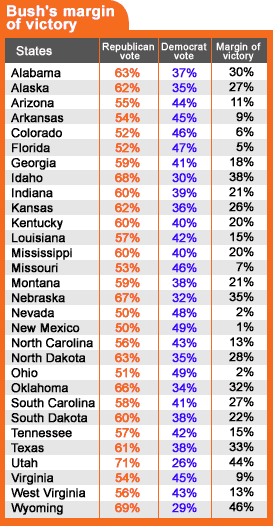
In all the 30 states that he won, his margin of victory in single digits was confined to eight states only. They were Arkansas, Colorado, Florida, Missouri, Nevada, New Mexico, Ohio and Virginia respectively.
In all other states, Bush's re-election was buttressed by a percentage that extended from 11 percent in Arizona to 46 percent in Wyoming (See chart below).
Bush also got three million more popular votes then John Kerry, a vast improvement from his previous performance in the 2000 election.
Thus, despite the negative media which Bush roundly received from the New York Times , The Washington Post , and The New Yorker - not forgetting an open letter from Tun Dr Mahathir himself urging Muslim voters in the US to vote for John Kerry, in addition to the anti-Bush campaign of George Soros that had been going on for more than a year - Bush`s vote totals were the biggest ever.
For all that has been said about President Bush, and how he divides the US right through the middle, it must seem quaint that this time around his re-election was backed by almost the whole of the country except the Californian and New England coasts.
Writing in The American Spectator , George Neumayr, affirmed: "The Democrats at this point are a bi-coastal party, claiming elite, populous pockets on the two coasts, but the rest of the country isn't interested in their effete agenda."
In all the 30 states that he won, his margin of victory in single digits was confined to eight states only. They were Arkansas, Colorado, Florida, Missouri, Nevada, New Mexico, Ohio and Virginia respectively.
In all other states, Bush's re-election was buttressed by a percentage that extended from 11 percent in Arizona to 46 percent in Wyoming (See chart below).
Bush also got three million more popular votes then John Kerry, a vast improvement from his previous performance in the 2000 election.
Thus, despite the negative media which Bush roundly received from the New York Times , The Washington Post , and The New Yorker - not forgetting an open letter from Tun Dr Mahathir himself urging Muslim voters in the US to vote for John Kerry, in addition to the anti-Bush campaign of George Soros that had been going on for more than a year - Bush`s vote totals were the biggest ever.
 Indeed, according to the
Associated Press
, "Bush`s slice of the vote, 51 percent, made him the first president to claim a majority since 1988 when his father won 53 percent against Democrat Michael Dukakis."
Indeed, according to the
Associated Press
, "Bush`s slice of the vote, 51 percent, made him the first president to claim a majority since 1988 when his father won 53 percent against Democrat Michael Dukakis."
Clear agenda
Reflecting on the re-election victory, Vice President Dick Cheney has affirmed that: "President Bush ran forthrightly on a clear agenda for this nation's future and the nation responded by giving him a mandate."
Bush and his Republican party not only improved in the popular vote, but widened their majority too. If anything, Bush's victory ensures Republican dominance of virtually every quarter of the US political system - particularly the White House, Congress and the federal judiciary - for years to come.
As Bush himself confirmed: "I earned capital in the campaign, political capital, and now I intend to spend it". Bush was the first president in 68 years to win re-election and gain seats in both the House of Representatives and Senate.
The election results also showed that the Republican party base was bigger, more rural, suburban and Hispanic than they had ever imagined. The fact that Bush speaks fluent Spanish, even better than his brother Jeb, who is the governor of Florida, bode well with the Hispanic voters too.
Granted that this is an election with a high turnout, suggesting that all the voters who wished to register their preferences, did indeed vote with their ballots, the wide margin of Bush`s victory implies the existence of a strong majority of Americans, 58 million at least, who support the way the Bush administration has pursued the war on terror, managed the economy, and sent its forces into Iraq, despite having suffered more than 1000 casualties already.
Now that Bush has been re-elected, it is not sensible for anyone to claim that Bush is ruling over a divided or polarised US. This is because the majority of the states in the heartland of the US support him.
In any case, even without a substantial majority, Bush had already governed the US, according to New York Times, as if he "had a landslide," this despite his wafer thin victory over Al Gore in the previous election, which was decided by the Supreme Court.
Whether this strong leadership can be described as neoconservative in inspiration but Texan in execution, is mere semantics.
 The fact is Bush won and it is likely that his rhetoric of healing a divided US, is no more than post election theatrics, meant more to appease John Kerry`s supporters than to indicate his willingness to compromise.
"Four more years" as Pepe Escobar of The Asia Times wrote could indeed result in "four more wars." From the standpoint of Bush, he couldn't care less, as he has already seen himself as a war time president in the mould of Winston Churchill and Henry Truman, both of whom he admired.
New realism
The wider implication for the world is to understand - if it has not done so already - the concept of 'new realism' implicit in Bush`s doctrine.
'New realism', as coined by Condoleeza Rice, who could serve as the defense secretary in the second term, posits the need to strengthen the considerable strategic, military and technological advantage that the US already possess.
The goal is to literally make it pointless for any powers to challenge the US in any way.
Such a lesson is most poignant, and relevant, to countries like North Korea and China, whom many in the Bush administration suspect still harbor anti-US designs.
Come what may, another four years of neo-conservative rule means more a jaundiced impression of 'the other', regardless of the cultural and international divide. After all, if Bush did not feel compelled to govern in a compassionate manner before, it is hard to believe that this approach will change.
In foreign policy, to quote John Kerry in his presidential debate, Bush is literally promising "more of the same."
Apparently, this message sits well with a majority of Americans in the heartland of the US. Hence, the much touted anti-Bush feelings, while palpable, did not translate into any attempt to deny him a second term.


Are you sure you want to delete this comment?
This action cannot be undone.