




Bloggers rock the boat (Pt 1)
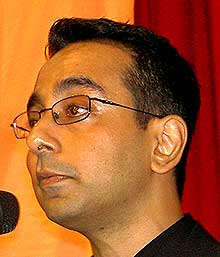
Leading human rights activist Malik Imtiaz Sarwar is one of the lawyers representing Jeff Ooi who is being sued by the New Straits Times Press and associated individuals for postings on his blog Screenshots . The defamation suit brought against Ooi concerns his comments on an article written by NSTP former group editor Brendan Pereira, against which was levelled accusations of plagiarism.
Malik has his own blog called Disquiet wherein he has posted on this acid test on expression in Malaysian blogsphere. In 'Defamation and the Blogger', Malik writes "Defamation suits are intended to deter, through a 'chilling effect', publications of a similar nature."
Leading human rights activist Malik Imtiaz Sarwar is one of the lawyers representing Jeff Ooi who is being sued by the New Straits Times Press and associated individuals for postings on his blog Screenshots . The defamation suit brought against Ooi concerns his comments on an article written by NSTP former group editor Brendan Pereira, against which was levelled accusations of plagiarism.
Malik has his own blog called Disquiet wherein he has posted on this acid test on expression in Malaysian blogsphere. In 'Defamation and the Blogger', Malik writes "Defamation suits are intended to deter, through a 'chilling effect', publications of a similar nature."
While he states that "blogging on the Internet is not immune from legal process", he is also mindful that bloggers play an important role in nation building through filling the information gap, opening up more democratic space as well as allowing Malaysians 'brain-drained' abroad to have their say on local affairs.
He believes that at this juncture, the "freedom to access information is more vital than ever" in Malaysia, and "as such a balance has to be struck between these two competing interests; personal reputation and integrity on the one hand, and nation building on the other."
"We cannot lose sight that in as much as vindication [in clearing one's reputation] may be achieved, the chilling effect may have far wider, and unintended consequences."
Malik, who pens a fortnightly column in the New Straits Times , was informed by the publication on Saturday that it will not be running his column until the Pereira case has been brought to a close. So it is perhaps fortuitous that Disquiet, which was launched last month, is there to bridge the connection for his column's dedicated following.
In an interview earlier with this malaysiakini columnist, Malik gives candid and off-the-cuff replies to her questions. Excerpts below.
On blogs and the timing of Disquiet
Malik: I think that's been recognised all over the world that the blogs are very important, especially here where there's so much restriction on expression. The media is limited, there's no free media; we all know that.
I think it was a good choice to come in only recently because this year, for whatever reason, the [Malik Imtiaz] profile has become much more developed. The Article 11 work, Lina Joy, and then Hakam [National Human Rights Association] presidency, and in part also what the NST has allowed me to do in terms of projecting ideas. And last year, the Interfaith Commission and so there is that sense that "Okay, this fellow, whatever it is, he's generally quite objective. He's not emotional about these things and so it's a voice to listen to.
 So that's been slowly building and I think it's a good thing to launch it [
Disquiet
] later rather than earlier because by then, as you say, there's already a credibility to an extent.
So that's been slowly building and I think it's a good thing to launch it [
Disquiet
] later rather than earlier because by then, as you say, there's already a credibility to an extent.
And that's why I'm more hesitant about what I do publish on the blog in terms of the material. And as I said earlier, I would rather publish something well thought through and comprehensive as far as possible, rather than simply dash off a thought about the RM30 million yacht or whatever.
I've been getting suggestions that "you should write more regularly" and I'm trying. In December [2006] alone, I did something like five or six big pieces which I thought was decent. But I realised how much time it was taking up. But then I do write in any event. My own thoughts, my notes for future activist concerns and so on, and some of it is being translated to the Net like the blog.
On the impetus and inspiration for Disquiet
It's actually taken from a book by Ferdinand Pessoa. He's a Portuguese poet from the early 1920s, 30s. A book of his musings was published under that title The Book of Disquiet . I only came across it last year but it was a book that resonated in a lot of ways.
To me, it represented two things. One is the ideal of the free flow of thoughts, and two, the sense of disquiet, unease. In the sense that principally this blog is about the social-legal-political landscape, and I think there's a lot to be said and not all of it is great. And so I figured that anyone motivated to write about that kind of situation would be motivated by disquiet in the state of disquiet because of what is happening.
I've been involved in all sorts of activist work from the mid-90s but in different senses of things at different points in time. The current situation is obviously one that people use the [Prime Minister Abdullah Ahmad] Badawi appointment as a milestone. So obviously when we talk about what is happening in the country at the moment, it's more usually associated in people's mind to the Badawi administration.
I think when you use that narrow margin, it starts off very promising and he's making all the right statements but over the last three years we've seen quite a bit of disappointment, quite a lot of frustration. I think fundamentally people don't necessarily see him as a bad person. So there's a general sense of unease at what's happening, perhaps a lack of control or a lack of understanding of what's happening in Malaysia at the moment.
You know there's so much doubt at the moment about the way things are. I think if you ask me how far back [the sense of disquiet], I would trace it back to his coming in on a wave of promise as it were.
The blog was something that I had been thinking about for some time. Throughout last year, people kept on saying set up a blog and even earlier than that because I've always written. But you know, time was limited and the freedom to do it was also limited because there was so much happening. Hence I've been mulling around with it mostly in the context of what I saw as nation building experiments.
And I've been thinking of something called Project Malaysia as a catchphrase to sort of identify a spirit or a willingness on the part of each of us to engage in nation building in one way or another.
Then I thought as a way into doing Project Malaysia as a website or something that I could start up a blog first, just to test waters, to get a sense of the technology because I'm doing it all on my own.
I've been a civil society activist for some time and amongst the problems that I've faced has always been a difficulty in getting my views across to the public and also not only views across but views across correctly because of the distortion that usually happens in the media. Primarily because I think it's a lack of sophistication or a lack of maturity about key issues. Possibly because of the journalists. Some are very good but some are very new or unschooled in the areas that they are covering, especially in court.
So I saw whenever we did any of these constitutional cases, there is a lot of distortion that was largely I think unwittingly caused by the way the Press was reporting what was happening. [The] Article 11 [civil liberties initiative] was 'freedom of religion' when actually it wasn't. It was about promoting awareness of constitutional rights and in the context of Islamisation issues. So you know, things like that.
I just think that the Press thinks that it's easier for people to access these issues if they use certain simplified language but they don't quite understand that there is a language to discourse in this sort of thing.
So all of that and more made me see that perhaps it would be useful to have a point of reference for people and for myself because you know when you do activist work you also want to make sure that your public views are accurately stated so that there is an accurate record of your particular position especially if the authorities decide that they want to take action.
It is one thing to say 'I didn't say that' to a journalist and then showing a correction letter which will then probably be seen as being an afterthought. And it's another thing have actually stated succinctly, correctly as you want it on the blog. So for me, that's become quite useful as well.
There was an article which I wrote about the [2006 Umno] general assembly which started off the blog which wasn't carried in the media because they thought it was too sensitive.
On the level of actual censorship
Obviously when you're writing for a national broadsheet and their editorial considerations I'm quite measured in the way I write for the NST . But I mean it is my writing style. As you would have seen from the blog, it is a similar style but I guess I can put concepts more pointedly [in Disquiet ] because I'm prepared to take that risk than say the editors are, and that's a premium I have found quite refreshing on the blog.
But having said that I do tend to write as a lawyer in my head so I'm quite clear about what I'm saying and why I'm saying it without committing an offence or two.
This is an interesting question [on the possible regulation of cyberspace by the Malaysian government] because it has not come up yet in court.
Right, so we've seen, one, some [postings or reader's posts] could be said to be seditious. Because sedition doesn't carry with it a necessary format of publication, and even under the Printing Presses and Publications Act [note: which widely defines "publication" to include "all written or printed matter and everything whether of a nature familiar to written or printed matter or not containing any visible representation", and "anything which by its form, shape or in any manner is capable of suggesting words or ideas"].
I think you can be charged with publishing false news.
Irene Fernandez gave out a memo which fell within the purview of the Act.
I don't think action would necessarily be taken on the publication on the Internet per se. What I'm trying to say is there's a legal concept: there is publication on the Internet and we've been promised freedoms on that. But having said that, what is stopping them from prosecuting if they want to? The authorities I mean.
So I would think it is promises made [with regard to former prime minister Dr Mahathir Mohamad's policy position vis--vis Cyberjaya] insofar as the Internet is concerned, about openness and so on and so forth. That's why they're talking about regulating, possibly, yes, the blogs.
But regulation means what? That means restriction of access possibly. It could mean that rather than prosecution. Let's say they start limiting. Can they do that? Like what China's doing with this. I'm not very technologically savvy on this. Like the kind of blocks that are being put up by certain states on access. That's one way of regulating rather than prosecution.
So regulation could take two forms. One is prosecution or one is actual physical regulation - from archaic methods like registering blogs to more sophisticated technological blocks set up to access. That's one way.
The other way is to actually prosecute for offences. In criminal law, we talk of the intention and the action, so the intention to commit a crime and then there is the action to commit a crime.
So arguably, like in the case of sedition, if you say something which is seditious, of a seditious tendency on a blog, because of the publication within Malaysia as well as outside, but forget the outside, think of Malaysia for the moment, arguably that could be an offence.


Report this comment
Are you sure you want to delete this comment?
This action cannot be undone.