




Bloggers rock the boat (Pt 2)
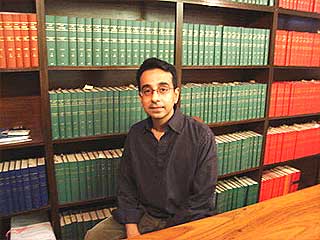
Human rights advocate Malik Imtiaz Sarwar believes labelling Disquiet as a political blog would only be correct in the wider and true sense of the word 'politics'. He says that his blog is not anti or pro any party as he does not have a political affiliation.
Instead Disquiet tries to understand the dynamics of power by taking an aerial view of the political landscape and building its analyses upon the fundamental principles underlying current issues. In a Q & A with this writer, Malik does not mince his words in tackling what he views as the middle-class malaise of 'not interested, not bothered'. Excerpts below.
Human rights advocate Malik Imtiaz Sarwar believes labelling Disquiet as a political blog would only be correct in the wider and true sense of the word 'politics'. He says that his blog is not anti or pro any party as he does not have a political affiliation.
Instead Disquiet tries to understand the dynamics of power by taking an aerial view of the political landscape and building its analyses upon the fundamental principles underlying current issues. In a Q & A with this writer, Malik does not mince his words in tackling what he views as the middle-class malaise of 'not interested, not bothered'. Excerpts below.
Malik: What I'm trying to express and to get people to understand is that there's no point in wishing for a change or improvement overnight, accepting that one accepts we need improvement. And it's going to be a long-haul process. I think the other idea that I'm trying to communicate is that at the end of the day we're all stakeholders, and the problem with what's happening in Malaysia right now is that a large number of us have refused to acknowledge that in a meaningful way.
 We've always taken the easy way of just saying "Well, it's comfortable here, we don't really need to engage, don't rock the boat" and in doing that we're actually implicitly rejecting stakeholdership of the country. Which is why the minority elites have been allowed to manipulate that so cleverly because it's always an easy thing to say "But you guys don't care", which is true to a large extent.
You know I've spoken to police officers who say "What does it matter, you leave the country when things get bad. We have to stay here." Of course they don't recognise in that that there's a growing elite within the Malay community that is going to do the same thing but it doesn't in any way address the reality of a large number of middle-class Malaysians who are not Malays thinking that way.
But I'm not writing to [address] those people. And that's the other problem I see in Malaysia that a lot of us assume that we speak for everybody else, that our views are shared by other people. And I think we do a lot of damage to idealism that way.
Without idealism, you can't have a hope or expectation. But I'm also seeing younger bloggers who are similarly frustrated because they're not finding role models who are articulating their own ideals. You know the same ideals that made you who you are and made me who I am and pushed us into doing what we are doing.
On making the best of the situation here
The other people don't have those role models and I've noticed that when they do find messaging or postings that in a way encapsulate what they're trying to say, they're very quick to disseminate that. And I see that I've had anonymous e-mails from people, as well as e-mail from postings, and also e-mails directly from young bloggers, Malaysians who live in Australia, who live in the UK, some are here, who say, ya, when they read that particular piece they thought, "Wow, here's somebody who's saying it". And that to me matters a lot.
As far as I'm concerned, I don't really give a hoot about the mid-30s, mid-40s Malaysians, you know, because their sorts are our worst enemies at the moment. Too desperate for security, too comfortable, too unwilling to give up the creature comforts in aid of improvement. But it's the younger group that, who I think for one reason or the other, will have no choice.
For example, there are young Malaysians now, non-Malays, who perhaps have gone through the education system here, right, say unlike predecessors who were sent off overseas at great expense or whatever. Now they are in as difficult a situation as the next Malaysian if they're thinking about moving off.
Slowly, there is a percentage that's growing of young Malaysians who perhaps have not been given the benefit or the opportunity of having that "I can go and work somewhere else" mindset as easily, partly because their credentials are not recognised overseas or because they've not been taught that. And that's the Malaysian I'm hoping to reach because these are the people who will make a change. And they are all across the racial boundaries; I don't think they're non-Malays. They are Malays, Chinese, Indians, other people. They are there. And I think that's the heart of Malaysia at the moment.
On effecting change on the ground
So what I'm trying to say is that not everything has to be controversial, not everything has to be about Lina Joy or the ISA or any of these so-called boutique human rights causes. It starts on the ground. Say that if everyone started to register dissatisfaction on the fact that, the water concessions for example, is causing a lot of hardship, they have to listen, you know. At the end of the day, if enough people say something, the government has to listen.
How many people have actually stood up? You get Charles Santiago and his crew, who I have the greatest respect for and I was working with them to some extent on the coalition and we will be doing something but at the end of the day, every civil society initiative that we see is 10 people, 20 people, then you get some 200 people turn up at some function somewhere and that's it.
Why do Malaysians think that it ends there? "I turn up on a Sunday morning, register my dissatisfaction, and walk off, that's it." Everybody in Malaysia wants everybody else to do their jobs for them. So if the younger people are prepared to be energetic, more dynamic and it starts with not just "okay, I'm going to right a wrong". It has to start with "I need to understand, I need talk about what is happening in my country, I need to be in a position where I can talk about it".
Why is it that our 20-year-olds, what, they're not stupid, I don't think our Malaysians are stupid at all in some ways but I think that you see a 20-year-old in Australia, he knows damn well what is happening in his political landscape. Why is the Malaysian not interested or not bothered? Because his parent is telling him "What for?" or his parent is not interested, or her parent is not interested. Alright, that's one level.
In school they are not taught to think. Well, it's not because they don't want to think. So people suggest a big scheme on the part of the government to de-educate Malaysians so that they are stupid and compliant. To some extent I think that may have been easy. It may have been one of the foreseeable consequences of our mass education in their churning out more middle-class Malays to keep the balance in redress. But this is an incident of that process so we've had a de-education over three generations. You mean it ends there?
It's a composite problem you see. I don't think it's open to any of us to say "What to do, it's like that what" because it suggests in that that we can't do anything about it.
But then if you say "We can't do anything", my question would be "Why not?" I've been at assemblies, where 18, 19-year-old Malay students are getting the brunt of the attacks from the police. Right, what's motivating them?
You know like when we handed the memorandum against police brutality two years ago in Bukit Aman that resulted in the FRU and all that and some of them being arrested. I wasn't at that assembly, I went later but I saw the people who were waiting outside Pudu jail, young activists. I've got photographs and I'm thinking "Okay, what is it that makes you want to do this?"
On crediting kids with more intelligence
And the rest of middle-class Malaysia can't be bothered. They whine, they whine a lot. You know, they whinge, but that's all they do. So what I'm trying to say is that that mentality seeps through and results in a 19-year-old saying "what to do" in the same way but for some reason those kids [at the assembly against police brutality] and other kids I've met along the way, don't think that.
Or myself at 19 or 20. I come from a very comfortable middle-class background. You know [referring to the writer who has a long acquaintance with Malik's family]. So what's motivating me to do what I was doing when I was 19, 20 and I got into these kinds of issues. What was it? I had sense of intelligence and I think that was what was being insulted most of all. Same with these kids. You know I'm hearing that they're saying "What, do you think we're stupid?" "Urm, what is it with these guys, I'm 18, 19, I know what I want for myself".
So how do we empower?
I think if we recognise that that segment of Malaysian society is extremely important for our future, and we start looking at ways in which we can empower these young Malaysians so if you go back and read the blog [Disquiet], you can see there's one chap who written in quite a lot on the law, proposing alternative viewpoints. He must be a law student somewhere and I'm going to write a piece on the jurisdiction of the lines between syariah and so on to address his questions. There are other people like that as well.
So when I wrote the 'Back to Basics' [a blog posting], somebody wrote a long piece complaining that I was preaching to the converted with all that. But you see I don't care about you. You're telling me you're an old-timer. What do I care about you? You're probably the cause of the problem, and if you aren't the cause of the problem, why don't you do something about it?
On influencing public opinion
It's apathy and the fact that too many of us are secure in our comfort zones and I think that's something the administration believes that we complain from a philosophical, intellectual standpoint because we're bored. Do you see? I'm not suggesting that people take to the streets but there are ways in which you can register a presence and in registering a presence, you can sway opinion.
I mean look at Article 11, right? What did we do? We did four road shows and we're a branded name now. Okay, how did that happen?
The first one we had 600, 700 people turn up on a Sunday morning in PJ. The next one we had 400 people turn up in Malacca. The next one, 300 people in Penang, disrupted. Next one, July, 200 people turned up, disrupted. But enough was done there somehow that it registered on a lot of people, in the minds of a lot of people. And people began to talk.
If you do Google on 'Article 11', 'Forum', look at the block that the blogs were saying about it. Sure there were the conservatives but they were the minority. A large number of people were saying "Why? Unfair. Not correct" [regarding the attempts by conservative Muslim activists to gag the NGO coalition].
And while you can say, "They're just mouthing off on their blogs", I don't think that I can say that it ends there. Because somewhere in the mind, [Article 11] is registering when that person is required by circumstances to make a decision that will in one way or another figure. So perhaps that person's perspective on race relations might have been shifted or changed by that. So what I'm doing is I'm trying to put enough material out there of sufficient objectivity and quality that will allow people to form a viewpoint [though] not necessarily share my viewpoint.
Demagogues work only because they control public space. If you accept the blogsphere as a public space, they don't.
On the prevalent climate of fear
I don't think there's a reason to be arrested. For me personally I'm writing in my own name, I am stating my views candidly but having said that, I do realise that Chandra [Muzzafar] was taken in 1987 for doing just that when the judiciary was being attacked.
But I guess a lot of us who are involved in this sort of work crossed that line some years ago. Not to say I'm martyring myself. I don't want to be arrested but I think I'd like to say that for whatever reason I still believe in the system, and you know, take it as it goes-lah.


Report this comment
Are you sure you want to delete this comment?
This action cannot be undone.