




Anwar says the 'twain can meet
Anwar Ibrahim’s decades-long search for common ground between the West and Islam was given renewed vigor as he traced similarities between ideas championed by the European Enlightenment and values sanctified by Islam.
Speaking in Paris last night in a debate ‘Islam and the West’, organised by the French Institute of International Relations (IFRI) and chaired by former International Monetary fund chief Michel Camdessus, Anwar attempted to give Islamic inflections to Enlightenment currents.
Anwar Ibrahim’s decades-long search for common ground between the West and Islam was given renewed vigor as he traced similarities between ideas championed by the European Enlightenment and values sanctified by Islam.
Speaking in Paris last night in a debate ‘Islam and the West’, organised by the French Institute of International Relations (IFRI) and chaired by former International Monetary fund chief Michel Camdessus, Anwar attempted to give Islamic inflections to Enlightenment currents.
For example, he said the French Revolution’s slogan - liberty, equality and fraternity - was incomprehensible to Muslims until one of them, Egyptian scholar Rifa’a al-Tahtawi, after a stay in Paris in the early 19th century, grasped the meaning of freedom in the Enlightenment context by suggesting what its parallel in the Islamic idiom would be.
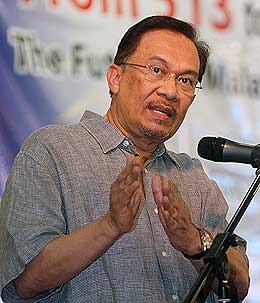 Anwar rendered Tahtawi’s interpretation thus: “Initially perplexed by the direct translation of the word freedom, which in the Arabic context generally referred to the condition of a freed slave, he later realised that the more accurate rendition of the motto’s underlying gist in Arabic was ’adl - justice - which is nothing short of one of the divine attributes in Islam and a prevailing concern of Muslim scholars and theologians since time immemorial.”
Anwar cited another instance of parallelism in the sanctity of life and property enunciated by John Locke, an Enlightenment luminary, which he said bore resemblance to what was meant by the Quranic invocation: “O mankind, your blood, your property, your honor is as sacred as this Holy Land.”
Europe’s largest Muslim community
For much of the last two decades, Anwar has been seeking consonances between Enlightenment and Islamic principles, an effort that has earned him in conservative Muslim circles the pejorative label ‘Erdogan’, after Turkish Prime Minister Recep Tayibb Erdogan, said to prioritise political victories over religious ones.
“Lockean principles as transmitted down the French and American constitutional norms bear striking resemblance to the ‘maqasid al-sharia’, the higher objectives of Islamic law, as expounded in the 8th century, which sanctify the preservation of religion, life, intellect, family, and wealth,” asserted Anwar to his Paris audience.
The IFRI is devoted to research and action on topics of grave international concern. The relationship of the West to Islam, often antagonistic, has become a subject – in the post 9/11 world - of weighty concern in western intellectual circles.
Home to Europe’s largest Muslim community - with almost 6 million - France considers itself the incubator of the Enlightenment, the intellectual movement ignited in the 17th century by French philosopher-mathematician Rene Descartes’ seminal musing “Cogito ergo sum” (I think therefore I am).
Anwar however lamented in Paris that “despite the shared belief in universal values which are as integral to Enlightenment Europe as they are to the classical period of Islamic history, Islam and the West are still juxtaposed as opposites.”
He told his audience that this need not be - a day before US President Barrack Obama was scheduled to give a major speech in Cairo on relations between the United States and the Muslim world.
Obama to reach out to Muslim world
Obama’s speech is being awaited with the same heightened anticipation as were President John Kennedy’s remarks at the Brandenburg Gate in West Berlin in 1961, renowned for its invocation “I am a Berliner”, a line whose pith and resonant brevity encapsulated the West’s determination to resist Soviet subjugation of all of Berlin, a focal point of East-West tensions in the Cold War.
These days the phrases ‘9/11‘, ‘war on terror’, and ‘Guantanamo’ have come to acquire the same emotive cachet of “Ich bin ein Berliner” as Kennedy rendered it in German, albeit without the latter phrase’s rallying momentum.
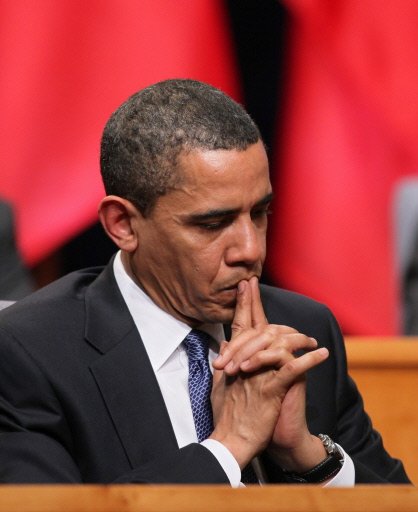 Anwar observed that Obama had inaugurated a policy of engagement and dialogue “in a language of mutual respect” that Muslims must welcome.
He admitted that extremist elements in Muslim countries were a hindrance to dialogue but claimed that these elements could only flourish in despotic countries which sometimes were aided and abetted by western democracies.
Anwar said that the forces unleashed by globalisation required that both the western and Islamic worlds join forces to resolve the issues of climate change, poverty and the depletion of energy sources.
He said these were immense challenges that could only be solved by a convergence of forces propelled by consonances in the ideologies that animated them.
According to Anwar, the effort would require the leadership mettle of individuals of “impeccable credentials”, both moral and intellectual, who can to rise above narrow concerns of self-, even national, interest, to serve humanity.
In conclusion, Anwar echoed the counsel of Immanuel Kant, another Enlightenment luminary, who held that it was better to bring about humanity’s progress through moral and intellectual enlightenment rather than through the experience of chaos which would be the case if Islam and the West were to go on colliding with each other like hostile strangers in a benighted epoch.


Are you sure you want to delete this comment?
This action cannot be undone.