




So near, yet so far
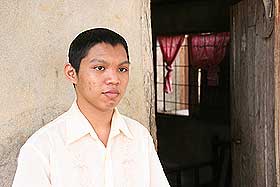
Andrew Missen is a charming, joyful 19-year-old Bidayuh. He lives with his parents and sister in a simple house with a low roof in Kampung Simpok in Padawan. His parents are both Bidayuh farmers, as their weathered faces and creased hands attest.
Andrew Missen is a charming, joyful 19-year-old Bidayuh. He lives with his parents and sister in a simple house with a low roof in Kampung Simpok in Padawan. His parents are both Bidayuh farmers, as their weathered faces and creased hands attest.
Andrew's Bidayuh family lives beside a narrow, tar-sealed road, only 40 minutes from the neon lights and grandiose government buildings of Kuching.
 But they do not own a motorcycle or any other form of transport.
Each time Andrew ( left ) travels home from his hostel in the Sekolah Pendidikan Khas (School for Special Students) in Kuching, he must take a taxi.
The price of a return trip on the 'contract taxi', RM40, is small by the standards of the Klang Valley. But for Andrew and his family, the cost is a hefty burden, to be calculated to the nearest ringgit. They must save up for every one of Andrew's visits home.
Andrew's father plants rice on a hilly plot of land. He walks two hours there and back home each day to nurture this life-sustaining crop. In most years, there is a little rice left over to sell, for a small cash income.
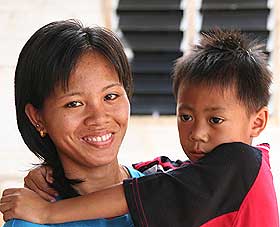 Andrew's sister Ruthie (
left in photo
) helps their mother at home, and Ruthie's husband taps rubber.
Andrew's sister Ruthie (
left in photo
) helps their mother at home, and Ruthie's husband taps rubber.
It goes almost without saying that Andrew's family earns substantially less than Sarawak's "poverty level" of RM760 per household per month.
A family celebration
Andrew's Gawai celebration with his family on June 1 this year was special for a variety of reasons.
One reason was the rarity of Andrew's visits home. Andrew started boarding school two years ago at the Special School in Kuching.
Another reason was the homecoming of Andrew's sister Reha. Reha has been working in a factory in Johor Baru.
She is a foot soldier in the legions of Dayak workers in Peninsular Malaysia, armed with few skills or formal education. Reha has returned home for a well-earned Gawai vacation. She plans to get married next month before returning to work in the big city.
A third, unspoken reason was that Andrew does not expect to live more than a few years. Andrew was a bright Form Four student in his local village school four years ago.
The teenager likes to show visitors his neat Mathematics exercise books and photos of a happy, good-looking younger Andrew, chatting to schoolgirls in their sky-blue pinafores. One day, Andrew started getting severe headaches, and went blind.
Andrew has brain tumour, a cancer of the blood, called a lymphoma. Andrew recalls undergoing chemotherapy and radiotherapy in 2005.
He says he was expected to live several months, or perhaps a year or two. He surprised his glum-faced doctors by surviving until today. He is cheerful, but he has lost his vision and his ability to write
mathematics solutions.
Andrew's father, Missen, recalls struggling to scrape family savings together to get to the hospital, week after week. But the visits paid off. Andrew feels fine, aside from his loss of vision.
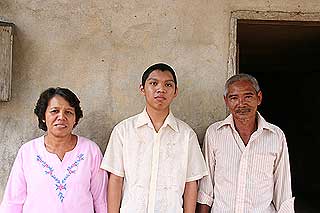 Andrew and his parents have been told there is no doubt the cancer will return eventually, but Andrew has retained his natural optimism.
He asked to be enrolled in the 'Special School' and learn Braille, because he used to enjoy his schoolwork.
"I had a lot of friends in school before I fell ill," Andrew says. "The girl in the photo on the wall" - he gestures from memory - "was, sort of, my girlfriend. She's moved away now," he smiles.
"I like the boarding school, but I wish I could go to 'sembahyang' (pray) more often," he says. "At home, the priest only comes to the village for a service once every month. In the churches in Kuching, the priest is always around. Still, I can't go to church by myself."
Andrew has lost a lot of weight recently. He misses home, though he has new friends in the boarding school.
Bidayuhs abroad
Andrew's sister Reha works in various factories in Johor. She says the wages, RM800 a month, are double what she can earn in Sarawak. Underemployment is a routine fact of life among Bidayuh, even those around major towns such as Kuching.
The road through Andrew's village was built in stages over 40 years. A new section was tarred every election campaign, bringing the promise of development. Roads have facilitated widespread migration to Kuching.
The physical signs of cultural dislocation are plain to see. One Bidayuh longhouse in Padawan, Kampung Benuk, was a bustling community until 20 years ago.
The longhouse wound its way up a slope, bisected by the round house, or 'barok', the traditional meeting room and resting place for skulls - headhunting trophies from the 19th century.
The longhouse was a refuge, a fortress, and the soul of its people. Its common verandah, where the longhouse dwellers gathered, was a common recreational space, a playground for the children, a reception area for honoured guests, and the repository of oral literature, weaving and musical traditions.
When a road arrived at the base of the Benuk longhouse, dwellings began to break off from the main body of the longhouse, forming small individual houses. The upper reaches of the longhouse, further up the slope, remained intact for many years, but are now in an advanced state of disintegration.
Kampung Benuk has become a tourist attraction, an easy drive from Kuching. A ticket collection booth sits at the bottom of the slope, but few families remain in the longhouse as exhibits.
Despite the road access, employment remains scarce, and income levels remain low.
Bidayuh contract labourers or coffee-shop waitresses in Kuching make three to four hundred ringgit a month.
They can afford to send little home to their aging families.
Only a tiny minority of Bidayuh families in Andrew's area can afford cars. Many young Bidayuh, like Reha, have left to seek employment in Peninsular Malaysia or Singapore.
Reha tells of a past experience working as a live-in maid in Johor. She used to chat with the maid in the house next to her employers', over the fence.
The neighbours' maid told Reha of daily abuse and beatings by her employers. Reha urged her to go to the police, but the neighbours' maid was terrified.
Bidayuhs at home
Andrew's house has little furniture. His parents and older sister Ruthie make it as homely as they can. When Andrew was found to have cancer, social welfare support of RM300 a month was provided for a couple of years.
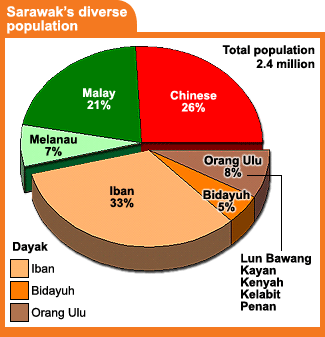 But the social welfare assistance has since dried up. All the same, Andrew had a happy Gawai. He is proud of his newly-acquired Braille skills, and wants to learn more.
Bidayuhs vote every election for the promises of development. Many Bidayuhs hold university degrees and important posts in the state administration and professions.
But national slogans such as Vision 2020 seem as alien to the majority of the Bidayuhs today, as when they first appeared on radio and television.
Three Bidayuhs were elected to Parliament last year. They have appeared frequently in the newspapers, because they remain engaged in bitter recriminations, complaining that none of them has been included in the federal cabinet.
KERUAH USIT is a human rights activist - anak Sarawak, bangsa Malaysia. His ‘The Antidote' column, which appears in Malaysiakini every Wednesday, is an attempt to allow the voices of marginalised people to be heard all over Malaysia. The writer can be contacted at keruah_usit@yahoo.com.
Previous columns
In defence of the emerald forests
Logging: Carrots, sticks and lies
Juni: Daughter, sister, unwilling mother


