




One vote difference for DNA Bill
The Deoxyribonucleic Acid (DNA) Identification Bill went down to the wire as parliamentarians voted for an amendment to Section 2 of the legislation.
The Deoxyribonucleic Acid (DNA) Identification Bill went down to the wire as parliamentarians voted for an amendment to Section 2 of the legislation.
However, the government voted it through with a single vote majority. Critics have described the legislation as a disaster for legal and human rights.
Opposition political parties, civil society and the Bar Council have slammed the bill for placing excessive powers in the hands of the police and the home minister.
Last year, opposition parliamentarians staged a walkout after failing in their bid to coerce the government to set up a special select committee to study the defects in the new legislation.
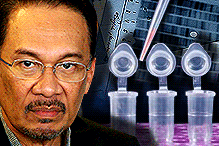 The MPs had suspected the bill was an attempt to trap Opposition Leader Anwar Ibrahim in his ongoing sodomy case.
The debate today concerned Section 2 and 3 of the bill which are related to the definition of detainees, from whom DNA samples can be extracted.
The MPs had voted through bloc-division voting where Barisan Nasional MPs secured 48 votes and the opposition 47 votes.
Prior to this, DNA samples can be collected from detainees held under the Internal Security Act (ISA).
This has now been removed from the bill and DNA samples can only be collected with consent from ISA detainees.
A point of contention by the opposition is that leaving out the ISA detainees alone does not make it a comprehensive bill.
Should be only for violent crimes
Subang Jaya PKR MP R Sivarasa told reporters at the Parliament lobby that the provision should only support DNA to be collected from people suspected of violent crimes which includes rapists and murderers.
It should not to be used to collect samples from drug dependants and those arrested under the Emergency Ordinance (EO).
 "When you counterfeit money you can be held under EO. When you organise illegal gathering you can be held under EO. These are all sorts of non-violent crimes. DNA is not relevant here," said Sivarasa.
The MPs also criticised the inclusion of saliva in a non-intimate category.
Sivarasa explained that a non-intimate sample is when saliva is taken from the ground or if it is spat into a cup with consent.
"But the bill that was passed makes it okay to swab saliva forcefully from someone’s mouth and still be treated as a non-intimate sample.
"You can refuse an intimate sample (but the provision passed) means you can't refuse (to give a sample)," he added.
There are around four to five more amendments to the bill to be debated in the House in the coming days.
Asked to comment on the slim majority, Sivarasa said: "BN has got 139 MPs but only 48 were debating whereas Pakatan had 47 out of 82 MPs debating."
Deputy Speaker Wan Juanidi Jaafar told reporters later that no bill had secured such a narrow pass since 1990, when he was a MP.


Are you sure you want to delete this comment?
This action cannot be undone.