




Co-op Act legalises robbing Peter to pay Paul
SPECIAL REPORT After 87 years, the co-operative movement in Malaysia could well be heading for an ignoble end, now that a new Act has been enforced and an old one amended.
SPECIAL REPORT After 87 years, the co-operative movement in Malaysia could well be heading for an ignoble end, now that a new Act has been enforced and an old one amended.
The Co-operative Societies Commission Act 2007 and Co-operative Societies (Amendment) Act 2007 were gazetted in 2007 and came into force in 2008.
Both these Acts tightened control and allowed the Co-operative Commission to exert greater authority over the movement.
Under the amended Act, a new body, called the Malaysia Cooperative Commission (MCC) has been set up.
The Commission has sweeping powers to enforce the provisions of the new Acts as well as by-laws in any co-operative society.
It can tax co-operative societies at will as well as select board members whom it thinks fits the bill.
 Prior to this, the Co-operative Development Department, under the then Entrepreneur and Co-operatives Development Ministry, supervised the running of the co-operatives in the country.
Now, new key provisions in both Acts will change the way co-operative societies are governed and how they conduct their affairs.
Changes brought by the Co-operative Societies Commission Act 2007 include the following additional sections that co-operative societies say are ultra vires the Federal Constitution under four articles:
* Article 13 (1) and (2) totally forbids the compulsory legal acquisition of property without compensation which is contravened by the following:
Section 42 of the new Act which allows the Commission to order any co-operative society to contribute to the Central Liquidity Fund a percentage of its share capital, subscription capital or assets as determined by the Commission without any compensation and,
Liberties being eroded
Section 43 (1) - all co-operative societies must deposit into the Co-operative Deposit Account all their funds "not immediately needed for operations or investment" operated and managed by the Commission without provision for compensation.
Both the above contradict Article 97 which states that all revenue and moneys howsoever raised and received by the Federation shall be paid into and form one fund known as the Federal Consolidated Fund.
* Article 5(1) and (3) no person shall be deprived of his life and personal liberty save in accordance with the law and shall be informed of the grounds of his arrest.
This proviso is allegedly contradicted by Section 54 of the new Act which states that every offence, punishable under the act, shall be a seizable offence.
Co-operative Societies (Amendment) Act 2007
* Section 36(2)(3) - set the criteria that the appointment of any person as a member of the Board of a co-operative society must win the prior approval of the Commission
 The Co-operative Societies (Amendment) Act 2007 is set to also contravene Article 10 of Federal Constitution which provides for freedom of association.
Malaysiakini understands that the Commission is working towards seeing a transfer of funds from all co-operative societies by the year-end.
However, the Co-operatives Union of Malaysia and the Midlands Co-operative Union - two umbrella bodies for 48 groups - are contesting the legality of the Act in court , on the grounds that it would curtail their democratic rights in managing funds and electing board members.
In their originating summons in chambers filed on Jan 6, 2009 at the Shah Alam High Court, they sought to declare parts of the two Acts invalid as these contravene Federal Constitution.
Hearing is set to resume on Sept 15.
Officials and members are also dissatisfied with the provisions for several other reasons.
Petaling District Co-operative Development vice-president Ahmad
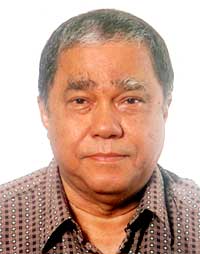 Ghazi Hamid voiced his frustration over the formation of the Commission without prior discussion with the co-operatives.
He slammed the Commission's attempt to dictate how people should run their organisations and said that the co-operatives are the people's movement, upholding democratic principles.
Democratic rights being robbed
"We are the ones running the show and we are real operators. In Scandivinian countries, Japan and Korea, the governments do not interfere."
In an impassioned plea, Ahmad Ghazi warned of the danger of the funds being drained out if the government were to continuously milk them.
"Jangan ambil wang koperasi untuk suruhanjaya, ambil wang kerajaan. Don't take the poor men's money and don't disturb us," he said.
He added that the co-operatives are self-sufficient and thus far, had served the community well.
"Our co-operatives inculcate the spirit of togetherness. It's a self help organisation, a people's organisation. We're representing the people so don't bully us," he said.
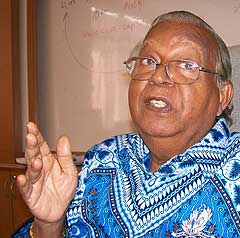 Unionist and president of the National Union of Teachers Multipurpose Co-operatives. A Rajaguru, 74, noted that the co-operatives do not need any government's approval for investment as the people are in control of how their monies should be utilised. Like Ghazi, Rajaguru stressed that the co-operatives ride on democratic principles of management.
"If the government controls, then it's not fair. We follow members' advice and decision. We have made good profits from investment in the share market and this enhances our income to give good dividends to members," he said.
Rajaguru, the former National Union of Teachers secretary-general, expressed worry that the Commission might again amend the Act and impose more rules and regulations at its whims and fancies, in future.
"The co-operatives are caught off guard by this Act. We should have been informed when drafted. They should take into account our views.
"They might again amend the act and change their minds if they could not collect enough money."
Act not thoroughly scrutinised
While acknowledging that amendments are necessary, Co-operatives Union of Malaysia president Dr Mohinder Singh, conceded Rajaguru's view that all provisions were not sufficiently scrutinised prior to enactment of the Act.
"There hasn't been sufficient dialogue on implementation and the implications of the Act. We would have like all provisions to be discussed with us.
He remarked that increased contribution to the statutory fund from 15 percent to 25 percent is unreasonable and its haphazard implementation causes uncertainty.
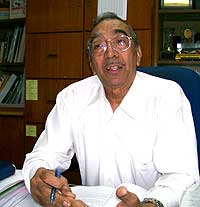 "This represents a big chunk of our profits. It would affect the dividends we can declare to members and also cash available for our business activities, said Mohinder.
(left)
"This represents a big chunk of our profits. It would affect the dividends we can declare to members and also cash available for our business activities, said Mohinder.
(left)
"We want more clarification - will the cash be tied up? Will it bear returns and will it be cumbersome to remove funds? Where to deposit the funds?
"Implementation should be deferred until the Act has been made available to us. The Commission was jumping the gun in improvising the amendments without providing clear interpretation of impact."
Mohinder, 72, is also involved in the Koperasi Khalsa Malaysia Bhd, Koperasi Persatuan Kanak-Kanak Spastik Selangor and Wilayah Persekuatuan Bhd, and Koperasi Perdanajaya Malaysia Bhd.
He is further concerned about the harsh penalties meted out as this would deter people from serving on a voluntary basis.
"Penalties put for directors are more severe than serious crime, very severe for even minor infringes. This puts fear into those taking this position. Most directors are volunteers."
Offences & penalties
* RM5 million fine and five years jail for pretending to be part of or working for a co-operative;
* RM5 million fine and five years jail for using the word 'co-operative' or anything similar without the right to use it;
* RM1 million and a year in jail for obstructing or failing to follow any orders issued by the co-operative commission;
* RM200,000 fine and one year in jail for failing to submit annual documents within 15 days of an AGM
"The government had over-reacted to past events. It should not treat co-operative societies like crooks. We mustn't hold a gun to people's heads. A mechanism can be put into place without creating fear," he added.
"Punitive measures are so excessive to the extent these no longer act as an incentive to work but become a deterrent."
He also mentioned that Angkasa should be more thorough in "gathering voices" from all spheres of the co-operative movement.
Angkasa's did not do its job
"There is a lot of room for better discussion and Angkasa did not give enough prominence to these issues.
"I am happy with Angkasa but there are areas where they can do more. Angkasa hasn't put enough effort in studying the implications of the Act," he said before adding that training and salary deduction facility are among the strengths of the movement.
Incidentally, Dr. Mohinder was the recipient of the Angkasa class one gold medal award twenty years ago.
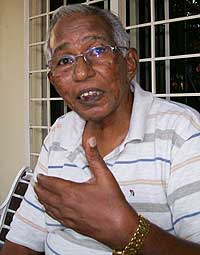 Jaffnese Co-operatives Society former president K.Thillainathan
(right)
echoed Mohinder's concerns on the increase of profits put into the fund and questioned the way it was implemented.
Jaffnese Co-operatives Society former president K.Thillainathan
(right)
echoed Mohinder's concerns on the increase of profits put into the fund and questioned the way it was implemented.
"It's like robbing Peter to pay Paul. They're using funds of successful co-operatives, saved by members over the years.
He was shocked that the Commission had been established to enforce law and order.
"You can give guidance but don't tell me what to do as long as I follow the provisions. The Co-operative Societies Act have been in existent since 1922 and amended over the years. Why is it now they change it this way?" he asked.
"If the co-operative department, with all its act, couldn't do a job well, what guarantee is there that the Commission will do the job well?"
The co-operative movement started in Malaysia in 1922 when some volunteers initiated a co-operative society to improve their living standards.
The activities enhanced economic opportunities and provided social services to the community.
The Act, which took a couple days to read, debate and approve , rubbishes a lifetime's work done ...and one wonders what the honourable members of parliament, on both sides of the divide, were doing?


Are you sure you want to delete this comment?
This action cannot be undone.