




Iban mother's fight for land rights
Elam Busang, 47, is a loving mother of three teenagers, but she is responsible for more than her own household. Elam is also the Tuai Rumah , or village chief, of Rumah Elam, a longhouse of 22 families in Ulu Niah, Sarawak.
Elam Busang, 47, is a loving mother of three teenagers, but she is responsible for more than her own household. Elam is also the Tuai Rumah , or village chief, of Rumah Elam, a longhouse of 22 families in Ulu Niah, Sarawak.
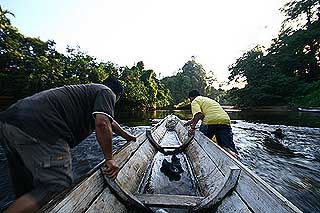 Elam has spent the last 10 years leading her Iban community in defending their Native Customary Rights (NCR) land.
She has seen her father, Tuai Rumah Busang, and 18 other villagers jailed for fighting for their ancestral land, but she remains defiant.
"This (land) case is certainly not a small one," Elam told Malaysiakini .
"The NCR area on the company's map was 249.8 hectares. Our own map in 2000 showed a slightly larger area. The company promised to negotiate the borders of our land at first, but they never put anything in black and white."
In the early years of their NCR campaign, Elam, her father, and other community organisers faced savage beatings and threats from Police Field Force personnel and from hired thugs. Elam says the thugs were employed by a plantation company, Sarawak Oil Palm (SOP).
According to Elam, SOP moved into the farmlands and forested lands of Rumah Busang, the former name for her longhouse, in 1999.
In those days, the village was named after Tuai Rumah Busang, following the name of the chief. After Busang died of lung disease in June 2008, villagers chose Elam to be the new chief. Following Iban adat or custom, the longhouse is now called Rumah Elam.
Savage beatings
There were clashes in 1999 and 2000 between Iban villagers from Rumah Busang, and nearby Rumah Bali, with employees of SOP. Elam says the company brought in gangsters from Miri to intimidate the villagers to give up their claims to the land.
The villagers made seven police reports but no action was taken against SOP.
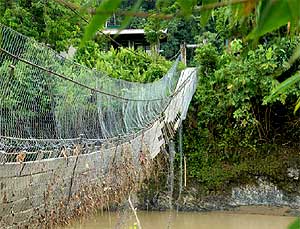 There were reports of villagers being harassed, beaten, and tied to trees, while gangsters threatened to attack them with samurai swords. The violence escalated.
On Sept 1, 1999, Bali and Busang villagers shot and killed four thugs with hunting guns. The remaining gangsters ran.
After the death of the four Chinese thugs, local newspaper reporters, including those from the Chinese press, visited Bali and Busang. The reporters made it clear the villagers' resistance was a spontaneous response to violence against them, and was not inspired by racist feeling.
Police arrested 19 villagers from the two villages, aged between 16 and 75. Eventually, 18 were discharged without convictions, after spending an average of two years in jail. Six were released after 20 months, Elam recalled.
But one old man remained in jail. Jalen anak Anton, now 84, applied his thumbprint to a confession. Based on this admission, Jalen was convicted of manslaughter.
Jalen did not have a lawyer present during his interrogation. He could not read nor write, and did not understand Malay or English. Furthermore, Jalen was visually disabled, because of cataracts. Yet his appeal against his conviction was not allowed.
 After Jalen was freed in 2007, he underwent cataract surgery, and his vision has since been restored. Jalen spent seven years in Lambir Prison, near Miri. The prison officers were not unsympathetic towards him, and treated him kindly.
Frail and deaf, but still cheerful, Jalen is living out his last days, respected by the other villagers. He remains a living testament to the suffering of these Iban communities over the last decade.
The villagers of Rumah Bali and Rumah Busang held two separate ritual celebrations - Gawai Kelingkang Bujang Berani - in honour of Jalen and the other 18 detainees.
Over a thousand Iban villagers from surrounding communities attended the Gawai .
The Gawai rituals were commemorations of bravery. A highlight was a spiritual offering to the spirits, to protect the defenders of the village. The Gawai , and the villagers' defence of their NCR land, were given worldwide coverage , including by the CNN.
Defending ancestral land
"If we do not have our land, how can we plant our crops? How can we live?" Elam asked. "We wanted proper discussions with the company, we did not want arguments or violence.
"We suffered a lot those years in 1999 and 2000, when the company tried to move in. We couldn't rest: we couldn't eat or sleep in peace.
"But if someone wants to seize other people's land, how can we allow it?"
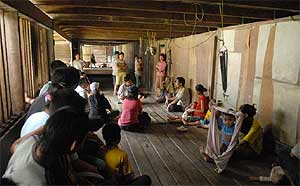 Elam explained that other Dayak people from other parts of Sarawak, including Kenyah people, had "brought in news" from their own campaigns against companies trying to take over their NCR land.
Among those activists sharing their experiences with the Bali and Busang communities were Orang Ulu villagers dispossessed by the Bakun Hydroelectric Dam.
Elam stayed the course. Like her father before her, she and other villagers have succeeded in warding off SOP's intrusions on to their NCR land.
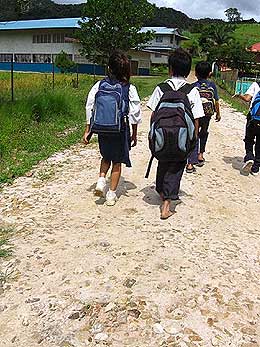 "We had it hard in the past, but now the land is safe for our children, thanks to hard work and sacrifice," Elam said.
Today, Elam and her fellow villagers remain in control of their own destinies.
Elam says her longhouse villagers have been planting their own oil palm crops, for between 4 and 12 years, with each bilek ( household ) owning between 1,000 and 6,000 oil palm trees.
The trees produced between two and fifty tonnes a month, fetching several thousand ringgit profit per household each month.
Local longhouses have even pooled their funds to buy a school bus and hire a driver to send their children to school. The villagers formed a cooperative and contribute equally to the scheme.
"We still need an electricity supply," Elam said. "The electricity company has refused to connect our supply. And we still hear rumours of the company trying to move back in next year. We keep talking to the elected representatives, but we have no written assurance the company will recognise our land."
Elam hopes the villagers will remember the sacrifices of her father and those who defended their land.
"My father's history is very important to me," said Elam. "We hope to publish a book to record the history of their struggle for the land."


Report this comment
Are you sure you want to delete this comment?
This action cannot be undone.