




The BTN debacle
COMMENT Is it racist to tell Malaysians that the nation was originally "Tanah Melayu" and that the present racial composition is primarily a result of five centuries of colonialism? The answer would have to be no.
Is it racist to tell Malaysians that the nation was originally "Tanah Melayu" and that the present racial composition is primarily a result of five centuries of colonialism? The answer would have to be no.
In fact, this is history although it might be more accurate to say that the Malay Peninsula has always been historically a trading area with its coastal territories being attractive to traders, sojourners and conquerors.
Like the Malay language, its roots are fundamentally multi-cultural with evidence of Sanskrit, Hindu, Chinese and Malay world influences. It would also have to be said that the Malay people, broadly defined, were themselves once traders, sojourners and conquerors.
We must not forget that the kingdoms of Srivijaya and Majapahit, which once ruled vast territories that today makes up Malaysia, were based in Sumatra and Java respectively.
 The historical wrangling above demonstrates the futility of attempts to re-cast history, especially Malaysian history through narrow ethnic lens.
Because we are a confluence of different cultures and histories, our past is highly contested and naturally multi-cultural.
As much as the Chinese educationists shout, they cannot alter the fact that different Chinese dialects exist and that Mandarin was only taught in schools as late as the 20th century.
Ask the Orang Asli communities whether they accept the Malays as original peoples and you will probably get an entirely different historical account.
The crux of the matter is that history is important but it has to be tempered by recent history and present circumstances otherwise there is a risk that we may become ossified, holding on to the views of our great-grandparents whilst ignoring reality on the ground.
We all know from our daily interactions that the average Malaysian may suffer from ethnic prejudice but on the whole we are not racist in the mould of the west or their exported models in the United States, Australia and South Africa.
Malaysians do not refuse to share the same pavement and we certainly will not tolerate any government that introduces laws discriminating against any particular ethnic group using the same lavatories.
Assist all less fortunate
Even when we speak about the New Economic Policy, we are not essentially against the fundamental idea behind such a policy, which is to band together to help the less fortunate.
What is the point of being a country if we do not channel resources to lift up the basic standards of living? This is why we are concerned about GDP, poverty levels and purchasing power.
What many cannot abide by is the fact that the NEP has been captured by a few, that a privileged class has emerged who play up the race card every time they feel threatened.
Nevertheless, one unforeseen consequence of the NEP has been the rise of ethnic stereotyping. Many social scientists and historians have recorded how ethnic-based politics, with parties presumably fighting for the interests of each ethnic group, is fundamentally contradictory to the idea of a united nation.
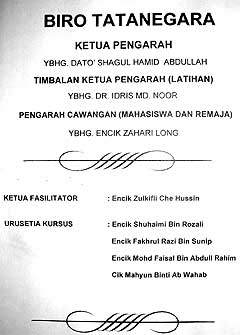 It should come as no surprise that BTN courses took pot-shots at Opposition leaders. It is only logical that the syllabus be informed by the needs and requirements of the party in
power.
What exactly is taught that is so unacceptable? It is not that Malaysia is fundamentally a Malay nation or even that Umno is the protector of the Malays.
What is unacceptable is the fact that what underlies the race-based components of BTN, as explained by Pakatan Rakyat and admitted by Nazri Aziz, is the fact that non-Malays are viewed as enemies of the Malays.
Fundamentally, we have here an impasse between those who view a nation as based on "bangsa" or ethnicity writ large; and those who view the nation as a civic construct and therefore bigger than any one ethnic group.
Umno not solely to blame for BTN
Now that there is a substantial Malay middle-class, an intellectual class as well as a robust political class; has the siege-mentality that underlies BTN outlived its usefulness?
Some will say no because there are still linguistic and religious fundamentalists, not to mention the dreaded socialists, who want to hijack the nation-building process to suit their needs.
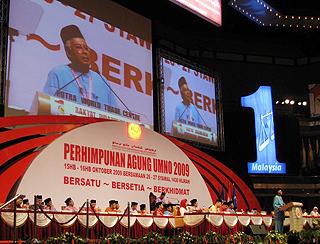 Nonetheless, Umno should not be blamed entirely for the BTN debacle. Where are the intellectuals in public universities?
In fact, some of the proponents of the BTN courses were from our public universities.
They did not tolerate much dissent. Those who spoke out against this type of historical wrangling were denied promotions and eventually had to leave the country. Others like Syed Hussin Ali, were put into Kamunting.
But all this is not Umno's fault alone. How come the BN's non-Malay champions like Gerakan, the MIC and the MCA sit idly by and tolerated the BTN courses?
Are they going to plead ignorance? As BN component parties, surely the MCA and MIC were part of the decision-making process? If not, then this case proves beyond any doubt the limits of their influence.
Gerakan is supposed to be a party of intellectuals and thinkers, why did they not mount a challenge internally and moderated BTN courses?
 If the BN is to be more effective and really wants to take the wind out of the sails of the opposition, it has to do more than change the BTN syllabi.
It has to demonstrate the spirit of "1Malaysia" by truly implementing policies that will help the majority of Malaysia's poor
regardless of race and creed.
This means giving more space to Malaysians to contribute towards nation building by including more people with different views. That was Tun Razak's vision and he even worked with the likes of Lim Chong Eu.
There is a silver-lining to this BTN debacle - we now know that race-baiting, ethnic championing and the narrow insistence on the history of one community, even if that is the majority community, over all others is not in the spirit of 1Malaysia.
Once again, it is the Malays who must want to lead and own this type of inclusive political philosophy and it is the patriotic duty of the rest of us to support it by putting the nation above our own ethnic interests. After all, the road to national unity and national healing is a two-way street.


Are you sure you want to delete this comment?
This action cannot be undone.