




Guan Eng, Mat Sabu - a friendship for our times (Pt 2)
Even the uneasy alliance between their parties, called the Barisan Alternative, to fight the general election of 1999 and its unsurprising end in 2001 did nothing to attenuate the relationship between Lim Guan Eng and Mohamad Sabu, whose inexorable rise within their parties’ hierarchy held the tantalising possibility that they would some day work together in government.
That possibility became real when DAP swept all 19 seats it contested in Penang in the March 2008 general election, catapulting Lim to the chief minister’s seat in Penang.
Although Sabu is a native Penangite - he was born in Tasek Gelugor - his stints in Parliament were served representing Kubang Kerian in Kelantan and Kuala Kedah...
Even the uneasy alliance between their parties, called the Barisan Alternative, to fight the general election of 1999 and its unsurprising end in 2001 did nothing to attenuate the relationship between Lim Guan Eng and Mohamad Sabu, whose inexorable rise within their parties’ hierarchy held the tantalising possibility that they would some day work together in government.
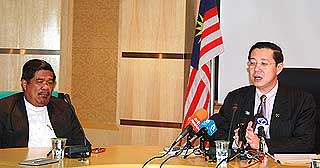 That possibility became real when DAP swept all 19 seats it contested in Penang in the March 2008 general election, catapulting Lim to the chief minister’s seat in Penang.
Although Sabu is a native Penangite - he was born in Tasek Gelugor - his stints in Parliament were served representing Kubang Kerian in Kelantan and Kuala Kedah, the former deep in the heart of solidly PAS territory and the latter newly-awakened to the need for raised opposition numbers in Parliament by the travails of Anwar Ibrahim in the late 1990s.
In the 2008 polls, Sabu contested in Kuala Terengganu, losing narrowly to his Umno opponent. The fact that voters in Terengganu were less able than their Kelantan - or for that matter, Kedah - counterparts to take to outsiders representing them factored in Sabu’s defeat, plus also that his Umno opponent was well-regarded.
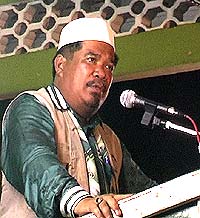 When the Umno incumbent died suddenly in December 2008, Sabu’s chances of another try for the parliamentary seat of Kuala Terengganu were weakened, not only because of his outsider status but also because divisions in PAS between the conservatives and the liberals were hardening at that point in time.
Sabu, though chary of owning up to the tag, is regarded as liberal, and therefore suspect in the eyes of the Terengganu wing of the party, a bastion of conservatism.
This faction put up a candidate of undoubted loyalty to them in the by-election which issued in a victory for PAS and in enhanced esteem for the conservatives.
Potential candidate in Penang
Now adrift and floating a trifle frustrated in the gap between a politico without a seat in Parliament and a party luminary without home turf traction – he had risen to become vice-president of PAS – Sabu attempted to regain ballast by contesting the deputy presidency in party elections last June.
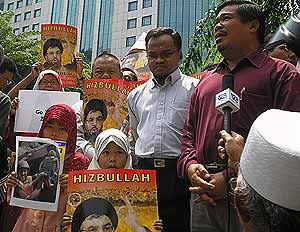 The contest crystallised long simmering tensions in the party between conservatives and liberals, the former represented by incumbent deputy president Nasharuddin Mat Isa and the latter by Husam Musa.
‘Liberal’ Sabu’s presence in the field was viewed as playing the spoiler’s role but he did well, running a close third in the vote.
The strong showing testified to his popularity in the party such that when the sole PAS state assemblyperson in Penang died in July 2009, Sabu’s name came up as potential nominee.
This was when speculation began to swirl that a Sabu candidacy and presumed victory would see him appointed by Chief Minister Lim to the state executive council as the sole PAS representative, thus making the ruling Pakatan Rakyat coalition inclusive of the third coalition member party. PAS had no seat in the state exco.
But this was quickly dismissed as wishful thinking because it could only be done by bypassing Salleh Man, the PAS chief for Penang, one of those sturdy if mundane personalities that compose the party in its middle echelons.
PAS is not the kind of political party that would slight the claims to elevation, when opportunity arises, of people like Salleh Man, knowing that it draws on the deep reservoir of loyalty to it among just such members.
Furthermore, Mat Sabu is not an interloper, encroaching on turf regarded as belonging to others. In the event, Salleh Man was nominated by PAS and he went on to retain Permatang Pasir for his party.
And Mat Sabu continued to drift in the ether of the popular but unelected politician, a void that must be frustrating to someone of his oratorical power and affinity for the goals of the movement for political reform in Malaysia.
Small consolations
But small consolations came: his friend CM Lim appointed him to the board of the state water authority and takes him along on investment-seeking trips to the Middle East where Sabu has many friends which smooths the way for the mission. The contacts were made on Sabu’s international forays in the cause of the Palestinians.
Good friends are aware but do not burden the other with their problems. They are careful not to even insinuate their deprivations into the other’s reckoning. Staunch discretion is de rigueur, which is why Sabu declined to talk of how he has helped Lim and vice versa.
 The speculation is that he could have helped Lim navigate the shoals when it came to use in his speeches of Koranic injunctions like ‘amar maa’ruf nahi mungkar’ (‘Enjoin the good and prohibit the bad’) that at one time got Lim into trouble with Umno’s erstwhile guardians of Islamic rectitude.
Umno controversialists denounced as improper non-Muslim use of terms supposedly exclusive to Muslims, but they found no support for this position from PAS, some of whose leaders hailed the employment of certain Islamic expressions by non-Muslim leaders as good for the religion’s propagation.
There may also have been advisory help rendered in handling the carping criticism hurled at Lim by those who claim that the Penang CEO has marginalised Malays.
Lim’s initial response to the criticisms, quite uncharacteristic of someone who prefers direct, sometimes brusque refutation, was to talk softly but carry a big sheaf of statistical rebuttals.
One can only speculate about the extent of the symbiosis between these two friends.
Suffice it is cause for thinking that the cooperation between the DAP and PAS, on which hinges the durability of Pakatan’s existence, is not as impossible as it sounds.


Are you sure you want to delete this comment?
This action cannot be undone.