




KL cuts off gasoline exports to Tehran
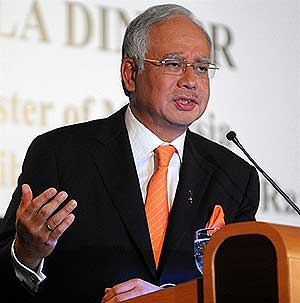
Malaysian Prime Minister Najib Abdul Razak confirmed Thursday that his country has cut off gasoline supplies to Iran, warning Tehran it was close to facing new international sanctions over its controversial nuclear program.
Najib's announcement came three days after he held talks with US President Barack Obama, who had called for the world to move "boldly and quickly" on additional sanctions on the sidelines of a 47-nation nuclear security summit.
Malaysian Prime Minister Najib Abdul Razak confirmed Thursday that his country has cut off gasoline supplies to Iran, warning Tehran it was close to facing new international sanctions over its controversial nuclear programme.
 Najib's announcement came three days after he held talks with US President Barack Obama, who had called for the world to move "boldly and quickly" on additional sanctions on the sidelines of a 47-nation nuclear security summit.
"It's going to be quite inevitable that additional sanctions will be imposed in the near future unless there is some movement in the right direction by Iran," Najib, on a US visit, told reporters in Washington.
"The onus is on Iran now to react expeditiously to prevent additional sanctions."
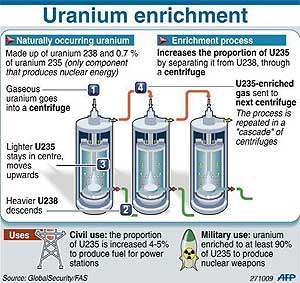
The 15-member Security Council, including China, has already imposed three sets of sanctions on Iran over its refusal to halt sensitive uranium enrichment and is considering the prospect of a fourth round of UN sanctions.
The United States and its allies believe Iran is covertly working on a nuclear weapon but the Islamic republic says it is pursuing only civilian power.
Najib said the gasoline supplies suspension was decided by Petronas after consultations with his government.
 He did not say when Petronas stopped supplying gasoline to Iran but some reports said it was done in the middle of March.
Petronas is among a small group of non-Chinese oil companies supplying gasoline to Iran, the world's fifth-largest crude oil exporter.
A member of the OPEC cartel, Iran has seen investment in petroleum refineries shrink as a result of US sanctions. It has resorted to importing about 40 percent of its gasoline needs.
Najib said that while Malaysia maintained that Iran had the right to develop nuclear energy for peaceful purposes, it must comply with the UN Security Council decision ordering it to suspend uranium enrichment activities until the International Atomic Energy Agency (IAEA) can verify they are exclusively peaceful as Iran claims.
"They must earn the trust of the international community and the only way they can earn the trust is to be fully transparent in whatever they do and allow full verification by the IAEA and there are some serious doubt as to whether this has been carried out or has been complied with by Iran," he said.
"They must earn the trust of the international community and the only way they can earn the trust is to be fully transparent in whatever they do and allow full verification by the IAEA," he said.
"There are some serious doubt as to whether this has been carried out or has been complied with by Iran," he added.
Asked whether Malaysia was reviewing any current projects or possible joint ventures in Iran, Najib said, "We will see how it goes, we do not want to send the wrong signals.
"We appreciate the importance of our economic relations with Iran as well."
Ambassadors from the five veto-wielding members of the UN Security Council - Britain, China, France, Russia and the United States - plus Germany - met for a second straight day in New York Thursday in what they described as "constructive" substantive talks on the sanctions issue.
 On the table was a US draft resolution outlining sanctions in five areas: arms embargo, energy, shipping, finance and targeted punitive measures against Iran's powerful Revolutionary Guards, a diplomat familiar with the discussions said.
"Our sense is that countries of the Security Council, probably including China and Russia as well, there is a shift in their opinion to indicate they would go for stronger sanctions against Iran," Najib said.
Iran insists it needs the higher-enriched uranium to fuel a research reactor which makes radioisotopes for medical purposes, such as the treatment of cancer, where the current fuel is expected to run out by the end of this year.
But Tehran has snubbed an IAEA-brokered deal that would have seen Russia and France fashion the fuel out of Iran's own stockpile of low-enriched uranium. Najib said Petronas would "certainly" lift its suspension on gasoline supplies if Iran complied with the IAEA.
Najib said Petronas would "certainly" lift its suspension on gasoline supplies if Iran complied with the IAEA.
"We believe in engagement but Iran has to respond as well and there are some clear indications of their non compliance."
- AFP


Are you sure you want to delete this comment?
This action cannot be undone.