




Petronas excluding Sabahans, decries former CM
Former Sabah chief minister Harris Salleh laments that the lack of a Sabah state representative on the board of directors of state-owned oil company Petronas is costing the state dearly.
Former Sabah chief minister Harris Salleh laments that the lack of a Sabah state representative on the board of directors of state-owned oil company Petronas is costing the state dearly.
He wants to know why Petronas never had a Sabahan on its board since its inception. He side-stepped the question of why he was raising the issue only now, and not when he was in a better position to do so when holding office from 1976 to 1985.
"The surrender of oil blocks L and M to Brunei is an example of decisions being taken against the interest of Sabah," said Harris in a belated assessment of the issue. "We would have been better protected with representation on the Petronas board."
If oil blocks L and M belong to Brunei for historical and other reasons, added Harris, then both the federal and state governments should take steps to formalise it through proper procedures.
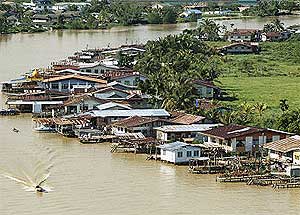 Harris opined that the same arguments could also be used in the case of the Limbang dispute. He urged the federal government to consult with the Sarawak state government.
Limbang is a slice of "Sarawak" territory that cuts Brunei into two halves, right up to the shoreline, and this partition has for long been a sore point with Bandar Seri Begawan.
Representation long overdue
Returning to the main topic, Harris fears that it may result in the state not getting the 5 percent oil royalty originally promised from oil blocks L and M.
"Murphy Oil Sabah Co Ltd was in 2003 awarded the two blocks worth more than US$100 million (RM325mil) in oil revenue," said Harris. "Now that the oil blocks have been ceded and Petronas has the right to jointly develop the fields with Brunei, is Sabah still entitled to the royalty or profits from Petronas?"
Harris reiterated that Kota Kinabalu must take up the matter of state representation in Petronas' board without delay, as it has far reaching implications for the state.
"Sabah is at the start of an oil boom after a string of successful discoveries in deepwater fields," said Harris. "The issue (of board representation) is timely now."
For starters, he pointed out that the state's deepwater projects like Kikeh, Gumusut/Kakap, Ubahcrest, Pisangan, Malikai Sumandak, and Ambalat, among others, would propel Sabah to be the biggest producer of crude oil in Malaysia.
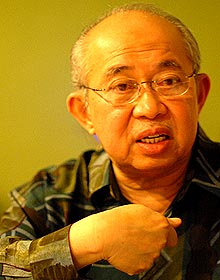 Harris says Sabah's projected output is expected to be 500,000 to 600,000 barrels per day as compared to the current national output of 700,000 barrels.
He did not disclose the source of his data but added that this does not include former Petronas chairman Tengku Razaleigh Hamzah's ( left ) recent claim in Kota Kinabalu of "a huge oil deposit off Sabah, the biggest in South East Asia, capable of producing one million barrels per day".
"The major grouse is that Sabah has little to show, despite its huge oil and gas reserves vis-à-vis Sarawak and Terengganu," said Harris."
Sabah contractors sidelined
Sabah has only a methanol plant and that too in Labuan, while even non-oil states like Pahang, Johor, Kedah and Malacca have extensive oil and gas infrastructure, industries and activities, he added. "Sabah should have been fully engaged since 1975 in the industry, with major oil and gas infrastructure, downstream industries and activities."
Harris says he has also received complaints from Sabah companies in the construction fabrication and service sectors, being sidelined from most of the Petronas projects onshore and offshore Sabah. The national oil corporation allegedly preferred to hire contractors from West Malaysia and Sarawak, who secure projects running into billions.
"Maintenance, logistics, support, catering, fabrication, vessels etc. are all clearly defined in the 1976 Petroleum Agreement under the ‘Local Content' clause i.e. Sabahans must be contracted to operate and provide these services," said Harris. "These companies are under Petronas' Vendor Development Programme. Petronas must not violate the Act."
 To add insult to injury, companies operating in Sabah in the oil and gas industry employ 95 percent of their workforce from outside the state, the veteran politician added. He is not entirely sure these workers have obtained the necessary work permits as required by the state's immigration laws.
He hopes the state government will investigate the matter immediately and even if the papers were in order, to probe how work permits could be issued to outsiders when the local workforce was being sidelined.
Harris, in a parting shot at Petronas, urged the national corporation to reveal the number and value of scholarships it has give out to Sabahans over the years.
He has some suspicions on the matter, since unlike other oil companies like Shell in Sabah, Petronas even charges each student RM20 when they apply online for scholarships, irrespective of whether the applications are successful or otherwise.
"This is really shameful considering that applying online is paperless and doesn't cost Petronas anything. They must have made millions over the years from our poor students this way," fumed Harris. "They should emulate Shell which is completely transparent in the award of scholarships."
Petronas in Sabah, when contacted, declined to comment on Harris' charges, saying any response will have to come from its Kuala Lumpur headquarters.


Are you sure you want to delete this comment?
This action cannot be undone.