




Greece mirroring Malaysia's Scorpene scandal
In more ways than one, Greece's profligacy in defence spending amidst slashes for other sectors of public expenditure uncannily reflects developments in Malaysia.
In more ways than one, Greece's profligacy in defence spending amidst slashes for other sectors of public expenditure uncannily reflects developments in Malaysia.
 According to a
Wall Street Journal
article
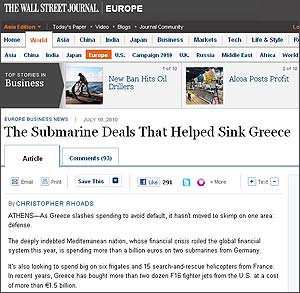
published over the weekend, Greece - embroiled in a financial crisis that has forced it to take very unpopular austerity measures - looks set to splurge in the procurement of defence equipment.
According to a
Wall Street Journal
article
published over the weekend, Greece - embroiled in a financial crisis that has forced it to take very unpopular austerity measures - looks set to splurge in the procurement of defence equipment.
Of particular irony is the Mediterranean nation's purchase of submarines - billed at more than one billion euros (RM4 billion) - from Germany.
Germany is among the European Union members that have had to shoulder most of the burden of bailing out Greece out of its financial crisis.
"The military deals illustrate how Germany and other creditors have in some ways benefited from Greece's profligacy, and how that is coming back to haunt them," said WSJ in its July 10 report entitled ‘The submarine deals that helped sink Greece'.
In May, more notably, Greece's law enforcement officials began investigating its defence ministry's procurement of weapons to determine how many - if any - of the deals involved overpayment or were unnecessary.
Mirroring accusations in Malaysia with regard to the 1.341 billion euro (RM6.7 billion) purchase of the two French Scorpene submarines, German prosecutors are investigating whether millions of euros in bribes were paid to Greek officials in connection with the sub deal, said WSJ .
Executives of Ferrostaal AG, one of the German companies helping to build the submarines, authorised payments worth millions of euros to politicians to win the initial deal in 2000, say German prosecutors.
Ferrostal's chief executive resigned amid the probe, WSJ reported further.
Though the Malaysian government has denied any need to investigate the purchase of the Scorpene submarines, French authorities have launched a probe into whether the 2002 sale involved the payment of any commission to Malaysian parties.
Problems with subs, too
Meanwhile, in another uncanny replication of the Malaysian scenario, WSJ reported that technical problems had cropped up with one of the submarines that Greece had ordered from Germany.
 Like the French submarine delivered to Malaysia last September that was found to have been
unfit for diving
, the German submarine - called the
Papanikolis
- also suffered from a technical glitch.
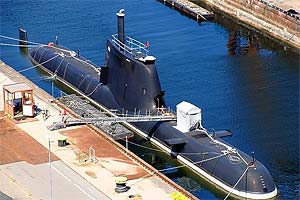
Like the French submarine delivered to Malaysia last September that was found to have been
unfit for diving
, the German submarine - called the
Papanikolis
- also suffered from a technical glitch.
In certain sea conditions, WSJ reported, during testing the submarine had the tendency to "list to the right."
"The navy said we cannot accept this sub," said a Greek admiral who recently resigned over the scandal.
The Greek controversy differs in many ways from the scandal in Malaysia.
For one thing, the government in Greece has been helmed by two opposing political parties - the Socialists party and their conservative rivals the New Democracy party - as the submarine controversy played out.
 But as in Malaysia, expensive procurement deals in Greece are apparently pulling through at a time when deep slashes are being made to public sector expenditures.
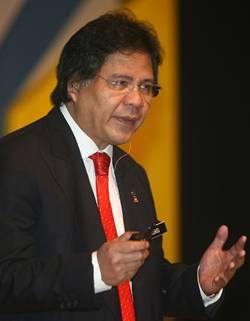
Minister in the Prime Minister's Department Idris Jala ( left ) announced in May that Malaysia would be bankrupt in nine years' time without deep cuts to government subsidies.
"We don't want to end up as another Greece ," he told a roadshow. Indeed.


Are you sure you want to delete this comment?
This action cannot be undone.