




Ex-ISA detainee loses RM2.5mil award, ordered to pay RM20,000
In a unanimous decision, the Federal Court has upheld the Court of Appeal ruling overturning a High Court decision to award former Internal Security Act detainee Abdul Malek Hussin RM2.5 million in his suit against the government.
In a unanimous decision, the apex court today dismissed a leave application by former Internal Security Act detainee Abdul Malek Hussein, following a rare award of RM2.5 million by the High Court over unlawful detention.
President of the Court of Appeal Alaudin Md Sheriff said the three questions posed to the Federal Court for the leave application did not fall within the purview of Section 96 of the Courts of Judicature Act.
"Hence this application is dismissed," Alaudin said in leading a three-man bench.
The other judges were Federal Court justices Hashim Yusof and Mohd Ghazali Mohd Yusoff.
With today's decision, the former ISA detainee has lost the last avenue to seek legal recourse for his 57 days detention without trial in 1998, where he was also assaulted.
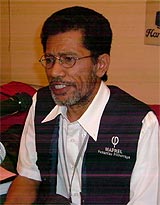 To make matters worse for Abdul Malek (
right
), Alaudin ordered him to pay costs of RM20,000 to the respondents.
To make matters worse for Abdul Malek (
right
), Alaudin ordered him to pay costs of RM20,000 to the respondents.
This was despite a passionate plea by his counsel Sulaiman Abdullah that the court not impose costs as ISA cases were public interests cases, thus imposition of costs would deter anyone from appealing.
Furthermore, the senior counsel said this was the month of Ramadan and in line with its spirit, the court should be compassionate,
However Alaudin would have none of that and imposed the costs sought by senior Federal Counsel Amarjeet Singh.
Decision overturned
On March 25, the Court of Appeal overturned the High Court's decision in granting the rare award to Abdul Malek when it ruled the detention was unlawful. Not only that, it also rejected allegations of torture while in custody.
It is extremely rare for the Court of Appeal and Federal Court to disturb the findings of fact by the High Court, which had heard evidence from the witnesses first hand.
However, as many may know, in human rights cases and the Perak constitutional matter in determining the rightful menteri besar, they had disturbed such findings.
Sulaiman had posed three questions of law to be considered by the court to grant leave as he felt the appellate court had erred in arriving to overturn the decision.
- Whether in relation to the arrest and or detention under the ISA, the Kim Teck Soo or the Mohd Ezam Md Noor appeal should be followed is with respect to the interpretation of Articles 5, 8, 149 and 151.
- Should the court when applying principles in the Dalip Bhagwan Singh case where there is a conflict of opinion between two Federal Court authorities, also take into account other factors
i.whether the judgment was unanimous or a majority
ii.number of judges in the quorum
iii.the later decision.
(This follows the conflicting judgments in the Kim Teck Soo and the Mohd Ezam cases on ISA detention, where both are said to have arrived and made about the same time.)
- whether the circumstances of the case in the appellate court was justified in departing from the rule that an appellate court does not interfere with findings of facts by the trial judge.
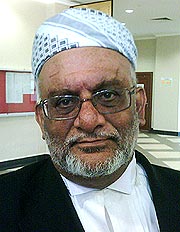 Sulaiman (
right
), who was assisted by lawyers Edmund Bon and Sivarasa Rasiah, said there were no grounds stated in Abdul Malek's arrest under the ISA, as when he was detained the police failed to state their reasons.
Sulaiman (
right
), who was assisted by lawyers Edmund Bon and Sivarasa Rasiah, said there were no grounds stated in Abdul Malek's arrest under the ISA, as when he was detained the police failed to state their reasons.
"This is in violation of the rights guarded under the federal constitution," he said, adding that Abdul Malek was also denied access to counsel during detention.
Meanwhile Amarjeet, who was assisted by Iznan Ishak, said in his submission that denial of access does not render the detention unlawful.
He also submitted that the questions posed did not fall within provisions of the Court of Judicature Act.
'Torture will never be forgotten'
Abdul Malek, who is now a parliamentary affairs coordinator for the opposition leader, said he was naturally upset over this dubious decision.
He said despite the apex court being the highest court in the country, it is not the ultimate court of judgment.
Abdul Malek said he cannot forget the torture he had undergone, and had hoped to find legal recourse through the courts.
In 2007, then Kuala Lumpur High Court judge Mohd Hishamudin Mohd Yunus, in a landmark decision ruled that Abdul Malek's detention during the Reformasi demonstrations in 1998, were made in bad faith under Article 5 of the federal constitution.
In ruling the arrest unlawful and affirming there indeed was assault while in custody, Hishamudin, who is now a Court of Appeal judge, also said the nature of Abdul Malek's interrogation was clearly for a political purpose and had nothing to do with genuine concern for national security.
Abdul Malek was arrested under the ISA on the night of Sept 25, 1998, after addressing a demonstration earlier that day in Masjid Negara following the sacking and arrest of Anwar Ibrahim, who was then deputy prime minister.
He was detained for 57 days, and was later released without being charged.
 Abdul Malek filed his suit civil suit in March 1999, naming special branch officer Borhan Daud, the then inspector-general of police Abdul Rahim Noor (
right
), and the government as respondents.
Abdul Malek filed his suit civil suit in March 1999, naming special branch officer Borhan Daud, the then inspector-general of police Abdul Rahim Noor (
right
), and the government as respondents.
Stripped naked
During the High Court trial, the plaintiff testified he was stripped naked in an air-conditioned room, blindfolded during interrogation, and physically assaulted up to 60 times, beaten until he was unconscious, forced to drink urine and subjected to sexual abuse.
He also told the court he saw Rahim punching him in his chin in the interrogation room when his blindfold accidentally dropped.
Justice Hishamudin also ruled the assault by Rahim did indeed take place as there was no denial and also there was no report lodged against Abdul Malek for falsifying his report.


Are you sure you want to delete this comment?
This action cannot be undone.